
BMW B58 PCV Valve Diaphragm Failure: The Tea Kettle Whistle, High Vacuum Squeal, Rough Idle & Valve Cover Repair Guide
Automotive Research, ASE Master Technicians & Fact-Checking
Direct Technical Summary
Forensic engineering diagnosis of integrated positive crankcase ventilation (PCV) rubber diaphragm failure across BMW B58 3.0L Turbo engines (M340i, 540i, X3 M40i, Toyota GR Supra). We examine crankcase vacuum spikes (-300 mbar), crankshaft main seal whistle vs. tea-kettle squeal, BMW shadow codes (101F01, 118001), and the permanent CNC billet aluminum cap fix avoiding a $1,500 valve cover replacement.
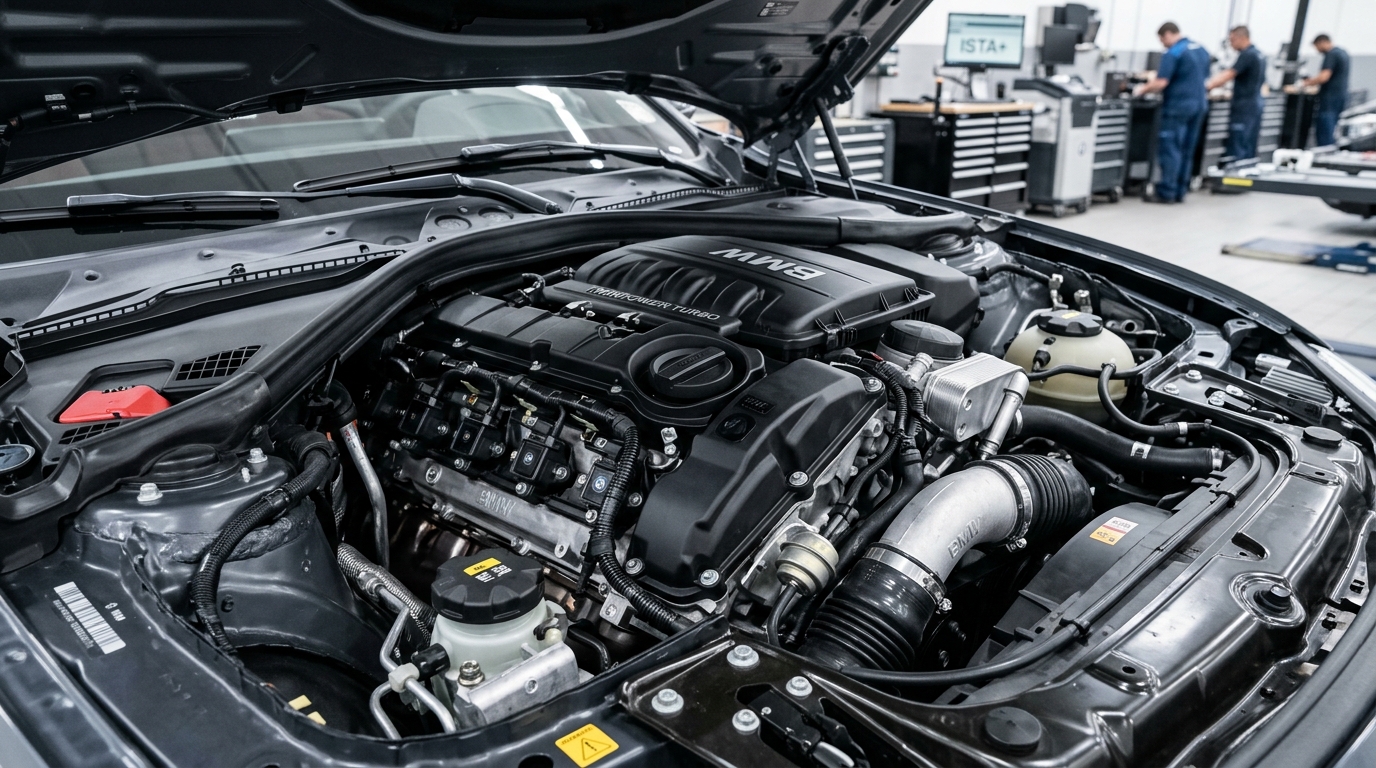
Among modern performance powertrains, the BMW B58 3.0-liter turbocharged inline-six (powering the BMW M340i, 440i, 540i, 740i, X3 M40i, X5 xDrive40i, and the Toyota GR Supra A90/A91) has earned a legendary reputation for closed-deck block strength and forged internals. However, as these vehicles cross the 50,000 to 80,000-mile threshold, thousands of owners encounter an alarming auditory symptom echoing from the engine bay: an intense, high-pitched "tea-kettle whistling" or metallic squeal at idle. When technicians or owners attempt to unscrew the oil filler cap, they find it virtually impossible to remove—clamped down by massive, unmetered engine vacuum.
While inexperienced shops frequently misdiagnose this piercing whistle as a failing turbocharger bearing, alternator decoupler pulley, or water pump bearing, the root cause is a predictable metallurgical and polymer failure: rupture of the positive crankcase ventilation (PCV) pressure regulating rubber diaphragm integrated permanently into the composite valve cover. When this flexible elastomer membrane tears under cyclical thermal fatigue, full manifold vacuum is drawn unrestricted through the crankcase. The resulting negative pressure spikes from a normal factory spec of -25 to -35 mbar to a destructive -250 to -350 mbar (-7.4 to -10.3 inHg). Air is violently sucked inward past the crankshaft front and rear radial oil seal lips, vibrating the rubber elastomer like a brass reed to generate the infamous scream.
Dealership service departments universally quote $1,200 to $1,800 to replace the entire composite valve cover assembly (BMW PN 11127645173 / 11128637896), requiring the removal of high-pressure direct-injection lines, fuel rails, and wiring harnesses. Based on official BMW Technical Information System (TIS) bulletins, field teardowns across G20 and Supra platforms, and dealership forensic logs, AutoZonic details the mechanical failure mechanics, diagnostic isolation procedures, the severe threat of crankshaft seal lip inversion, and the permanent CNC billet aluminum cap retrofit that cures the failure permanently in 45 minutes for under $60.
i Quick Engineering Summary: BMW B58 PCV System Failure Profile
Affected Vehicles: 2016–2024 BMW 340i/M340i (F30, G20), 440i/M440i (F32, G22), 540i (G30), 740i (G11), X3 M40i (G01), X5 40i (G05); Toyota GR Supra 3.0 (A90/A91).
Primary Failure Mode: Circumferential fatigue tearing of the internal fluorosilicone/nitrile rubber diaphragm inside the plastic valve cover PCV chamber.
Acoustic Signature: High-frequency whistle/screech at warm idle that instantly silences when the oil cap is loosened or dipstick/vent is breached.
Telemetry & Codes: Crankcase vacuum > -200 mbar (factory: -25 to -35 mbar); BMW Shadow Codes 101F01, 118001 (Mixture rich/lean), 118401, 104301.
Secondary Risk: Inversion of front crankshaft main seal lip causing massive external oil spew; oil ingestion into intake producing blue tailpipe smoke.
Permanent Fix: Retaining original valve cover + installing upgraded reinforced fluorosilicone diaphragm with CNC billet aluminum threaded/snap cap.
Forensic Physics: Why the B58 PCV Membrane Tears
To understand the failure cascade, one must examine the thermal and pneumatic architecture of the BMW modular B-engine family (B58B30M0, B58B30O1, and B58TU). Unlike older N54 and N55 engines that utilized external oil catch channels and replaceable cyclone separators, BMW integrated the entire crankcase ventilation labyrinth directly into the PA66-GF30 (polyamide with 30% glass fiber reinforcement) composite valve cover.
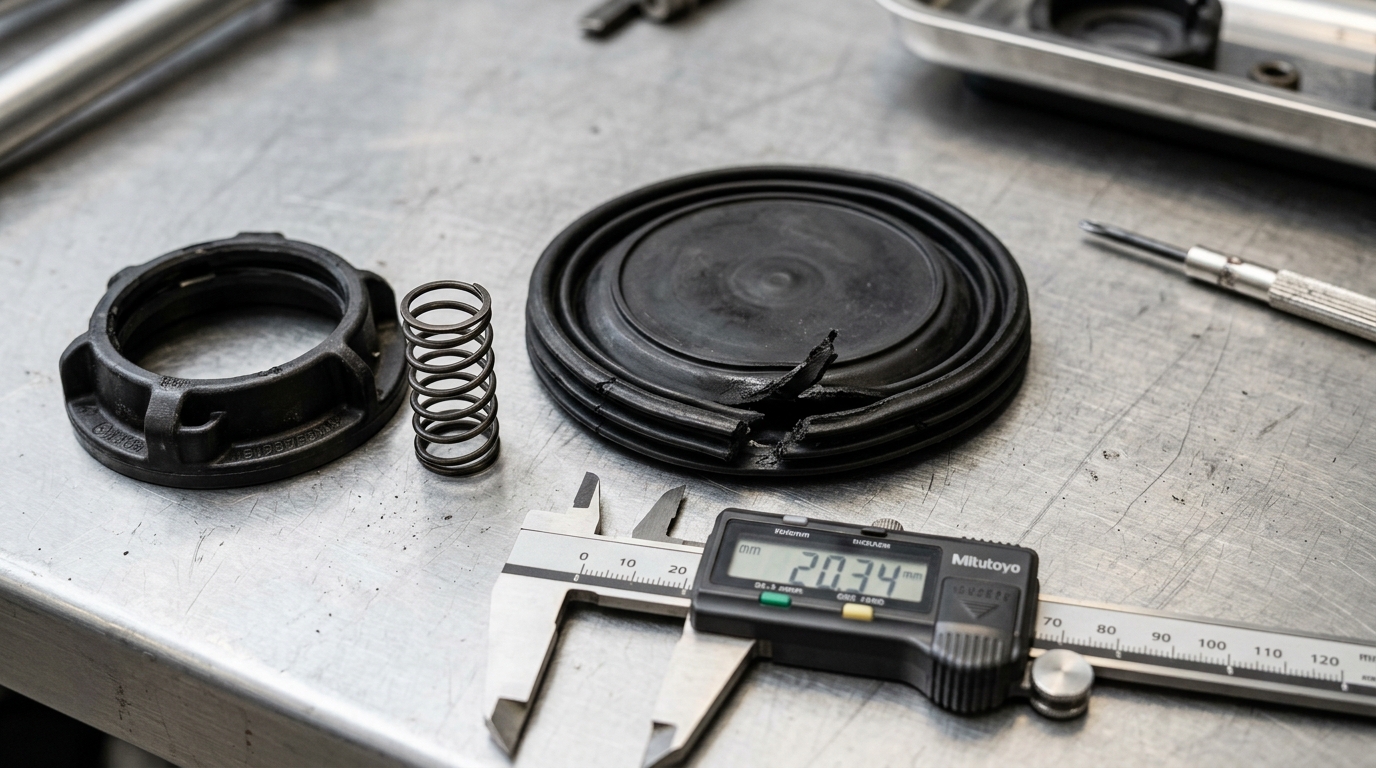
The PCV system operates via a spring-loaded elastomer diaphragm that balances crankcase blow-by pressure against intake manifold vacuum:
- Elevated Thermal Operating Parameters: For thermal efficiency and strict Euro 6d / EPA emissions compliance, the B58 engine management system operates coolant temperatures at a blistering 105°C to 111°C (221°F to 232°F) under low-load cruising. Furthermore, the twin-scroll turbocharger mounted directly adjacent to the cylinder head radiates immense radiant heat into the rear half of the valve cover.
- Polymer Embrittlement: Constant exposure to synthetic motor oil hydrocarbons, fuel blow-by vapors, and elevated temperatures leaches plasticizers out of the factory rubber membrane. Over 40,000 to 70,000 miles, the soft, compliant elastomer becomes rigid, brittle, and prone to micro-cracking along its primary flexing hinge.
- The Perforation Cascade: When you lift off the throttle after boost, the throttle body closes and intake manifold absolute pressure plunges into deep vacuum (up to -20 inHg). The brittle rubber membrane is slammed against the internal plastic metering orifice. Eventually, a fatigue tear rips along the outer convoluted perimeter (as documented in Figure 1).
- Runaway Crankcase Evacuation: Once the diaphragm ruptures, the pressure regulation valve is locked permanently wide open. The intake manifold now pulls unmetered vacuum directly from the engine oil sump and valvetrain cavity, collapsing crankcase pressure far beyond engineered safety thresholds.
Diagnostic Matrix: Isolating the Tea-Kettle Whistle
Because the whistling sound is generated by air rushing inward through microscopic gaps around external gaskets and rotating seals, technicians who do not understand crankcase physics routinely replace alternator pulleys, serpentine belt idlers, and water pumps without resolving the noise. Use this definitive forensic isolation sequence:
| Diagnostic Parameter | Factory Nominal Spec (Healthy B58) | Ruptured PCV Diaphragm (Failed) | Mechanical Failure Consequence |
|---|---|---|---|
| Crankcase Vacuum (Slack Tube Gauge) | -25 to -35 mbar (-0.36 to -0.51 psi) | -250 to -350 mbar (-3.6 to -5.1 psi) | Severe negative pressure over-evacuation; pulls 10x rated vacuum on engine seals. |
| Oil Filler Cap Removal Force | Light resistance (removable with two fingers, < 2 lbs force) | Immense suction (requires two hands, > 25 lbs pull force) | Unmistakable physical confirmation of manifold vacuum direct-path breach. |
| Whistle Noise Behavior During Oil Cap Removal | Steady mechanical purr; no whistling | Whistle instantly silences the millisecond cap seal is cracked | Confirms the acoustic frequency is caused by air entering inverted seals under vacuum. |
| Tailpipe Exhaust Emissions | Clear exhaust; zero visible oil burn | Periodic clouds of thick blue-white smoke on hot restart or idle | Liquid oil mist sucked past ruptured diaphragm directly into intake manifold runners. |
| Primary BMW Diagnostic Fault Codes | No fault codes logged | 101F01, 118001, 118401, 104301 | DME logs intake manifold absolute pressure vs. throttle opening angle implausibility. |
The Hidden Threat: Radial Crankshaft Seal Lip Inversion
The most dangerous misconception regarding B58 PCV failure is that the whistling noise is merely an acoustic annoyance. In reality, continuing to drive a vehicle with a torn PCV diaphragm can trigger secondary catastrophic engine damage within several hundred miles.
Automotive crankshaft seals—specifically the front vibration damper radial oil seal and the rear main seal—are engineered with directional lip geometry. The PTFE / Viton sealing lip is angled inward toward the engine crankcase so that positive crankcase pressure presses the lip tighter against the rotating steel journal. When the torn PCV diaphragm applies -350 mbar of vacuum, the pressure differential flips backward: atmospheric pressure outside the engine is higher than crankcase pressure. This reverse pressure gradient physically inverts the sealing lip outward or pulls it off the journal.
When the seal lip inverts, the whistling sound reaches peak volume as air rushes past the dry, spinning metal journal. If driven under boost, the sudden transition from high vacuum to positive pressure forces pressurized motor oil out of the inverted seal, coating the accessory drive belt in oil (causing it to slip off and shred into the front crank seal) or dumping quarts of oil out of the bellhousing. Addressing the PCV immediately prevents a $2,500 transmission-out rear main seal replacement.
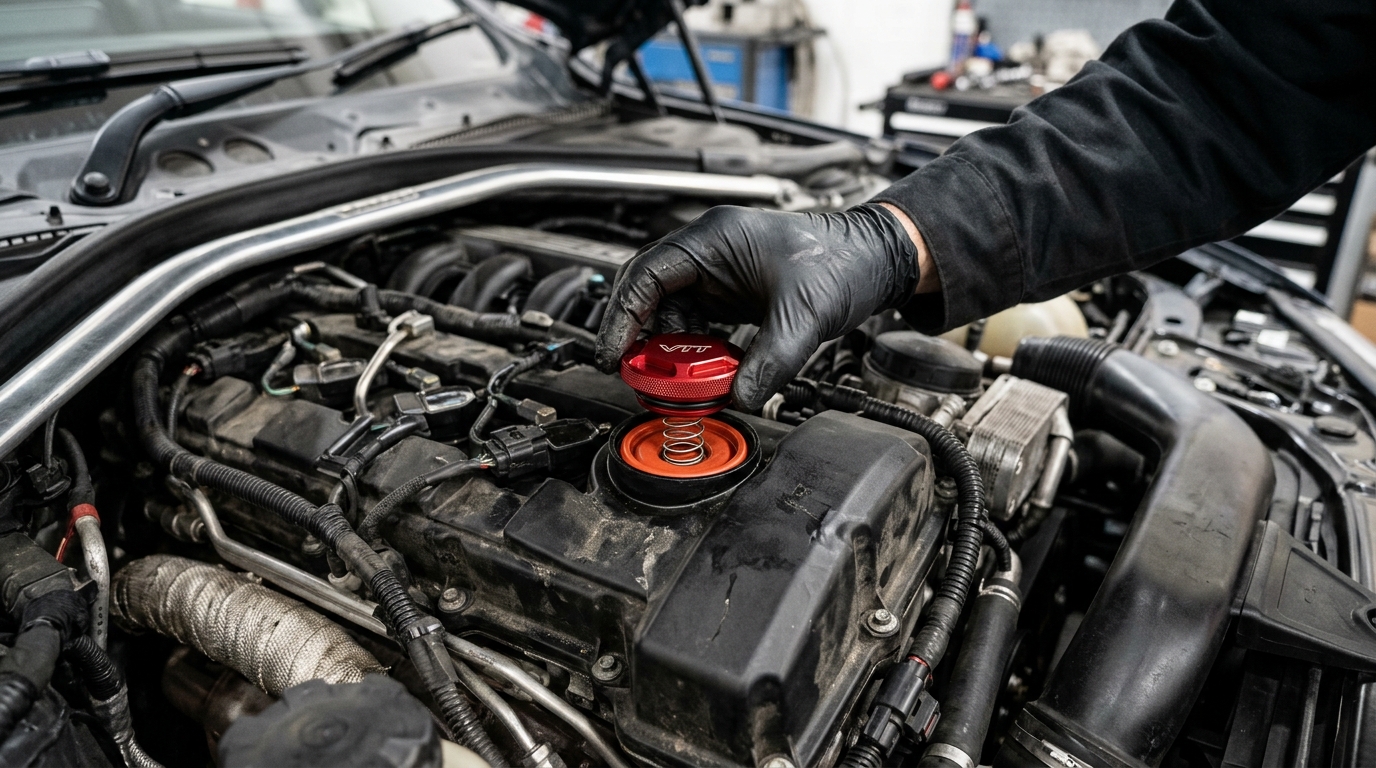
Step-by-Step Retrofit: CNC Billet Aluminum PCV Cap Upgrade
Dealerships force owners into buying a brand-new valve cover assembly because BMW does not sell the internal rubber diaphragm as a standalone replacement part. However, precision aftermarket engineering provides a permanent in-chassis fix:
- Access and Engine Bay Preparation: Disconnect the negative battery terminal in the trunk. Remove the engine acoustic beauty cover. Loosen the passenger-side strut tower brace (E18 Torx, torqued to 56 Nm) to grant clean vertical clearance over the rear of the cylinder head.
- Releasing the Sonic-Welded Plastic Cap: The factory black plastic PCV cap is retained by heat-welded plastic tabs around its perimeter. Using a sharp utility blade or micro-rotary hobby tool, carefully score the ultrasonic weld seam along the bottom edge of the plastic cap. Do not cut deeply into the valve cover body. Gently pry upward with a nylon trim tool; the plastic cap will pop off, exposing the internal steel spring and torn rubber diaphragm.
- Cavity Inspection and Decontamination: Extract the old steel spring and the perforated rubber membrane. Inspect the internal vacuum orifice for carbon varnish or sludge. Spray lint-free shop towels with isopropyl alcohol and wipe the sealing deck spotlessly clean. Ensure no plastic debris falls into the crankcase breather channel.
- Installing the Fluorosilicone Membrane: Seat the upgraded high-temperature fluorosilicone diaphragm into the circular groove. Ensure the molded center nipple faces upward into the new compression spring. Seat the heavy-duty spring squarely over the center guide.
- Installing the CNC Billet Aluminum Cap: Position the precision-machined CNC 6061-T6 aluminum cap over the spring. Press down firmly with even thumb pressure until the locking tabs snap positively into place (or tighten the integrated allen fasteners if using a threaded conversion model). Verify the cap is seated 100% flush around its entire 360-degree circumference.
- Post-Installation Telemetry Verification: Start the engine and allow it to reach full operating temperature (105°C). Verify with an OBD-II scanner that code 101F01 is cleared. Perform the oil filler cap test: the cap should remove smoothly with two fingers, the whistle must be completely eliminated, and long-term fuel trims (LTFT) will stabilize within ±3%.
Eliminating the high-pitched PCV squeal and monitoring real-time crankcase intake manifold absolute pressure (MAP) requires precision-machined hardware and professional OBD-II telemetry:
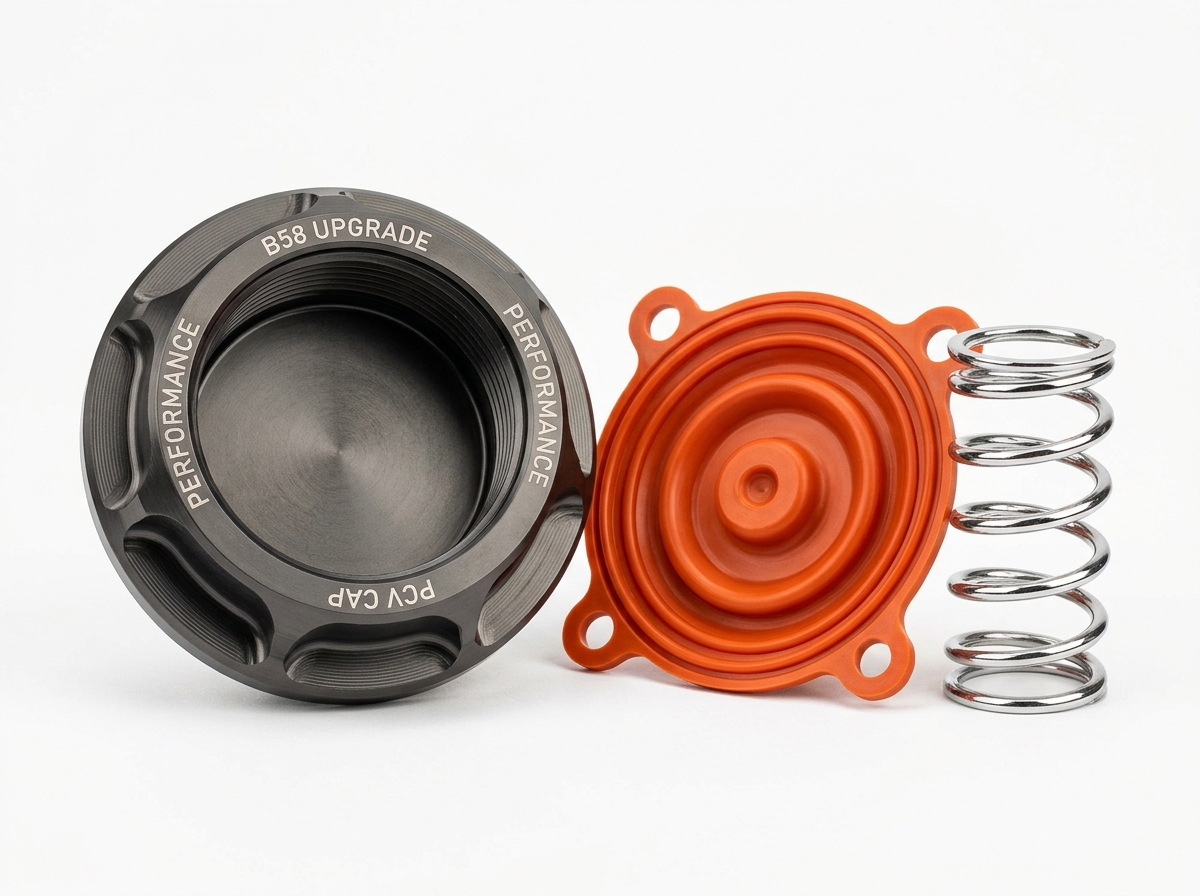
BMW B58 & B48 PCV Valve Diaphragm Replacement Cap & Fluorosilicone Membrane Kit
CNC Billet Aluminum Housing • Eliminates $1,500 Full Valve Cover Replacement
- ✓Cures High-Pitched Squeal: Eliminates vacuum whistle and blue exhaust smoke caused by torn factory rubber membrane.
- ✓Aircraft-Grade CNC Billet Aluminum: Replaces fragile heat-welded plastic cap with durable screw-down or heavy-duty snap-fit housing.
- ✓High-Temp Fluorosilicone Diaphragm: Engineered to withstand 230°F+ synthetic oil vapor and extreme crankcase pressure cycles.

BlueDriver Bluetooth Pro OBD-II Diagnostic Scan Tool
Technician Recommended for Enhanced OEM PIDs
- ✓Enhanced Diagnostics: Reads proprietary manufacturer ABS, Airbag, transmission, and body codes.
- ✓Real-Time Telemetry: Graph live oil pressure, coolant temp (ECT), and cam phaser angular deviation.
- ✓Wireless Bluetooth: Full iOS & Android integration with zero monthly subscription fees.
BMW TIS Documentation & Technical Service Bulletins
For independent technicians, warranty adjusters, and BMW enthusiasts seeking authoritative documentation, review these official technical references:
- BMW Service Information Bulletin SI B11 03 18: "Whistling / Squealing Noise from Engine Compartment at Operating Temperature" — Officially acknowledges crankcase over-vacuum conditions causing radial crankshaft seal vibration across modular B-series engines.
- BMW TIS Group 11 (Engine Mechanical) Section 11 12: "Cylinder Head Cover with Crankcase Ventilation System Inspection Protocol" — Mandates crankcase manometer testing via the oil filler neck using BMW Special Tool 11 9 280 (IMIB Pressure Sensor) to verify target depression between -25 mbar and -35 mbar.
- BMW SI B11 05 20: "Diagnostic Protocol for Mixture Control Fault Codes 101F01, 118001, and 118401" — Details systematic false air detection, directing technicians to eliminate crankcase depression valve rupture prior to replacing intake mass airflow (MAF) or manifold absolute pressure (MAP) sensors.
- S58 vs. S55 Crank Hub Architecture Note: For owners cross-shopping M-models, the S58 (found in the G80 M3, G82 M4, and X3 M) redesigned the timing chain drive system, mounting the dual-stage timing assembly at the rear of the crankshaft with keyed sprockets—completely eliminating the infamous friction-washer "spinning crank hub" failures that plagued the previous-generation S55 engine. S58 owners must focus maintenance attention on the PCV system and cooling circuits rather than crank hub pinning.
By diagnosing the tea-kettle whistle early and installing an upgraded CNC aluminum PCV cap with reinforced fluorosilicone internals, BMW B58 and Toyota Supra owners can permanently resolve this chronic vulnerability for less than 5% of dealership replacement costs while protecting their crankshaft seals from catastrophic oil loss.
Researching this vehicle or comparing used inventory?
Always cross-reference factory service bulletins, verify warranty coverage, and compare dealer financing rates or insurance quotes before purchasing.
Reader Feedback
Was this technical guide helpful?
Your verification vote informs our ongoing automotive research schedule.