
Honda 1.5L Turbo Head Gasket Failure & Oil Dilution: CR-V, Civic & Accord Teardown, TSB Fixes & Block Test Guide
Automotive Research, ASE Master Technicians & Fact-Checking
Direct Technical Summary
Forensic teardown of the chronic head gasket failure and fuel-in-oil dilution across Honda CR-V, Civic, and Accord (1.5L Earth Dreams L15B7/L15BE). We analyze cylinder head bolt stretch, fire ring blow-by between cylinders 2 and 3, cold-start misfire P0300-P0302 triggers, Honda TSB 18-114/19-037 software fixes, and the permanent ARP stud + MLS gasket overhaul.
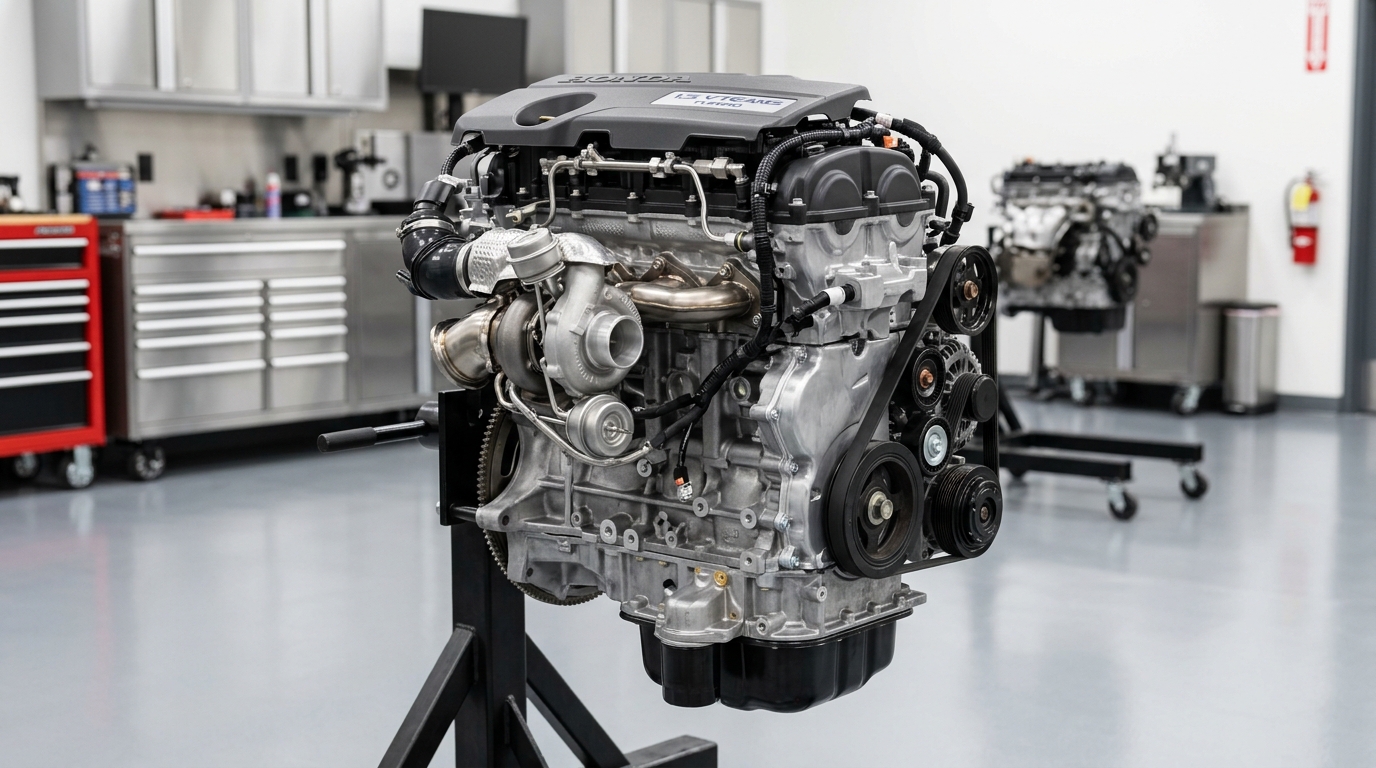
Across North America, more than 4.1 million vehicles—including the Honda CR-V (2017–2024), Honda Civic (2016–2024), and Honda Accord (2018–2024)—are propelled by Honda's high-efficiency 1.5-liter Earth Dreams Direct-Injected VTEC Turbo 4-cylinder engine (L15B7, L15BA, and L15BE series). Designed to deliver V6-like midrange torque while meeting stringent federal CAFE fuel economy targets, this forced-induction platform has developed two interconnected, severe mechanical vulnerabilities: Severe Fuel-in-Oil Dilution during cold operating cycles and Premature Multi-Layer Steel (MLS) Cylinder Head Gasket Failure between 60,000 and 110,000 miles.
Unlike historic naturally aspirated Honda engines renowned for running 300,000 miles on factory assembly hardware, the 1.5L Earth Dreams engine generates over 18 to 20 psi of peak turbocharger boost on a high-compression (10.3:1 to 10.6:1) open-deck aluminum block. As these vehicles age past their factory 5-year/60,000-mile powertrain warranties, dealerships are reporting an epidemic of stretched M10 cylinder head bolts, breached fire rings between cylinders 2 and 3, and localized coolant combustion leaks. Franchise dealerships routinely quote $3,600 to $4,800 for head gasket replacements, leaving owners wrestling with pending misfire codes (P0300, P0301, P0302) and sudden cabin heat loss.
Compounding this head-gasket vulnerability, cold-climate short-trip driving causes direct-injected fuel spray to wash past cold cylinder piston rings, elevating the crankcase oil level on the dipstick and dropping viscosity below SAE 0W-16 limits. Based on official Honda service bulletins (TSB 18-114 & TSB 19-037), SAE thermodynamic combustion papers, and master-technician teardowns, AutoZonic delivers the comprehensive forensic autopsy, live diagnostic protocol, and permanent mechanical remediation manual for the Honda 1.5L Turbo engine.
Quick Workshop Diagnostic: Honda 1.5L Turbo Failures at a Glance
- Impacted Powertrains: Honda 1.5L Turbo DOHC 16-valve
L15B7,L15BA, andL15BE(2017–2024 CR-V, 2018–2024 Accord 1.5T, 2016–2024 Civic EX/Touring/Si). - Primary Symptoms: Violent stumbling/shaking on cold start that smooths out after 30 seconds; cabin heater blowing cold air at idle (trapped exhaust air pocket in heater core); sweet coolant smell from exhaust; engine oil level rising 1/2-inch above the orange plastic dipstick indicator.
- The Mechanical Root Cause: Inadequate clamping load from factory torque-to-yield M10 cylinder head bolts under high cylinder pressures, allowing microscopic vertical head lift that incinerates the narrow (6.8 mm) MLS fire ring bridge between cylinders 2 and 3.
- Official Honda Service Actions: TSB 18-114 & TSB 19-037 (PCM Software Update to modify fuel injection timing and raise cold idle target temperatures; updated air conditioning control logic).
- The Permanent Mechanical Solution: Precision deck resurfacing (maximum 0.002 in warpage), installation of high-tensile ARP Head Studs torqued to 70 ft-lbs, revised OEM multi-layer steel gasket, and mandatory 4,000-mile / 6-month oil drain intervals using high-HTHS full synthetic oil.
1. Forensic Physics: Why Do Honda 1.5L Turbo Head Gaskets Breach?
To understand why the L15 Earth Dreams engine blows head gaskets while Honda's legendary K24 or R18 engines virtually never did, one must examine the extreme thermodynamic demands placed on a tiny 1,498 cc displacement block.
Honda engineered the 1.5T with an open-deck aluminum die-cast block to maximize coolant flow around the upper cylinder bores for rapid warmup. In an open-deck layout, the cylinder liners stand free-standing inside the cooling jacket without structural aluminum bridges connecting the top of the liners to the outer engine perimeter. Under 18+ psi of manifold boost pressure, the peak cylinder combustion pressure (Pmax) routinely spikes beyond 1,800 to 2,000 psi. These immense cyclic pressure pulses induce microscopic radial cylinder barrel distortion and vertical elasticity.
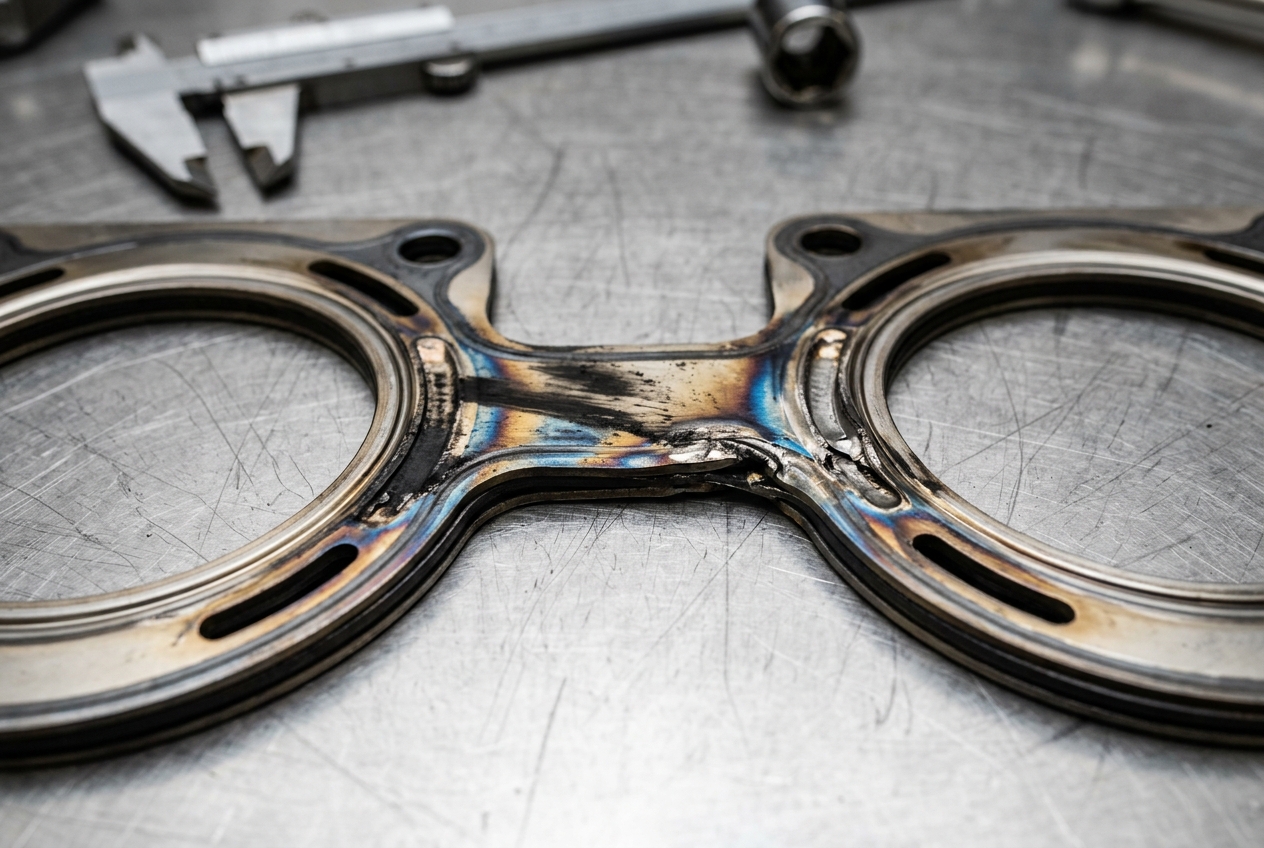
The primary engineering shortfall lies in the clamping architecture: Honda secured the DOHC cylinder head using standard M10 torque-to-yield (TTY) cylinder head bolts. Over tens of thousands of thermal expansion cycles—accelerated by localized heat buildup between the Siamese exhaust ports—these factory head bolts experience plastic elongation (permanent stretch). Once bolt tension relaxes by even 8 to 12 percent, the multi-layer steel gasket's embossed sealing rings lose their active spring load.
Because cylinders 2 and 3 operate at the highest thermal concentration inside the cylinder head casting, the 6.8 mm metal bridge between cylinders 2 and 3 experiences combustion gas blowout first. High-pressure combustion gas forces its way past the embossed fire ring, entering the water jacket. When the vehicle is turned off, residual cooling system pressure (15–18 psi) pushes liquid coolant back across the breach into the combustion chamber, accumulating on the piston crown overnight.
⚠️ Workshop Warning / Field Note: The "Steam-Cleaned Piston" Diagnostic
When diagnosing an intermittent cold-start misfire on an L15 1.5T, never replace ignition coils or fuel injectors before performing a borescope inspection down the spark plug holes on a dead-cold engine. An engine suffering from early fire ring breach will show dark carbon crust on cylinders 1 and 4, but the piston crown on cylinder 2 or 3 will appear spotless, shiny bare aluminum—literally steam-cleaned by atomized coolant during startup. If you see a sparkling clean piston crown, the head gasket is 100% breached.
2. The Fuel-in-Oil Dilution Phenomenon (TSB 18-114 & 19-037)
The second chronic ailment plaguing the Honda 1.5L Turbo is severe crankcase fuel dilution, predominantly in cold-weather regions (northern US states and Canada) during short commute cycles.
In high-pressure direct-injection (GDI) systems operating at up to 2,900 psi (20 MPa), fuel is sprayed directly into the combustion chamber rather than into the intake ports. When an engine starts in freezing ambient temperatures (below 32°F / 0°C), the cold aluminum cylinder walls act as a thermal quench surface. Fuel droplets impinging on the cold cylinder walls fail to fully vaporize. As the piston ascends, the compression and oil control rings scrape liquid raw gasoline down into the crankcase oil sump.
In conventional port-injected or larger displacement engines, prolonged highway driving warms engine oil above 190°F–212°F (88°C–100°C), allowing volatile fuel fractions to vaporize and vent through the positive crankcase ventilation (PCV) system. However, the ultra-efficient 1.5L Earth Dreams engine produces so little waste heat that in cold weather, coolant temperatures struggle to reach normal operating range, and engine oil rarely exceeds 160°F (71°C).
As a result, gasoline continuously accumulates in the oil pan. Vehicle owners report the oil level rising half an inch to an inch above the orange plastic dipstick full mark, accompanied by an intense raw gasoline odor inside the vehicle cabin when the heating/defrost system is activated. Severe fuel dilution degrades the oil's high-temperature high-shear (HTHS) film strength, causing premature wear on the turbocharger journal bearings and exhaust camshaft lobes.
⚠️ Workshop Warning / Field Note: The Oil Level Rising Threshold
Honda's factory position states that up to 2.5% to 5% fuel dilution is acceptable in direct-injected engines. However, independent used-oil laboratory analyses (UOA) on winter-driven 1.5T vehicles routinely uncover fuel dilution exceeding 7% to 11%, dropping nominal 0W-20 factory oil into a thin 0W-12 or 0W-8 viscosity range. If your oil dipstick reads more than 15 mm (0.6 in) above the maximum fill notch, drain and refill the crankcase immediately to prevent catastrophic bottom-end bearing wear.
3. Live Diagnostic Protocol: 5 Progressive Stages of Head Gasket Failure
Unlike sudden catastrophic overheat events, Honda 1.5L Turbo head gasket failure progresses through five distinct, predictable mechanical phases:
| Failure Stage | Physical Symptoms & Driver Experience | Telemetry & Forensic Verification |
|---|---|---|
| Stage 1: Microscopic Seepage | Brief 3 to 5 second cold-start rough idle; no check engine light; coolant expansion tank level drops 1/4-inch per month with no visible external leak. | Mode $06 live misfire data shows 15–40 pending counts on Cylinder 2 or 3 exclusively during the first 60 seconds after cold start. |
| Stage 2: Combustion Gas Intrusion | Cabin climate control blows ambient or ice-cold air while stopped at red lights; temperature surges back to hot upon revving above 2,500 RPM. | Combustion gases displace liquid coolant from the heater core into the radiator expansion tank, forming an air pocket at the highest elevation of the cooling loop. |
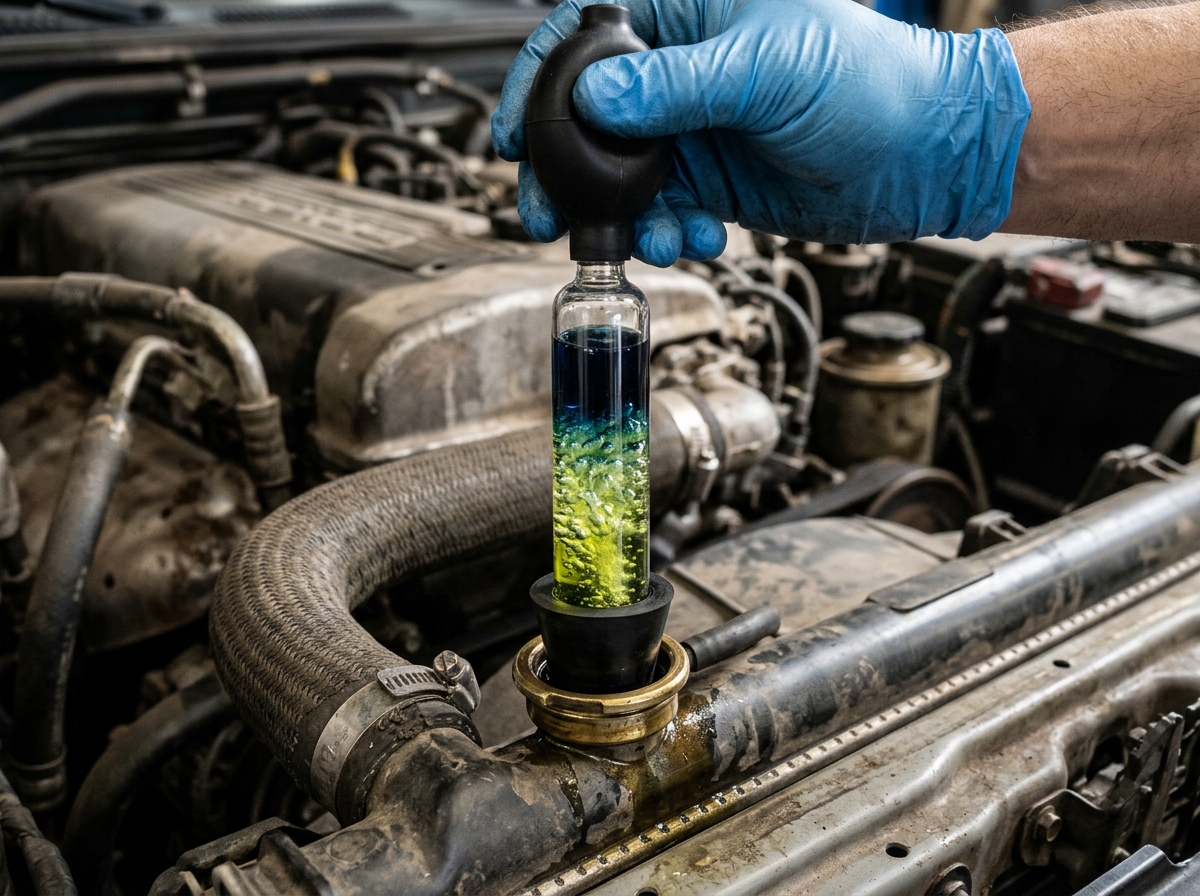
| Stage 3: Chemical Block Test Positive | Check Engine Light flashes on cold start; DTC P0300 (Random Misfire) with P0302 or P0303 stored; sweet white haze from tailpipe for 15 seconds. |
Chemical Combustion Leak Tester: Blue chemical fluid turns bright yellow-green within 45 seconds of running over the radiator neck. |
| Stage 4: Cooling System Over-Pressurization | Radiator upper hose rock-hard and swollen even 8 hours after engine shutdown; coolant forced past expansion tank cap onto transmission case. | Cooling jacket pressure exceeds 18 psi under 50% throttle, bypassing the 1.1 bar radiator cap pressure relief spring. |
| Stage 5: Hydraulic Lock / Bore Scoring | Starter motor hesitates or jams on cold crank; loud metallic clunk; persistent high engine temperature gauge spikes under boost. | Liquid coolant in cylinder 2 or 3 resists piston upward travel (hydro-lock risk); cylinder head deck warped beyond 0.003 in limit. |
4. Telemetry Diagnostics: Normal Operating Baseline vs. Failure Thresholds
Before commissioning an expensive engine teardown, certified technicians rely on objective telemetry benchmarks. Connect a professional bi-directional or high-speed OBD-II scanner to record the following live diagnostic parameters:
| Sensor / Diagnostic Parameter | Factory Healthy Baseline (L15B/L15BE) | Active Head Gasket / Dilution Failure |
|---|---|---|
| Cylinder Leak-Down Rate (at 100 psi shop air) | < 5% across all 4 cylinders | > 18% leakdown on Cyl 2 or 3; bubbles erupting in coolant neck |
| Overnight Cooling Jacket Residual Pressure | 0 psi (hose completely soft and pliable when cold) | 6 to 12 psi retained pressure (upper hose firm after 10 hours cold) |
| Crankcase Fuel Dilution by Weight (UOA) | < 2.0% fuel content | > 6.5% to 11.0% fuel content (oil viscosity sheared below SAE 16) |
| Cold Start Cylinder Misfire Counter (Mode $06) | 0 misfires per 1,000 engine cycles | > 50 misfires on Cyl 2/3 during first 45 seconds of idle |
| Cylinder Head Deck Flatness Tolerance | < 0.001 in (0.025 mm) maximum deflection | > 0.0025 in (0.063 mm) warpage across exhaust center bridge |
Accurately detecting microscopic combustion gas blow-by into your Honda cooling jacket and isolating intermittent cylinder 2/3 cold misfires requires dedicated technician-grade test hardware:
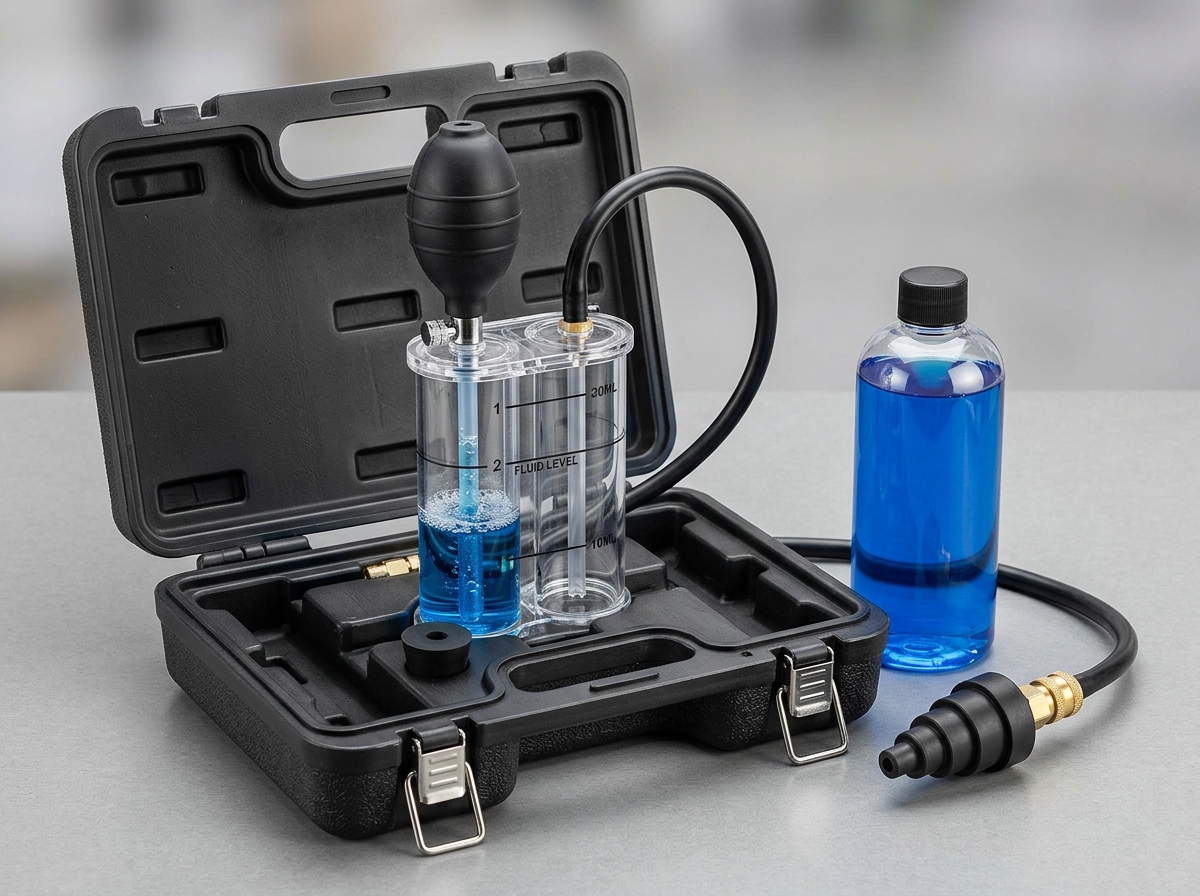
Block Tester BT-500 Combustion Leak Test Kit with Test Fluid
Detects Microscopic Exhaust Gas Intrusion into Coolant Within 60 Seconds
- ✓Bromothymol Blue Indicator: Chemical test fluid turns yellow/green instantly upon contact with exhaust CO2.
- ✓Dual-Chamber Protection: Upper chamber prevents vacuum aspirator from sucking raw coolant into test zone.
- ✓Irrefutable Diagnostic Evidence: Confirms internal combustion breach before investing thousands in teardowns.

BlueDriver Bluetooth Pro OBD-II Diagnostic Scan Tool
Technician Recommended for Enhanced OEM PIDs
- ✓Enhanced Diagnostics: Reads proprietary manufacturer ABS, Airbag, transmission, and body codes.
- ✓Real-Time Telemetry: Graph live oil pressure, coolant temp (ECT), and cam phaser angular deviation.
- ✓Wireless Bluetooth: Full iOS & Android integration with zero monthly subscription fees.
5. The Permanent Mechanical Fix: ARP Head Studs & Multi-Layer Steel Overhaul
If your Honda 1.5L Turbo has blown its head gasket, simply slapping another OEM gasket on with new factory torque-to-yield bolts is a temporary band-aid that routinely fails again within 40,000 to 60,000 miles. To permanently bulletproof the L15 platform against boost-induced head lift, master engine builders adhere to a strict 4-step mechanical protocol:
Step 1: Precision Cylinder Head Resurfacing (Ra 30–50 Finish)
Whenever a head gasket breaches, the high-velocity escaping combustion gas creates microscopic erosion grooves (brinelling) in the aluminum cylinder head deck. The cylinder head must be dismantled and skimmed on a precision wet-belt surfacer or CNC mill by an automotive machine shop. Specify an arithmetic average roughness (Ra) finish between 30 and 50 micro-inches. If the surface is too smooth (below 20 Ra), the MLS gasket cannot grip; if too rough (above 60 Ra), combustion gas will channel through machining valleys.
Step 2: Upgrade to High-Tensile ARP Head Studs
Discard the factory M10 torque-to-yield stretch bolts. Install an ARP Custom Age 625+ or ARP 2000 Cylinder Head Stud Kit engineered specifically for the Honda L15 engine. Unlike torque-to-yield bolts that permanently stretch upon installation, ARP studs are manufactured from ultra-high tensile 8740 chromoly steel with a tensile strength exceeding 220,000 psi. Studs deliver consistent, perpendicular clamping load without applying torsional friction to the engine block threads.
Step 3: Installation of Updated Multi-Layer Steel Gasket
Install Honda's latest revised OEM MLS head gasket or a heavy-duty aftermarket Cometic / Fel-Pro PermaTorque MLS gasket. Ensure both the block deck and cylinder head mating surfaces are completely degreased using virgin acetone or brake cleaner; never use abrasive Scotch-Brite roloc discs on aluminum surfaces, as aluminum-oxide grit will permanently contaminate engine bearings.
Step 4: Revised Torque Sequence and Clamp Loads
Using ARP Ultra-Torque fastener assembly lubricant on the stud threads and washer faces, execute the factory spiral torque sequence in three progressive stages:
- Stage 1: Torque all 10 head studs to 25 ft-lbs (34 Nm) starting from the center studs and working outward in a spiral pattern.
- Stage 2: Progressively torque all 10 studs to 50 ft-lbs (68 Nm).
- Stage 3: Final torque to 70 ft-lbs (95 Nm). Wait 15 minutes for clamping relaxation, then re-verify all studs at 70 ft-lbs.
Frequently Asked Questions (FAQ)
Does Honda cover 1.5L Turbo head gasket failures under warranty?
Under Honda's standard factory warranty, the powertrain is covered for 5 years or 60,000 miles (whichever occurs first). Because the vast majority of head gasket failures manifest between 70,000 and 110,000 miles, most repairs are denied warranty coverage by corporate Honda unless the owner purchased an extended HondaCare vehicle service contract. However, if your vehicle is within 10,000 miles of warranty expiration and has a complete dealership service history, politely ask the service director to submit a Honda Goodwill Assistance Request to cover a portion of the parts and labor.
Can I drive my Honda CR-V or Accord with a blown head gasket?
No. Continuing to drive with an internal combustion leak continuously over-pressurizes the cooling system, which will inevitably rupture the plastic radiator end tanks or heater hoses. More critically, when the engine is turned off, coolant seeping into cylinder 2 or 3 can cause hydro-lock upon startup, bending connecting rods or cracking the aluminum cylinder sleeve. If your block test is positive, park the vehicle until repaired.
Does Honda TSB 18-114 fix the fuel dilution issue permanently?
Honda Technical Service Bulletin TSB 18-114 (and 19-037) updates the Engine Control Module (ECM) software to alter direct-injection fuel timing, optimize transmission shift points to raise cruising engine RPM, and adjust climate control logic to heat the engine faster in cold weather. While the software update reduces fuel dilution by approximately 40% to 60%, it does not eliminate it entirely for drivers who take frequent trips under 10 minutes in freezing climates. Winter oil changes every 3,500 to 4,000 miles remain essential.
Researching this vehicle or comparing used inventory?
Always cross-reference factory service bulletins, verify warranty coverage, and compare dealer financing rates or insurance quotes before purchasing.
Reader Feedback
Was this technical guide helpful?
Your verification vote informs our ongoing automotive research schedule.