
Ford 6.7L Power Stroke Bosch CP4 High-Pressure Fuel Pump Failure: Metal Contamination Teardown, Disaster Prevention Kit & TSB Guide
Automotive Research, ASE Master Technicians & Fact-Checking
Direct Technical Summary
Forensic teardown of the catastrophic Bosch CP4.2 high-pressure fuel pump failure across Ford F-250, F-350, and F-450 Super Duty trucks (6.7L Power Stroke V8, 2011–2024). We analyze ULSD fuel lubricity deficits, roller lifter rotation, metal shavings contamination, diagnostic fuel pressure telemetry (FRP / FRP_ACT), and the mandatory S&S Disaster Prevention Bypass Kit installation that saves $12,000 in fuel system replacement costs.
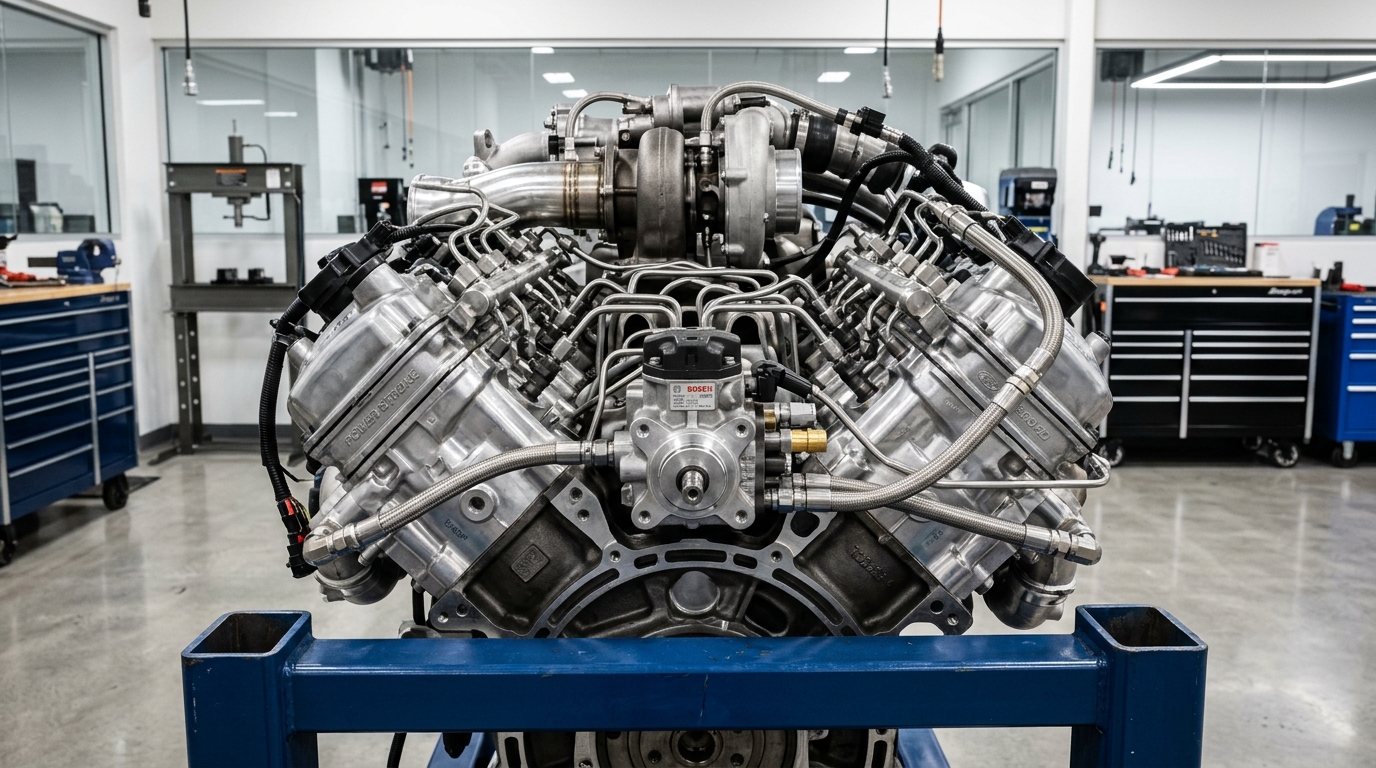
Between the 2011 and 2024 model years, more than 1.8 million Ford Super Duty trucks (F-250, F-350, F-450, and F-550) equipped with the 6.7L Power Stroke Turbo Diesel V8 ("Scorpion" platform) left the Kentucky Truck Plant carrying a chronic, ticking mechanical time bomb deep inside their engine valley: the Bosch CP4.2 high-pressure radial-piston fuel injection pump. While the 6.7L Power Stroke is celebrated for delivering up to 500 horsepower and 1,200 lb-ft of torque, a single microscopic failure mode inside the CP4 pump routinely triggers total fuel system destruction, stranding heavy-duty trucks on highways and presenting owners with repair estimates ranging from $10,000 to $14,000.
The severity of the CP4 disaster is not merely that the pump fails—it is how it fails. Unlike its legendary, bulletproof predecessor (the Bosch CP3 used in earlier diesel platforms), the CP4.2 features an unkeyed cylindrical roller lifter (tappet) that rides upon an eccentric camshaft lobe inside an aluminum crankcase. When poor fuel lubricity, water intrusion, or cavitation causes the roller to rotate just 90 degrees out of alignment, the hardened steel roller stops rolling and begins skidding. Within minutes, the spinning cam lobe acts as a high-speed metal lathe, shaving microscopic steel glitter, needle-like slivers, and aluminum filings into the fuel stream. Because Bosch designed the CP4's internal lubrication circuit to dump return fuel directly back into the low-pressure supply and fuel tank, this toxic metal glitter circulates through the entire fuel infrastructure—destroying all eight Bosch piezo fuel injectors, the high-pressure common rails, pressure regulating valves, fuel return lines, and the in-tank lift pump.
Based on official federal investigation files from the National Highway Traffic Safety Administration (NHTSA Action Numbers PE21-010 & EA21-002), Ford technical service bulletins (TSB 11-10-10, TSB 14-0196, and SSM 47854), metallurgical SAE teardowns, and master diesel fuel injection specialists, AutoZonic delivers the comprehensive forensic autopsy of Bosch CP4 pump failure, live OBD-II diagnostic pressure thresholds, and the definitive mechanical installation guide for the Disaster Prevention Bypass Kit that permanently bulletproofs your Power Stroke.
i Quick Mechanical Summary: Ford 6.7L Power Stroke CP4 Failure Profile
Affected Vehicles: 2011–2024 Ford F-250, F-350, F-450, F-550 Super Duty (6.7L Power Stroke V8 Diesel).
Component: Bosch CP4.2 Twin-Piston High-Pressure Radial Pump (Ford P/N: BC3Z-9A543-A, FC3Z-9A543-A).
Failure Root Cause: Lack of mechanical pin alignment allows roller lifter rotation; skidding roller galls camshaft lobe, generating metal shavings.
Diagnostic Fault Codes (DTC): P0087 (Fuel Rail/System Pressure Too Low), P0088 (Pressure Too High), P0093 (Major Fuel Leak Detected).
Average Failure Window: 85,000 – 140,000 miles (heavily accelerated by winter dry diesel or water in fuel).
Permanent Fix: S&S Diesel Motorsport / Gen 2.1 Disaster Prevention Bypass Kit + High-Lubricity Additives (ASTM D6079 < 460 µm).
Forensic Teardown: Why the Bosch CP4.2 Self-Destructs on US Diesel
To understand the catastrophic vulnerability of the 6.7L Power Stroke, one must examine the fundamental design differences between the robust Bosch CP3 and the cost-reduced Bosch CP4.2. In the older CP3 pump, three radial pumping elements were arranged in a star configuration around an eccentric shaft, utilizing massive surface-area bronze bushings lubricated by continuous low-pressure fuel flow. The CP3 was deliberately over-engineered to withstand contaminated or dry fuel without structural disintegration.
In contrast, Bosch engineered the CP4.2 to be smaller, lighter, and capable of generating up to 30,000 psi (2,000 bar) of injection pressure using two opposed vertical pumping plungers. However, to reduce internal parasitic friction, Bosch replaced the wide bushings with free-floating roller lifters (tappets) riding on an internal twin-lobe camshaft. Herein lies the fatal design flaw:
- Unpinned Roller Tappet Bore: In high-performance valvetrains, roller lifters are locked in place with mechanical guide bars or precision anti-rotation pins. In the Bosch CP4.2, the roller tappet is held in alignment solely by hydraulic fuel pressure and the friction between the roller and its cylindrical aluminum bore. There is no positive mechanical pin preventing the lifter from twisting.
- The ULSD (Ultra-Low Sulfur Diesel) Lubricity Deficit: Unlike European diesel fuel, which is mandated to meet a strict maximum wear scar diameter of 460 microns under ASTM D6079 High-Frequency Reciprocating Rig (HFRR) testing, United States commercial diesel fuel is legally permitted to have a wear scar up to 520 microns. US diesel is significantly "drier" and provides substantially less hydrodynamic boundary lubrication to precision steel-on-steel interfaces.
- Lifter Rotation & Galling: Under cold starts, high fuel temperatures, or momentary micro-cavitation (air bubbles), the lubricating hydrodynamic film between the roller and the cam collapses. The roller lifter drags, catches, and twists 90 degrees perpendicular to the camshaft. Instead of rolling smoothly across the eccentric lobe, the hardened roller is dragged sideways across spinning steel at 3,000 RPM.
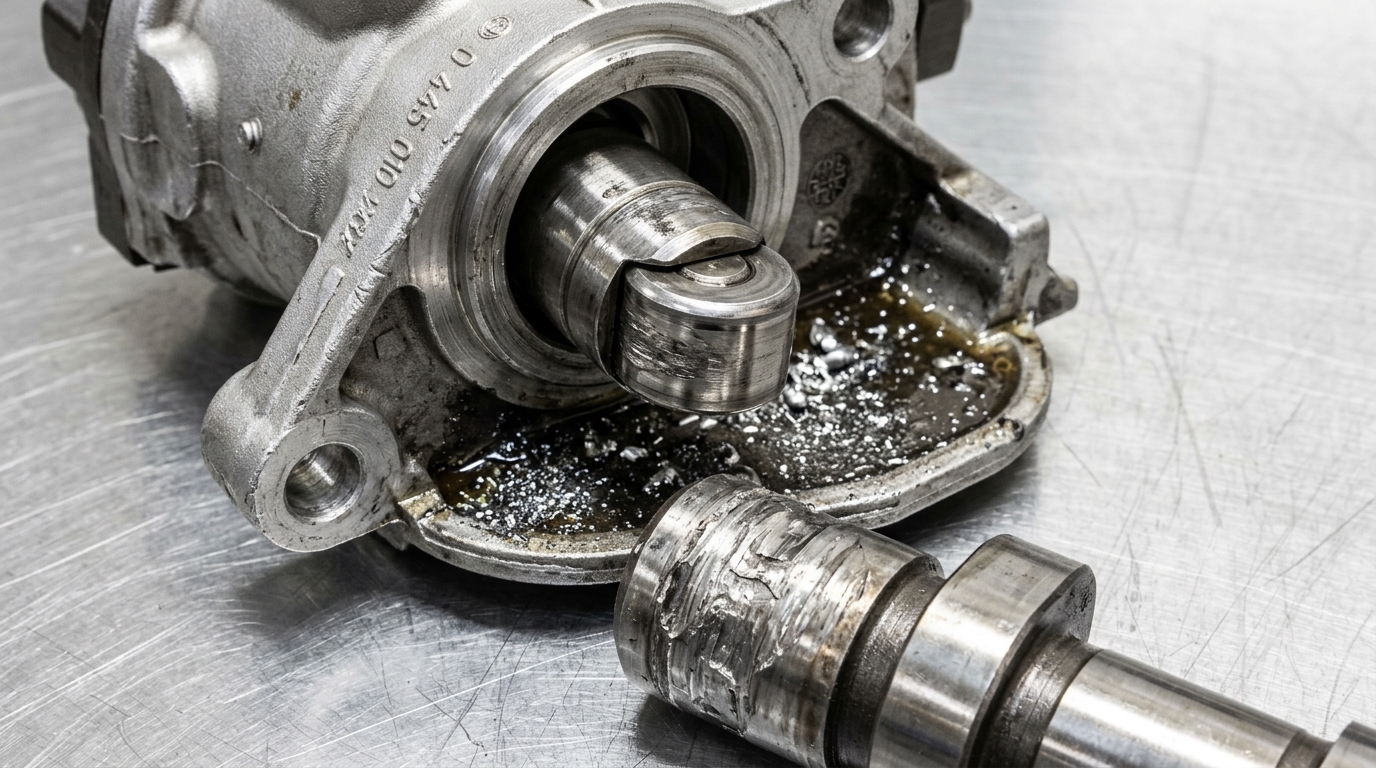
The Cascade Destruction: Why a $900 Pump Causes a $12,000 Repair Bill
When an alternator, starter, or water pump fails, you replace that specific component and resume driving. Why does a Bosch CP4 pump failure require replacing the entire fuel system from the bumper to the tailgate? The answer lies in the factory return-fuel plumbing architecture of the 6.7L Power Stroke:
In the factory configuration, low-pressure diesel (approx. 55–65 psi) is delivered from the tank-mounted lift pump and primary/secondary fuel filters directly into the crankcase of the CP4 pump. This incoming fuel lubricates the camshaft, rollers, and aluminum bores. Excess fuel not pushed past the inlet metering valve into the high-pressure pumping chambers is collected as return fuel.
Crucially, this crankcase return fuel is routed directly back into the secondary engine-mounted fuel filter and the main diesel tank. When the roller lifter rotates and begins shaving the camshaft, millions of microscopic steel glitter particles (measuring between 1 and 50 microns) are instantly discharged into the low-pressure return line. Within seconds of pump failure:
- The metal glitter travels back into the fuel tank, embedding into the plastic tank floor and coating the in-tank sending unit.
- The low-pressure electric lift pump sucks the metal shavings back up, sending them through the supply lines.
- The microscopic metal particles bypass or overwhelm the fuel filter and enter the high-pressure pumping chambers.
- The CP4 compresses the metal-contaminated fuel to 29,000 psi and shoots it directly into the left and right common fuel rails.
- The razor-sharp metal shavings blast through the micro-orifices of all eight Bosch piezo fuel injectors, scoring the internal needle seats, seizing the piezo actuators, and causing injectors to stick permanently open or closed.
Workshop Warning: The Sticking Injector Hydro-Lock Hazard
When CP4 metal shavings jam an injector needle in the open position, the high-pressure common rail continuously sprays raw diesel fuel into the cylinder at 25,000+ psi. This creates an immediate risk of cylinder washdown, catastrophic piston crown melting, or hydrostatic engine lockup (hydro-lock), which can bend connecting rods and destroy the 6.7L Power Stroke engine short block. If your truck stumbles under acceleration with a sudden P0087 code, shut the engine off immediately and do NOT crank it.
Diagnostic Telemetry: Identifying CP4 Degradation Before Total Seizure
Catching CP4 wear before catastrophic seizure can save an owner thousands of dollars in collateral damage. Master diesel technicians monitor live fuel rail pressure parameters using an enhanced OBD-II diagnostic scan tool while performing two definitive physical inspections:
1. Live OBD-II PID Verification
Monitor FRP (Fuel Rail Pressure Desired) versus FRP_ACT (Fuel Rail Pressure Actual) along with the PCV (Pressure Control Valve) and VCV (Volume Control Valve) duty cycles during wide-open-throttle (WOT) acceleration:
| Operating Metric | Healthy OEM Baseline | Failing CP4 Threshold | Diagnostic Significance |
|---|---|---|---|
| Idle FRP (Actual) | 4,500 – 5,500 psi | < 3,200 psi (erratic) | Low pressure indicates internal pump leakage or stuck pressure control valve. |
| WOT FRP (Actual) | 28,000 – 30,000 psi | < 22,000 psi (P0087 trigger) | Pump cannot keep up with injector demand; PCM enters reduced power mode. |
| FRP Variance (Desired vs Act) | ± 250 psi | > 1,500 psi delta | Severe delta indicates volume control valve sticking due to metal debris. |
| Low-Pressure Fuel Supply | 55 – 65 psi constant | < 40 psi | Low supply pressure starves CP4 crankcase, triggering immediate cavitation. |
2. The Definitive Magnetic VCV Physical Inspection
The single most definitive test for CP4 health requires no teardown. Located on top of the CP4 pump in the engine valley is the Volume Control Valve (Fuel Pressure Regulator 1), held by two T25 Torx screws. Technicians disconnect the electrical pigtail, unbolt the valve, and inspect the fine stainless steel mesh screen on the snout:
- Normal Condition: Clean, gold or amber diesel film on the screen with zero particulate matter.
- CP4 Early Degradation: Fine microscopic sparkles visible when illuminated with a bright LED inspection light. Rubbing the screen with a clean paper towel leaves a grey metallic smudge.
- Catastrophic Failure: The screen is completely choked with dense, shiny steel shavings that adhere strongly to a magnetic pickup tool. If metal is present on this screen, the pump has self-destructed.
Preventing catastrophic metal contamination across all 8 piezo injectors and diagnosing real-time fuel rail pressure drops requires precision mechanical isolation and OBD-II telemetry hardware:
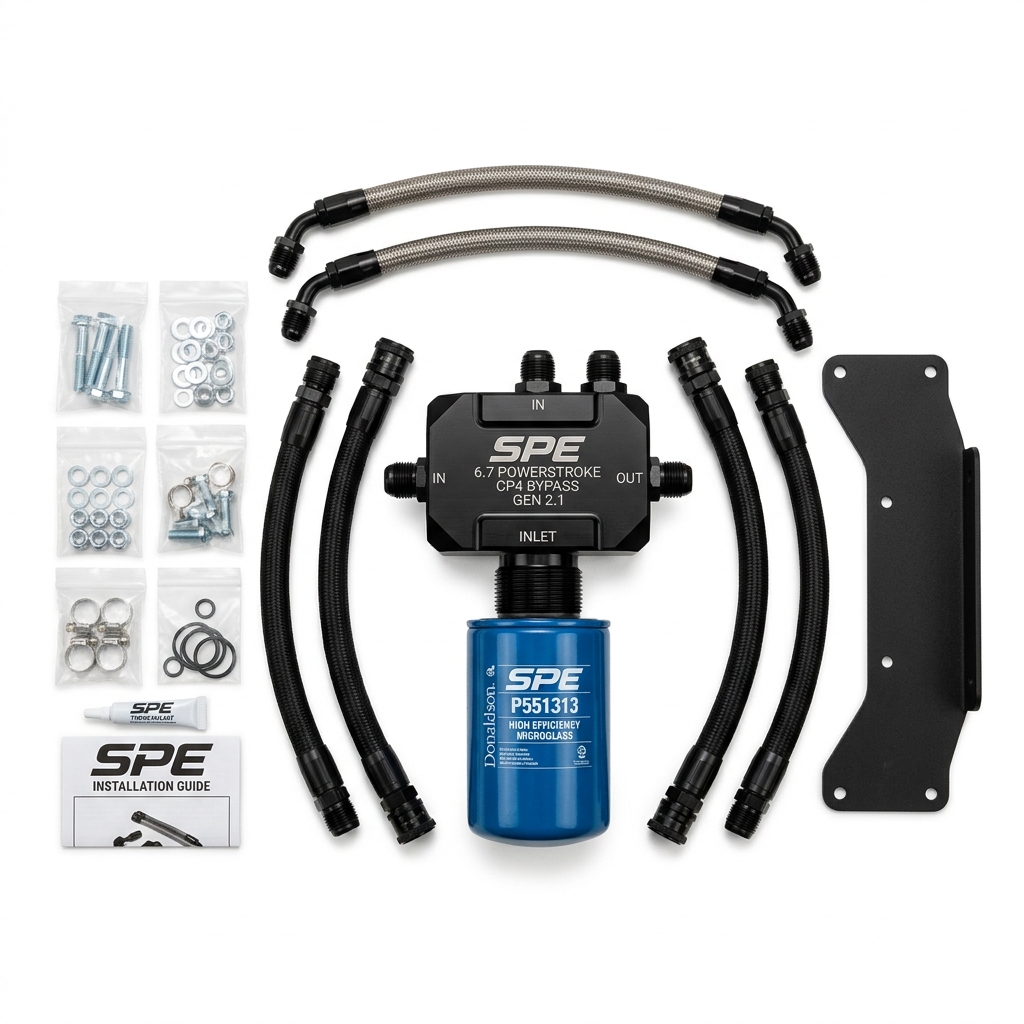
Ford 6.7L Power Stroke CP4 Disaster Prevention Bypass Kit (Gen 2.1)
Isolates High-Pressure Fuel Contamination • Protects Rails & 8x Piezo Injectors
- ✓Billet Aluminum Return Manifold: CNC-machined block redirects internal pump crankcase fuel away from high-pressure elements.
- ✓Secondary 9-Micron Microglass Filtration: Traps metal shavings before return fuel ever reaches the fuel tank.
- ✓100% Plug-and-Play OE Lines: Braided high-pressure lines and factory-style quick connects with zero wire slicing or ECM tuning needed.

BlueDriver Bluetooth Pro OBD-II Diagnostic Scan Tool
Technician Recommended for Enhanced OEM PIDs
- ✓Enhanced Diagnostics: Reads proprietary manufacturer ABS, Airbag, transmission, and body codes.
- ✓Real-Time Telemetry: Graph live oil pressure, coolant temp (ECT), and cam phaser angular deviation.
- ✓Wireless Bluetooth: Full iOS & Android integration with zero monthly subscription fees.
The Permanent Mechanical Solution: How the Disaster Prevention Bypass Kit Works
Because the factory Bosch CP4.2 design cannot be structurally modified without replacing the entire pump architecture (such as converting to a retrofitted CP3 or DCR pump), the aftermarket diesel engineering community—led by S&S Diesel Motorsport—developed an ingenious mechanical safeguard: the CP4 Disaster Prevention Bypass Kit (Gen 2 / Gen 2.1).
Rather than attempting to stop the CP4 from ever wearing out, the Disaster Prevention Kit addresses the fatal flaw of the fuel return loop. Here is the mechanical physics of how it isolates the failure:
- Bypassing Clean Supply Fuel: In the factory setup, clean fuel from the secondary filter enters the pump crankcase, lubricates the camshaft, and then spills over into the high-pressure pumping plungers. The Disaster Prevention Kit introduces a CNC-machined billet aluminum manifold block that separates incoming fuel into two completely isolated circuits.
- Independent High-Pressure Feed: Fresh, 100% clean fuel from the secondary filter is routed directly to the high-pressure pumping elements, completely bypassing the crankcase.
- Isolated Contaminated Return Filtration: The fuel used to lubricate the cam and roller lifters is captured by a dedicated return port. Instead of being dumped raw into the fuel tank and injectors, this return fuel is routed through a secondary 9-micron spin-on microglass filter.
- The $10,000 Safeguard: When the CP4 pump inevitably suffers roller lifter rotation and sheds steel glitter, 100% of the metal debris is trapped inside the dedicated bypass filter. The contaminated fuel cannot reach the common rails, cannot enter the 8 piezo injectors, and cannot contaminate the fuel tank. When the pump dies, you replace only the $900 CP4 pump and the bypass filter—saving over $10,000 in fuel system overhaul labor and parts.
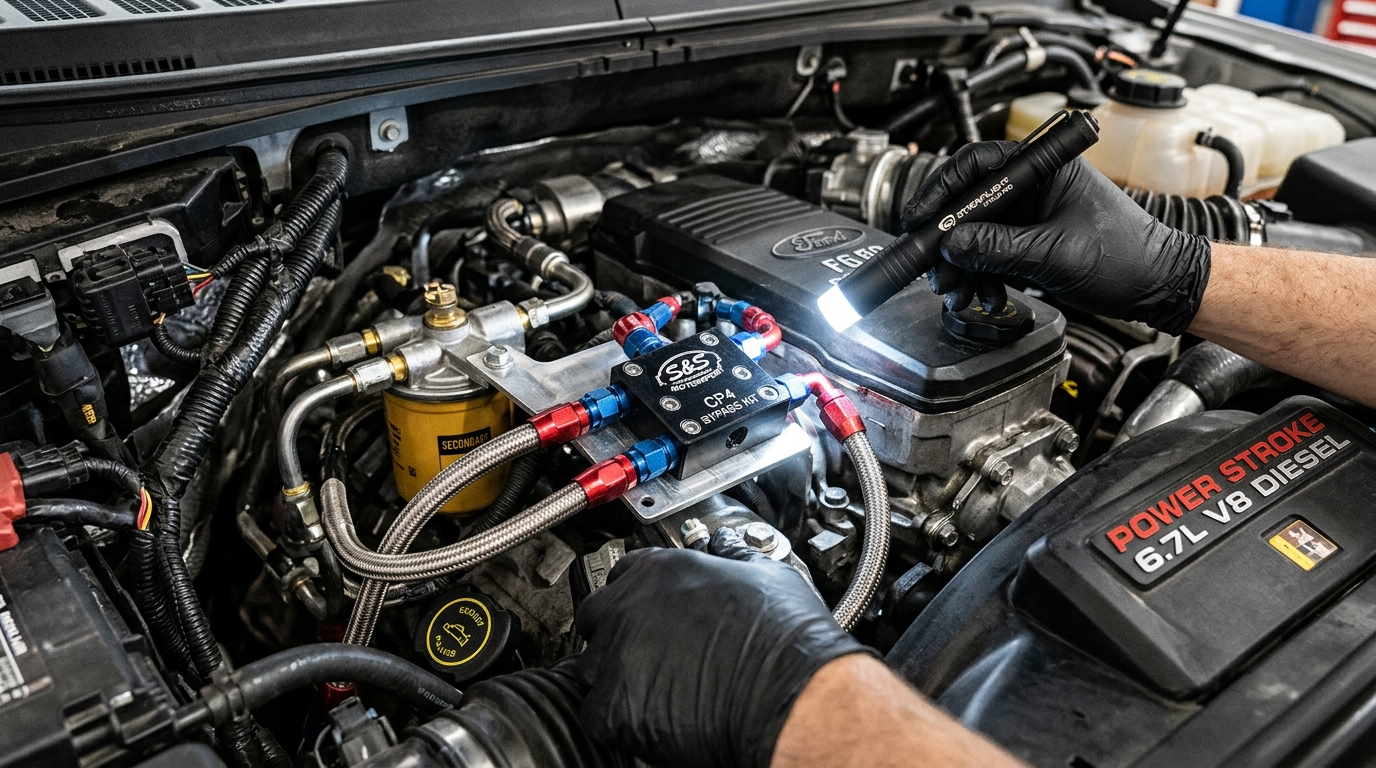
Step-by-Step Installation Protocols: Installing the Gen 2.1 Bypass Kit
Installing a Disaster Prevention Kit requires approximately 2 to 3 hours for an experienced DIY diesel enthusiast or independent technician using standard hand tools:
Step 1: Relieve Low-Pressure Fuel & Disconnect Batteries
Disconnect both negative battery terminals on your Super Duty. Locate the secondary fuel filter mounted on the driver's side upper engine shroud. Clean all surrounding dust and debris with brake cleaner and compressed air before disconnecting factory quick-connect fuel lines.
Step 2: Access the CP4 Metering Block in the Valley
Remove the upper intake air ducting and disconnect the electrical connector to the Volume Control Valve (VCV). Unbolt the factory fuel supply line and return manifold from the CP4 pump body. Use a clean lint-free shop towel to cap all exposed ports immediately.
Step 3: Mount the Billet Disaster Prevention Manifold
Install the new CNC billet distribution block onto the CP4 pump using the supplied Viton O-rings and torque the hardware to 89 in-lbs (10 Nm). Ensure the O-rings are lubricated with clean motor oil or diesel fuel to prevent shearing.
Step 4: Route Braided High-Pressure Lines & Secondary Filter
Mount the secondary spin-on filter bracket to the driver's side cylinder head or alternator bracket. Route the braided stainless bypass lines, ensuring at least 1 inch of clearance from rotating accessory drive belts and high-temperature EGR plumbing. Connect the OEM-style quick-disconnect fittings until an audible 'click' is heard.
Step 5: Priming the Low-Pressure System (Mandatory)
NEVER crank a dry 6.7L Power Stroke. Reconnect the batteries. Turn the ignition key to the 'RUN' position (without cranking the starter) for 30 seconds to allow the low-pressure lift pump to cycle. Repeat this key cycle 6 to 8 times until the low-pressure fuel system is fully purged of air and solid fuel pressure is restored. Start the engine and inspect all fittings with an inspection mirror for leaks.
Technician Recommendation: The ASTM D6079 Fuel Additive Protocol
While the Disaster Prevention Kit protects your injectors and fuel tank when the pump fails, adding a dedicated high-lubricity fuel treatment at every fill-up significantly extends the physical lifespan of the CP4 roller lifters. Treatments formulated with synthetic lubricity esters (such as Hot Shot’s Secret Everyday Diesel Treatment or Opti-Lube XPD) reduce ASTM D6079 wear scar diameter from 520+ microns down to sub-400 microns, restoring boundary layer lubrication parity with European diesel standards.
NHTSA Recalls, Class Actions & OEM Service Bulletins
The chronic failure of the Bosch CP4 injection pump has prompted extensive legal and regulatory scrutiny across North America:
- NHTSA Engineering Analysis (EA21-002): The Office of Defects Investigation (ODI) opened multiple preliminary evaluations investigating stalling and loss of motive power at highway speeds caused by Bosch CP4.2 pump failures in commercial diesel applications.
- Ford Technical Service Bulletin 11-10-10 & SSM 47854: Ford service guidelines establish the diagnostic protocol for contaminated fuel systems. Dealers are instructed to inspect the high-pressure fuel rail and VCV screen for metal shavings. If metal is identified, the official Ford warranty procedure mandates total replacement of the fuel pump, both common rails, all eight fuel injectors, high-pressure pipes, low-pressure lines, fuel coolers, and the entire fuel tank.
- The "Bad Fuel" Warranty Denial Battle: When 6.7L owners bring a truck with CP4 failure to a dealership under the 5-year/100,000-mile powertrain warranty, service departments frequently pull a fuel sample from the water separator. If even microscopic traces of water, rust, or gasoline contamination are found, Ford routinely denies warranty coverage under the classification of "environmental contamination" or "bad fuel"—leaving the customer with an out-of-pocket invoice exceeding $11,000.
Installing a Disaster Prevention Bypass Kit is the single most important preventative investment any Ford 6.7L Power Stroke owner can make. For less than 5% of the cost of a complete fuel system replacement, your Super Duty is permanently protected against catastrophic metal glitter contamination.
Researching this vehicle or comparing used inventory?
Always cross-reference factory service bulletins, verify warranty coverage, and compare dealer financing rates or insurance quotes before purchasing.
Reader Feedback
Was this technical guide helpful?
Your verification vote informs our ongoing automotive research schedule.