
Nissan CVT Transmission Failure: Jatco JF011E & JF017E Judder, Belt Slip & Flow Control Valve Repair Guide
Automotive Research, ASE Master Technicians & Fact-Checking
Direct Technical Summary
Forensic teardown of the chronic Nissan CVT transmission failure across Rogue, Altima, Murano, and Pathfinder (Jatco JF011E, JF016E, JF017E). We dissect high-pressure flow control valve bore wear, segmented steel push-belt slipping, diagnostic trouble codes P17F0 & P17F1, NS-2/NS-3 fluid overheating, and permanent auxiliary cooler & Sonnax valve upgrades.
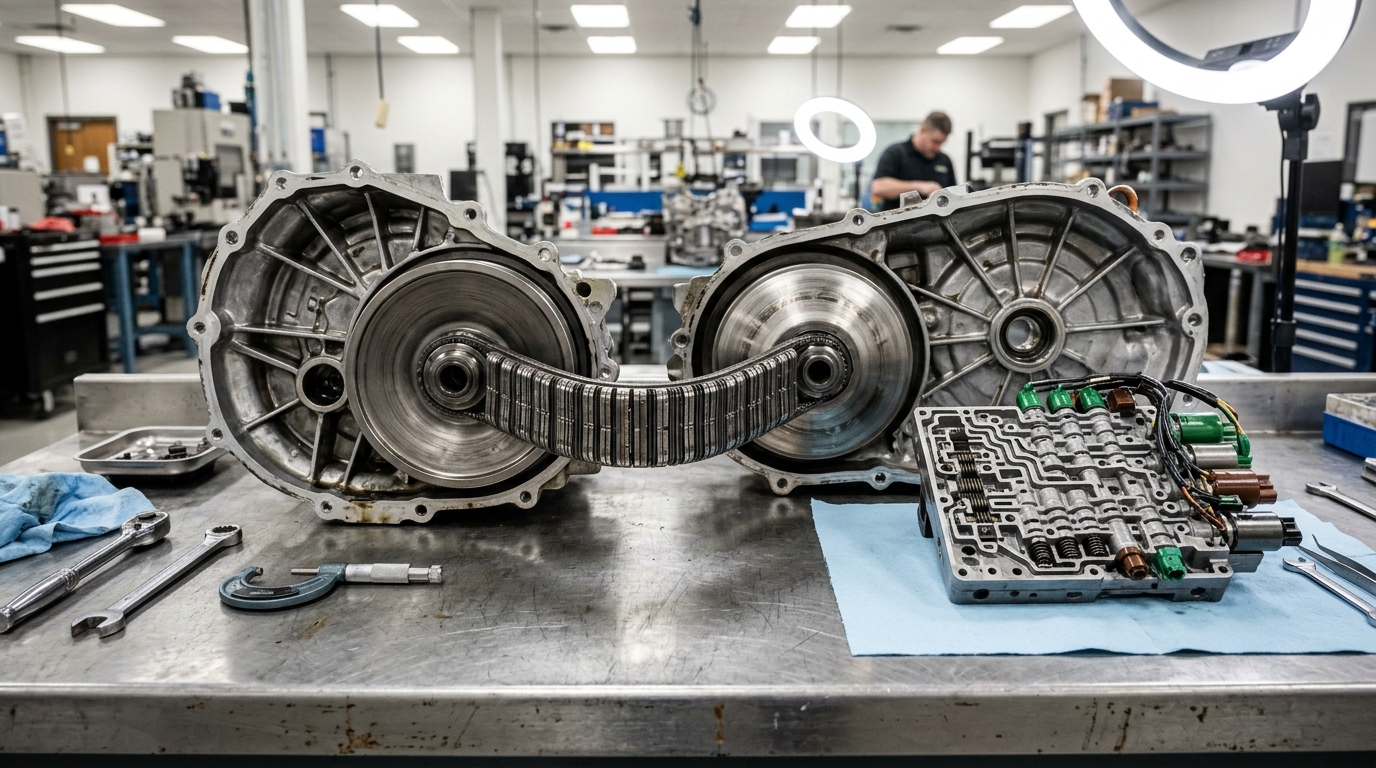
Across North America, more than 10 million vehicles—including the Nissan Rogue (2008–2024), Nissan Altima (2007–2024), Nissan Murano (2009–2024), Nissan Pathfinder (2013–2020), and Nissan Sentra (2013–2024)—are equipped with continuously variable transmissions engineered and manufactured by Nissan's transmission subsidiary, Jatco (Japan Automatic Transmission Company). Spanning generations of the JF011E (CVT2), JF016E, JF017E, and JF018E architectures, these belt-driven transmissions have generated the highest volume of consumer complaints, class-action warranty settlements, and catastrophic mechanical breakdowns in modern automotive history: Violent CVT Judder, Steel Push-Belt Slippage, and Complete Loss of Motive Power.
Unlike conventional planetary automatic transmissions that employ fixed mechanical gear sets and clutches to transfer torque, a Continuously Variable Transmission (CVT) relies on a segmented steel push-belt operating between two smooth, hydraulically adjustable conical pulleys (sheaves). To prevent the steel belt from slipping under engine torque, the transmission oil pump must generate continuous, extreme hydraulic clamping pressure—often exceeding 600 to 850 psi (40 to 60 bar). When the factory steel flow control valve wears into the soft aluminum oil pump casing, hydraulic line pressure collapses. The steel push-belt immediately slips across the mirror-polished pulley faces, gouging concentric circular grooves, shedding hardened steel debris into the valve body, and triggering the dreaded P17F0 (CVT Judder Inspection Required) or P17F1 (CVT Judder Detected) diagnostic trouble codes. Dealerships routinely quote $4,500 to $6,500 for total transmission replacement.
Compounding this hydraulic defect, factory transmission cooling systems rely on an undersized liquid-to-liquid heat exchanger tied into the engine radiator. During summer highway driving or hill climbs, transmission fluid temperatures routinely exceed 205°F–230°F (96°C–110°C), causing the transmission control module (TCM) to engage an aggressive thermal protection limp mode that limits vehicle speed to 45 mph and creates an unbearable high-pitched whining noise. Based on official Nissan technical service bulletins (NTB15-084, NTB18-058, & NTB17-039), SAE tribological teardowns, and master transmission rebuilders, AutoZonic delivers the comprehensive forensic diagnosis, live telemetry benchmarks, and permanent mechanical bulletproofing manual for Nissan Jatco CVTs.
Quick Workshop Diagnostic: Nissan Jatco CVT Failure at a Glance
- Impacted Transmission Models: Jatco
JF011E(RE0F10A),JF016E(RE0F10D),JF017E(RE0F10E), andJF015E(RE0F11A) found across Nissan Rogue, Altima, Murano, Pathfinder, Maxima, and Sentra. - Primary Driver Symptoms: Severe vehicle shaking/shuddering during light acceleration between 20 and 45 mph; delayed engagement when shifting into Drive or Reverse (1.5 to 3-second lag); sudden engine RPM flare without vehicle acceleration (slipping); high-pitched hydraulic jet-engine whine on highway trips.
- The Mechanical Root Cause: Wear of the steel flow control valve inside the un-sleeved aluminum bore of the high-pressure oil pump. Pressure leakage drops primary pulley clamping force below the friction threshold of the steel push-belt, precipitating catastrophic sheave scoring.
- Official Nissan Technical Bulletins: NTB15-084 (CVT Judder Diagnosis & Sub-Assembly Replacement); NTB18-058 (CVT Judder Software Update & Inspection); NTB17-039 (Cooler Kit Retrofit for Whining & High-Temperature Limp Mode).
- The Permanent Mechanical Solution: Precision reaming and installation of an upgraded hard-anodized Sonnax Oversized Flow Control Valve in the oil pump, installation of an external stacked-plate auxiliary transmission cooler, and strict 30,000-mile fluid drains using genuine Nissan NS-2 or NS-3 CVT Fluid.
1. Forensic Physics: How Jatco CVTs Self-Destruct
To understand why Nissan CVTs experience such catastrophic failure rates while Honda and Toyota CVTs run reliably for hundreds of thousands of miles, one must examine the tribology and hydraulic circuit architecture of the Jatco design.
In a Jatco CVT, power is transferred through a specialized push-belt composed of approximately 400 individual high-carbon stamped steel elements held together by two multi-layer flexible steel bands. This belt is wedged between two sets of cone-shaped pulleys (the primary driver pulley connected to the torque converter, and the secondary driven pulley connected to the final differential). Stepless gear ratio changes are achieved by hydraulically expanding one pulley while contracting the other, altering the effective running diameter of the belt.
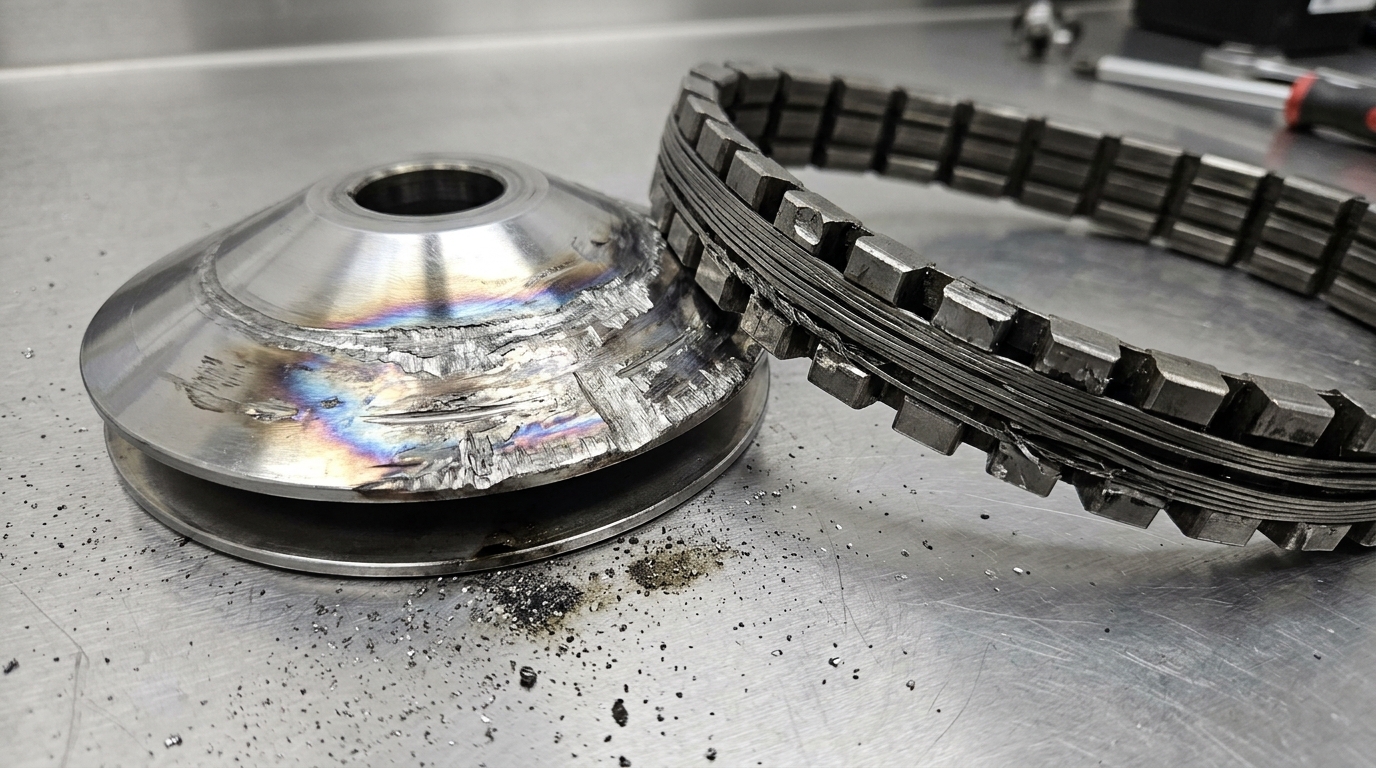
The entire system depends on traction-drive friction. Because steel-on-steel contact has an inherently low coefficient of friction, the transmission oil pump must maintain massive hydraulic line pressure (up to 850 psi) against the pulley sheaves. If line pressure drops by as little as 10% under load, the normal force holding the steel elements against the sheaves collapses.
Once slippage occurs, the hardened steel elements (Rockwell hardness ~60 HRC) act like a high-speed metal lathe against the softer cast-iron pulley sheaves. Within fractions of a second, the mirror finish is destroyed, generating abrasive steel shavings that circulate through the transmission. As this metal glitter enters the hydraulic valve body, it jams spool valves, scoring solenoid plungers and initiating a vicious cycle of irreversible hydraulic degradation.
⚠️ Workshop Warning / Field Note: The Universal Fluid Trap
Never allow an independent oil change facility to refill a Nissan Jatco CVT with "multi-vehicle universal" ATF or generic CVT fluid. Nissan CVTs operate on unique anti-shudder friction modifiers and ultra-high shear stability chemistry. Using standard ATF will dissolve the paper friction material on the forward clutch pack within 500 miles and cause immediate catastrophic belt slip. Vehicles requiring Nissan NS-2 (amber/green fluid, pre-2013) must NEVER be mixed with Nissan NS-3 (blue-green fluid, high-pressure low-viscosity, 2013+). Always verify factory fluid specification on the transmission dipstick cap.
2. The Core Metallurgical Defect: The Flow Control Valve Bore
While dealerships often blame customer driving habits or lack of maintenance, the fundamental root cause of 85% of Jatco CVT failures is a manufacturing and metallurgical flaw inside the transmission oil pump housing.
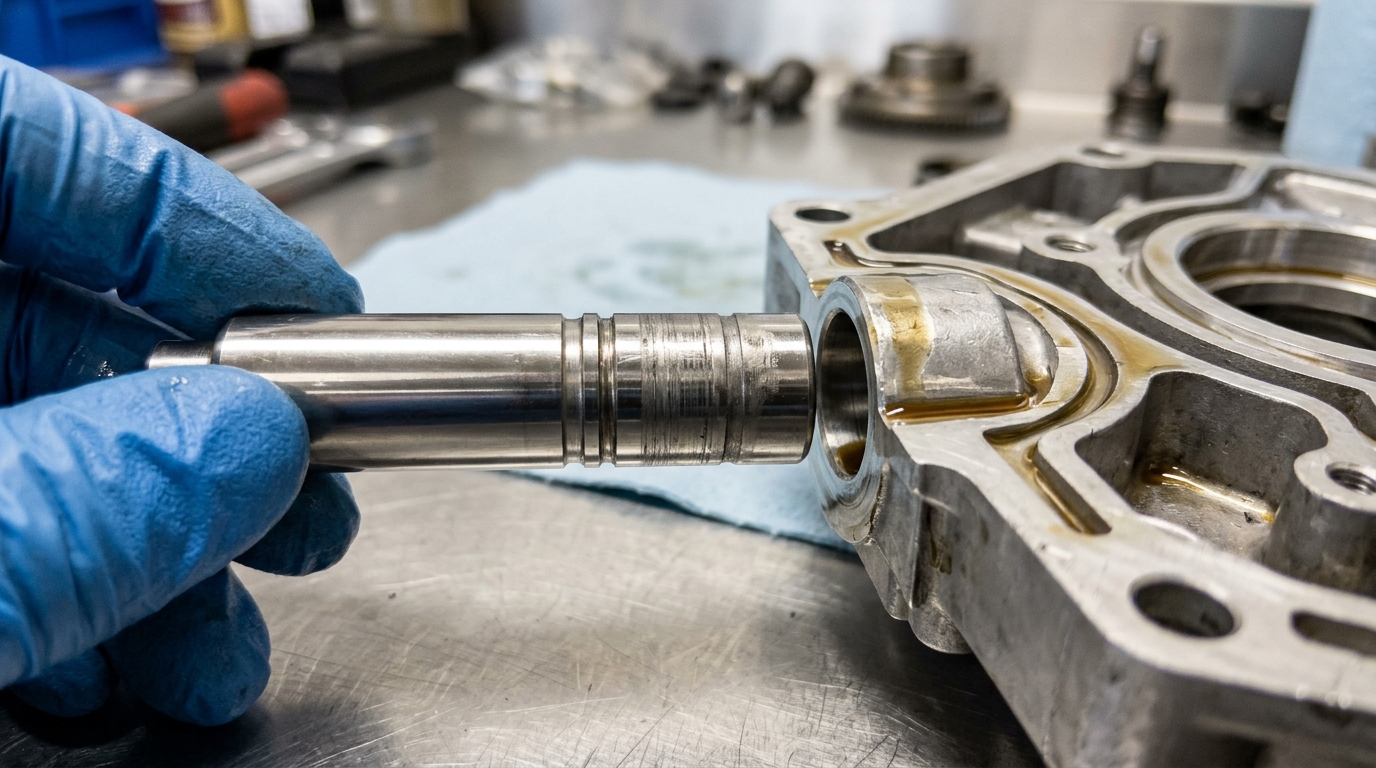
The variable-displacement vane pump utilizes a reciprocal steel flow control valve to regulate system line pressure across different engine RPMs. Jatco engineered this hard steel valve plunger to ride directly inside an un-sleeved, bare aluminum bore in the cast pump housing. Because the valve cycles back and forth thousands of times per drive cycle, side-loading forces inevitably cause the steel lands to wear an ovalized ridge into the softer aluminum casting.
As this wear step develops, two disastrous failure modes occur:
- Internal Hydraulic Leakage: High-pressure fluid leaks past the worn bore clearance back into the low-pressure suction side of the pump. At low engine RPMs (such as accelerating from a stoplight or cruising at 35 mph), the pump cannot maintain required pulley clamping force, causing immediate belt slip and vehicle shuddering.
- Valve Sticking: When fine metallic swarf lodges between the worn valve plunger and the bore ridge, the valve sticks wide open or closed. If it sticks open, line pressure drops to near zero and the vehicle loses all forward drive. If it sticks closed, line pressure spikes violently, blowing internal hydraulic piston seals.
3. Live Diagnostic Protocol: 5 Progressive Stages of Nissan CVT Failure
Nissan CVT breakdown is rarely instantaneous; it follows five distinct, predictable degradation phases that owners and technicians can catch before total mechanical lockup occurs:
| Failure Stage | Physical Symptoms & Driver Experience | TCM Telemetry & Diagnostic Codes |
|---|---|---|
| Stage 1: Hesitation & Engagement Lag | Noticeable 1.5 to 2.0-second delay when shifting from Park into Drive or Reverse; slight engine RPM sag before vehicle moves. | CVT fluid deterioration counter exceeding 120,000 counts; line pressure slow to prime during cold starts. |
| Stage 2: The "Rumble Strip" Judder | Vehicle shudders violently under light throttle at 25–45 mph, feeling like driving over rumble strips; stops when throttle is released. | TCM logs hidden pending code P17F1 (CVT Judder Inspection); primary/secondary speed sensor differential > 120 RPM. |
| Stage 3: Thermal Whining & Limp Mode | High-pitched jet-engine whining noise from beneath floorboards after 45 minutes of highway driving; vehicle speed electronically capped at 45–55 mph. | Fluid temperature sensor exceeds 225°F (107°C); TCM engages thermal protective derating to prevent immediate belt snapping. |
| Stage 4: Permanent Code P17F0 & RPM Flaring | Check Engine Light illuminated; engine revs to 4,000 RPM while vehicle crawls forward sluggishly; heavy metallic glitter on dipstick. | Permanent DTC P17F0 (CVT Judder - Component Replacement Required) stored in non-volatile memory; belt sheave scoring exceeds 0.005 in. |
| Stage 5: Catastrophic Belt Severance | Loud metallic gunshot sound followed by complete loss of all forward and reverse drive; engine revs freely in gear; vehicle must be towed. | Multi-layer steel retaining bands snap; hundreds of individual steel drive elements scatter inside case; complete internal transmission destruction. |
⚠️ Workshop Warning / Field Note: Reading the CVT Deterioration Counter
Nissan TCMs utilize a mathematical algorithm that calculates a CVT Fluid Deterioration Date/Counter based on operating temperature and run-time hours. When fluid temperature stays below 194°F (90°C), the counter advances slowly. However, once fluid temperature exceeds 212°F (100°C), the deterioration rate multiplies exponentially. Nissan's official threshold for mandatory fluid replacement is 210,000 counts. Using a professional bi-directional scanner (such as BlueDriver), check this PID regularly. If your counter exceeds 210,000 counts, change the fluid and perform a software counter reset immediately.
4. Telemetry Diagnostics: Healthy Baseline vs. Failure Thresholds
Before condemning a transmission or approving a $5,000 replacement, certified diagnostic technicians rely on real-time data streaming through the OBD-II port. Connect a capable scanner and observe the following primary PIDs during a live road test:
| Diagnostic Parameter / PID | Healthy Operating Baseline | Active Flow Valve / Belt Failure |
|---|---|---|
| Primary Pulley Pressure (Idle / Strew Line) | 1.0 to 1.5 MPa (145 to 217 psi) | < 0.6 MPa (< 87 psi) due to flow valve bore leakage |
| Secondary Pulley Clamping Pressure (Full Throttle) | 4.0 to 5.5 MPa (580 to 797 psi) | < 2.8 MPa (< 406 psi); insufficient to hold belt friction |
| CVT Fluid Operating Temperature (Highway) | 160°F to 185°F (71°C to 85°C) | > 215°F to 235°F (102°C to 113°C); thermal breakdown active |
| Pulley Speed Differential (Slip Calculation) | 0 RPM slip during steady cruising | > 75 to 250 RPM erratic delta under light acceleration |
| Transmission Pan Magnet Metal Swarf Volume | Fine gray metallic paste (< 2 mm thick) | Coarse razor-sharp steel slivers and curled metal ribbons |
Accurately monitoring transmission fluid temperature, reading proprietary Nissan TCM deterioration counts, and eliminating heat-induced limp mode requires dedicated cooling and diagnostic hardware:
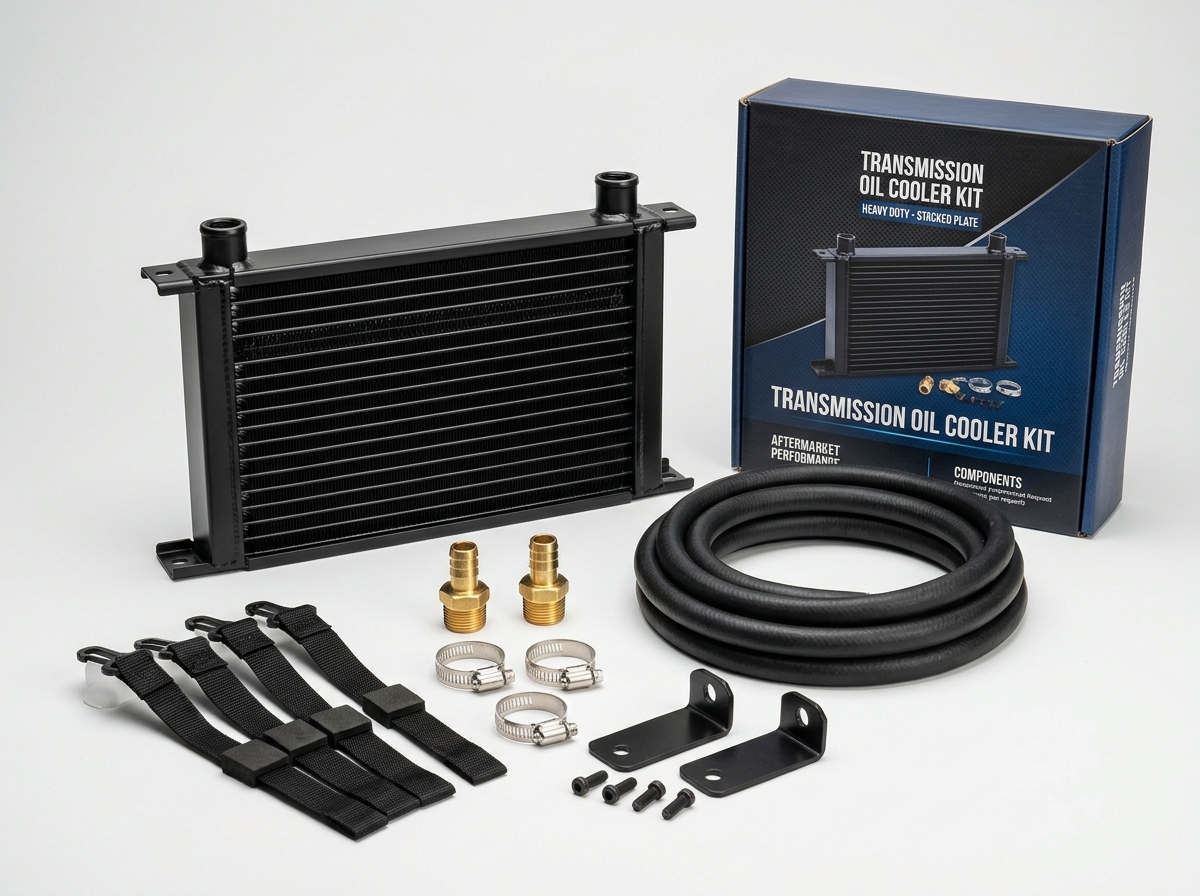
Hayden Automotive Heavy-Duty Rapid-Cool Transmission Oil Cooler Kit
Prevents Nissan CVT Fluid Boiling & Limp Mode • Stacked-Plate Aluminum
- ✓Patented Stacked-Plate Design: Delivers 15x more efficient heat rejection than standard tube-and-fin coolers.
- ✓Eliminates CVT Thermal Limp Mode: Keeps transmission fluid below 180°F to prevent protective 45 mph limp speed.
- ✓Complete Installation Hardware: Includes high-pressure transmission line, mounting brackets, and brass fittings.

BlueDriver Bluetooth Pro OBD-II Diagnostic Scan Tool
Technician Recommended for Enhanced OEM PIDs
- ✓Enhanced Diagnostics: Reads proprietary manufacturer ABS, Airbag, transmission, and body codes.
- ✓Real-Time Telemetry: Graph live oil pressure, coolant temp (ECT), and cam phaser angular deviation.
- ✓Wireless Bluetooth: Full iOS & Android integration with zero monthly subscription fees.
5. The Permanent Mechanical Fix: Sonnax Valve & Auxiliary Cooler Blueprint
If your Nissan CVT has not yet snapped its steel belt or deeply scored its pulley sheaves, the platform can be permanently bulletproofed without spending $6,000 at a dealership. Master transmission rebuilders execute a proven 3-phase remediation protocol:
Step 1: Oil Pump Remanufacturing with Sonnax Oversized Flow Control Valve
Rather than replacing the failed oil pump with another defective OEM pump that will wear out again in 50,000 miles, transmission specialists remove the pump and ream the bore using precision tooling. They install the Sonnax Oversized Flow Control Valve Kit (Part Number 33510N-02 or 33510N-01). The Sonnax valve is manufactured from hard-coat anodized aluminum that resists wear, features annular grooves to prevent side-loading wear, and utilizes an upgraded calibrated spring to maintain exact hydraulic line pressure across all operating temperatures.
Step 2: External Stacked-Plate Auxiliary Oil Cooler Retrofit
The single most important reliability modification for any Nissan CVT is eliminating high-temperature thermal breakdown. Discard the restrictive OEM in-radiator heat exchanger loop. Install a heavy-duty stacked-plate external transmission oil cooler (minimum 18,000 to 24,000 GVW rating) mounted directly in front of the vehicle's air conditioning condenser. By keeping transmission fluid temperatures between 160°F and 180°F even in severe summer traffic, the fluid retains its full hydrodynamic film strength and the TCM never enters protective limp mode.
Step 3: Dual-Filter Replacement and 30,000-Mile Flush Regimen
Every Jatco CVT contains two distinct fluid filtration elements that dealerships almost never replace during standard maintenance:
- The Lower Pan Sump Filter: A flat rectangular metal-and-mesh screen bolted to the bottom of the valve body that catches coarse debris.
- The Cartridge Paper Cooler Filter: A small cylindrical pleated paper filter located behind the round fluid cooler housing on the exterior of the transmission case. This paper filter traps microscopic 10-micron metal silt. When it clogs, fluid bypasses the cooler entirely, causing immediate overheating.
Replace both filters, thoroughly clean the two bottom pan magnets, and refill exclusively with fresh Nissan NS-3 (or NS-2) synthetic fluid every 30,000 miles (50,000 km).
Frequently Asked Questions (FAQ)
Did Nissan extend the warranty on CVT transmissions?
Yes. Following numerous nationwide class-action lawsuits (including Gann v. Nissan North America and Stringer v. Nissan), Nissan extended the factory powertrain warranty on millions of vehicles. Most settlements extended coverage to 7 years or 84,000 miles or 10 years or 120,000 miles (whichever comes first) for specific model years of the Rogue, Altima, Murano, Sentra, and Versa. If your vehicle is within this timeframe, contact your local Nissan dealership to verify VIN eligibility for 100% free transmission replacement.
Can I fix Nissan CVT shudder by just changing the transmission fluid?
If your vehicle is in Stage 1 or early Stage 2 (occasional light shudder with no permanent P17F0 code stored and clean pan magnets), performing a complete fluid flush with genuine Nissan NS-3 fluid and replacing both internal and external filters can restore traction-drive friction and resolve the shudder in approximately 40% of cases. However, if the pulley sheaves are already physically scored or the flow control valve is severely grooved, fresh fluid will only provide temporary relief for 1,000 to 3,000 miles.
What is the difference between Nissan CVT codes P17F0 and P17F1?
Diagnostic trouble code P17F1 (CVT Judder Detected) is an early warning inspection code indicating that the TCM detected momentary speed differentials between the primary and secondary pulleys. Under Nissan service bulletin NTB15-084, P17F1 allows the dealer to perform a software reflash, inspect the belt, or replace only the valve body sub-assembly. In contrast, P07F0 / P17F0 (CVT Judder - Component Replacement Required) indicates severe, permanent slippage. When P17F0 is logged, Nissan factory service guidelines strictly prohibit valve body replacement and mandate complete replacement of the entire transmission assembly.
Researching this vehicle or comparing used inventory?
Always cross-reference factory service bulletins, verify warranty coverage, and compare dealer financing rates or insurance quotes before purchasing.
Reader Feedback
Was this technical guide helpful?
Your verification vote informs our ongoing automotive research schedule.