
GM 8L90 & 8L45 Transmission Shudder: TSB 18-NA-355 Flush, Torque Converter Glazing & Complete Diagnostic Guide
Automotive Research, ASE Master Technicians & Fact-Checking
Direct Technical Summary
Diagnose and permanently eliminate the notorious 8L90 & 8L45 8-speed transmission shudder in Chevrolet Silverado, GMC Sierra, Tahoe, Yukon, Corvette, and Camaro. Complete breakdown of GM TSB 18-NA-355, Mobil 1 Synthetic LV ATF HP fluid flush, torque converter clutch glazing telemetry, and thermal bypass valve upgrades.
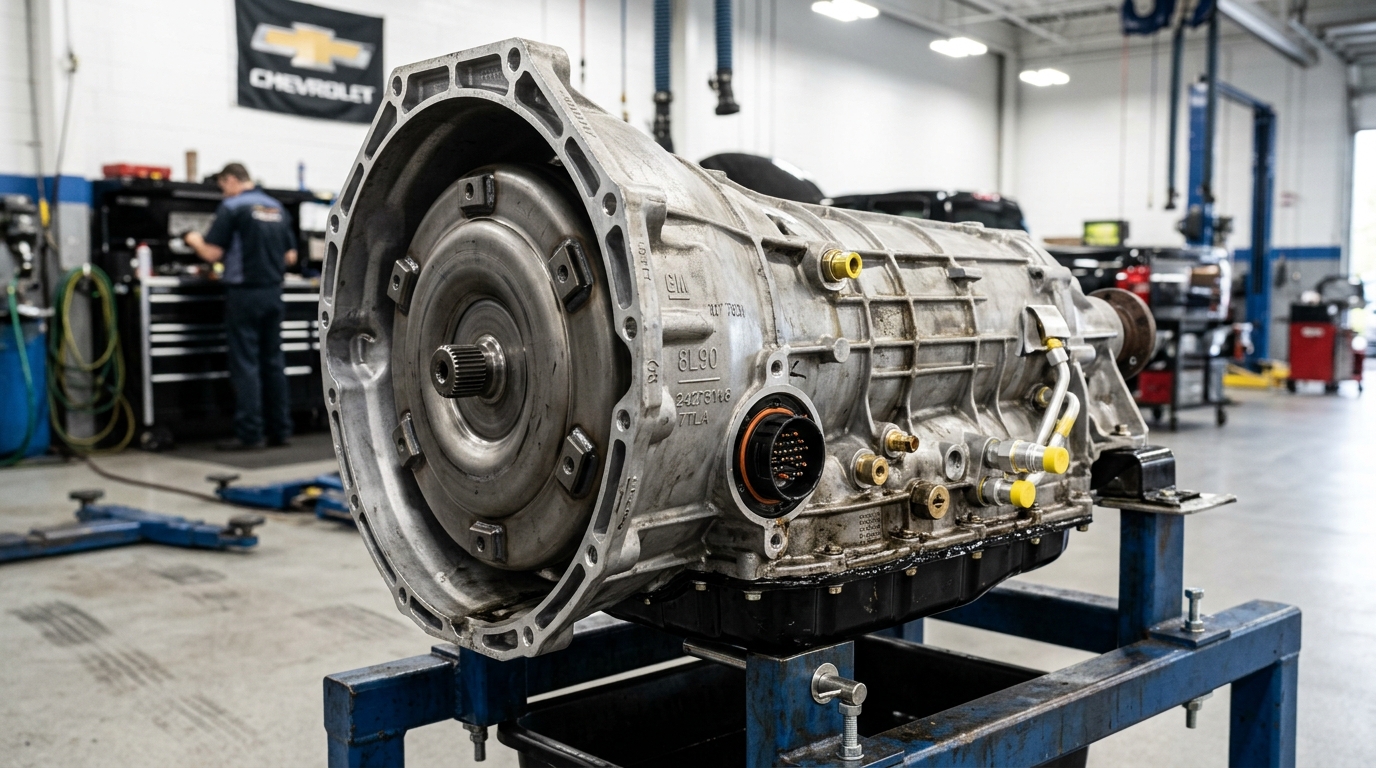
Between the 2015 and 2020 model years, General Motors installed millions of Hydra-Matic 8L90 and 8L45 eight-speed automatic transmissions across its flagship vehicle lines—including the Chevrolet Silverado 1500, GMC Sierra 1500, Tahoe, Suburban, Yukon, Cadillac Escalade, Chevrolet Corvette (C7), and Chevrolet Camaro. Engineered with four planetary gearsets and five shift clutches to optimize fuel economy and acceleration, these transmissions became infamous for a severe, unsettling drivability defect widely known as the "GM 8-Speed Transmission Shudder."
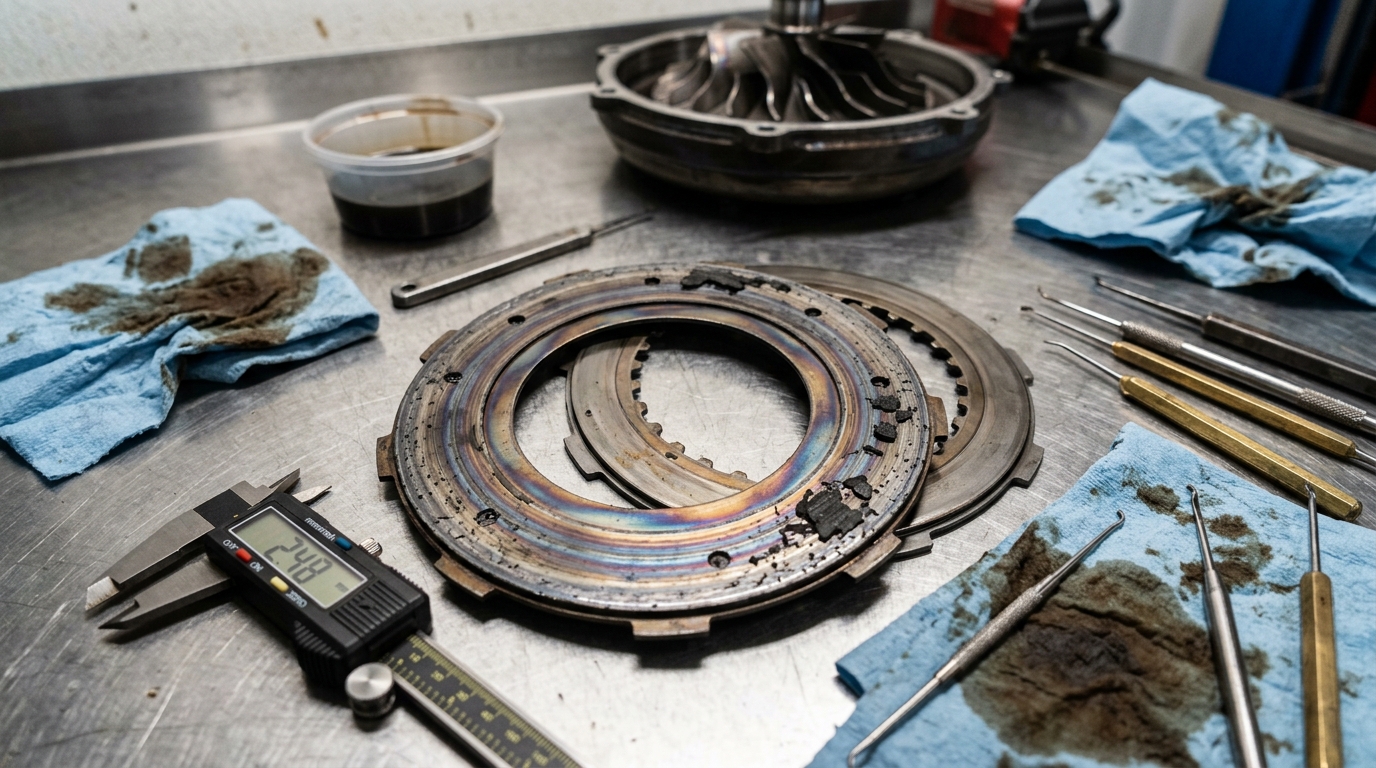
Drivers universally describe the sensation as driving over rough highway rumble strips or an aggressive washboard road between 25 and 60 mph under light throttle or when cruising up slight highway inclines. The vehicle's entire cabin vibrates violently for two to three seconds, frequently cycling on and off. What many owners initially misdiagnose as an out-of-balance driveshaft, bent wheel, or engine misfire is actually the Torque Converter Clutch (TCC) slipping and chattering uncontrollably against the converter front cover due to friction material moisture absorption and fluid breakdown.
After five years of class-action litigation, multiple superseded Technical Service Bulletins, and hundreds of thousands of dealership visits, General Motors released the definitive service procedure: TSB 18-NA-355. Based on official GM service engineering documentation, SAE drivetrain friction studies, and ASE Master Technician field teardowns, AutoZonic provides the authoritative technical dossier for diagnosing, flushing, and permanently fixing the GM 8L90 and 8L45 transmission shudder.
Quick Workshop Diagnostic: GM 8L90 Shudder at a Glance
- Affected Transmissions: GM Hydra-Matic
8L90(RPO M5U / M5X) and8L45(RPO M5T / M5N). - Affected Model Years: 2015–2019 Chevrolet Silverado / GMC Sierra 1500; 2015–2020 Tahoe, Suburban, Yukon, Escalade; 2015–2019 Corvette C7; 2016–2019 Camaro; 2016–2019 Cadillac ATS, CTS, CT6.
- Primary Root Cause: Factory factory-fill Dexron-HP transmission fluid was hygroscopic (water-attracting). Moisture absorption altered the dynamic coefficient of friction (\(\mu\)), causing negative friction-velocity slope (\(d\mu/dv < 0\)) and stick-slip vibration across the torque converter clutch friction lining.
- Official GM Remediation Bulletin: TSB 18-NA-355 (Replaces prior bulletins 16-NA-175 and 17-NA-287). Mandates a 20-to-24 quart fluid exchange using updated Mobil 1 Synthetic LV ATF HP (Blue Label).
- Mandatory Fluid Part Number: Mobil 1 Synthetic LV ATF HP — GM Part
19417577(US Quart) or19417904(Canadian Litre). Look for the dark blue front label; never use legacy black-label Dexron-HP. - Secondary Hardware Upgrade: Upgraded 70°C (158°F) Transmission Oil Cooler Thermal Bypass Valve (GM Part
86774933/85585333) to prevent elevated fluid operating temperatures.
1. The Mechanical & Chemical Root Cause: Why Does the 8L90 Shudder?
To meet increasingly stringent federal CAFE fuel economy standards, GM transmission engineers designed the 8L90 torque converter clutch to operate with continuous, micro-controlled slip. Rather than keeping the clutch fully unlocked or completely locked, the Transmission Control Module (TCM) commands a calibrated 5 to 20 RPM slip rate during light-load cruising. This continuous slip absorbs natural four-cylinder torsional engine pulses generated by Active Fuel Management (AFM / DFM) cylinder deactivation without transmitting harsh vibrations to the cabin.
However, this strategy relies on an exact friction coefficient between the carbon-metallic clutch material and the converter housing. The original factory-fill fluid—early formulation Dexron-HP (black label)—had a high affinity for ambient moisture. Over 10,000 to 30,000 miles of thermal cycling, water molecules penetrated through the transmission casing vent tube and accumulated in the fluid.
When moisture contaminated the fluid, the friction characteristic inverted from a positive slope (smooth engagement) to a negative slope (as sliding velocity decreases, friction spikes). This created an aggressive stick-slip mechanical oscillation. The clutch disc rapidly grabs, slips, grabs, and slips at a frequency of 15 to 25 Hz. This high-frequency mechanical shudder resonates through the planetary gearsets, aluminum transmission case, driveshaft, and rear differential, shaking the entire vehicle cabin like driving over rumble strips.
2. Live Telemetry Protocols: Distinguishing Shudder from Misfires & Driveshaft Runout
Because torque converter shudder manifests at 25 to 60 mph under slight load, non-specialist technicians often mistake it for a secondary ignition misfire, torque-split transfer case shudder, or warped driveshaft runout. Master technicians use a specific live-data PID logging procedure to isolate the transmission:
| Live Data Telemetry Parameter | Normal 8L90 Operating Baseline | Active TCC Shudder Condition (TSB 18-NA-355) |
|---|---|---|
TCC Slip Speed (PID: TCCSLIP) |
Stable variance between +2 to +15 RPM during steady-state light throttle cruise. | Wild, rapid oscillations fluctuating between -50 RPM and +150 RPM (delta > 80 RPM within milliseconds). |
| TCC Commanded Duty Cycle | Smooth PWM ramping between 40% and 85% without sudden duty cycle spikes. | TCM rapidly dithers pressure solenoid between 20% and 95% trying to arrest runaway slip speed. |
| Transmission Fluid Temperature (TFT) | 150°F to 180°F (65°C to 82°C) with updated 70°C thermal bypass valve. | Often exceeds 195°F–215°F on factory 90°C thermal valves, accelerating chemical additive shear. |
| PicoScope Driveline Vibration Frequency | T1/P1 tire and propshaft harmonics below 0.05G acceleration amplitude. | Distinct 15 Hz to 25 Hz peak spike aligning perfectly with torque converter slip speed cycles. |
⚠️ Workshop Diagnostic Trick: The Tap-Test Verification
To confirm TCC shudder without a scan tool while road testing: Maintain steady 40–50 mph speed where the vibration is actively shaking the cabin. With your right foot holding steady throttle, use your left foot to very gently tap the brake pedal just enough to illuminate the brake lights without slowing the car. This sends an electrical signal to the TCM to immediately disengage the torque converter clutch (0% duty cycle). If the rumble strip vibration vanishes instantaneously the exact microsecond the brake pedal is tapped, the issue is 100% torque converter clutch shudder and NOT tires, u-joints, or engine misfires.
3. The Definitive Fix: GM TSB 18-NA-355 Triple-Flush Procedure
In mid-2019, General Motors collaborated with ExxonMobil to engineer an entirely new hydrocarbon formulation: Mobil 1 Synthetic LV ATF HP, easily identified by its distinctive Blue Front Label. Unlike the hygroscopic factory fluid, this revised formulation exhibits exceptional thermal shear stability, virtually zero moisture affinity, and a permanent positive friction-velocity gradient (\(d\mu/dv > 0\)) that completely stops clutch chatter.
Step-by-Step TSB 18-NA-355 Protocol
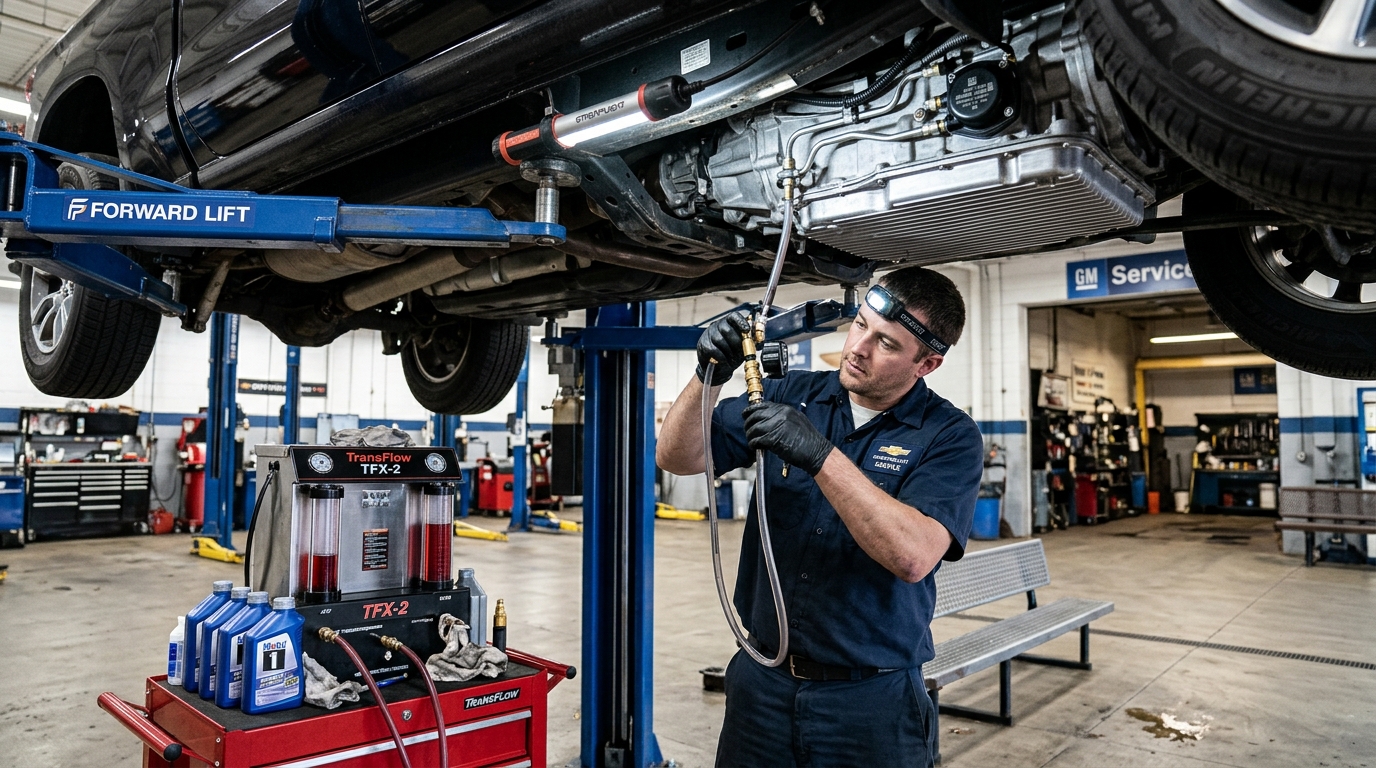
- First Drain & Pan Drop: Hoist vehicle, remove the 8L90 transmission oil pan (drain plug or drop pan), discard the old fluid, clean the pan bottom and dual ceramic magnets, and install a brand-new transmission filter (GM Part
24274402for 8L90). Reinstall pan with new gasket. - Initial Fill & Warm-up: Pump approximately 7.5 to 8.0 quarts of fresh Mobil 1 Synthetic LV ATF HP (Blue Label) into the side fill plug. Start the engine and cycle through PRNDL ranges with foot on the brake, allowing fluid temperature to reach 100°F (38°C).
- TransFlow Machine Cooler Line Exchange (or Manual Flush): Connect fluid exchange equipment (DT-45096 TransFlow or specialized cooler line adapters) into the transmission cooler circuit. Flush an additional 8.0 to 10.0 quarts of fresh fluid while idling, circulating clean fluid through the torque converter, valve body, and external cooling circuit until the discharged fluid runs crystal clear.
- Final Level Calibration at Exact Temperature: Reinstall all cooler lines. Run engine until transmission fluid temperature reaches precisely 95°F to 113°F (35°C to 45°C) on the scan tool. Remove the check plug on the pan bottom. Fluid should run out in a thin pencil-sized stream before turning into a steady drip. Torque check plug to 9 N·m (80 lb-in).
- The 200-Mile Adaption Drive Cycle: The new fluid chemistry takes approximately 100 to 200 miles of mixed driving to wash out old fluid deposits from the pores of the clutch paper and re-establish the optimal boundary lubrication layer. In over 85% of cases, the shudder completely dissipates within this break-in period.
⚠️ Workshop Critical Warning: Black Label vs. Blue Label Fluid
Ensure the bottles of fluid installed have the Dark Blue Label stating "Mobil 1 Synthetic LV ATF HP" with GM Part Number 19417577. Several big-box auto parts stores and quick-lube shops still stock leftover old inventory of the discontinued "Black Label" Dexron-HP (GM Part 19300536). Installing Black Label fluid will reintroduce the exact hygroscopic chemical defect that causes the shudder in the first place.
Eliminating torque converter clutch cycling and capturing real-time TCC slip telemetry requires targeted diagnostic hardware and active cylinder deactivation management:
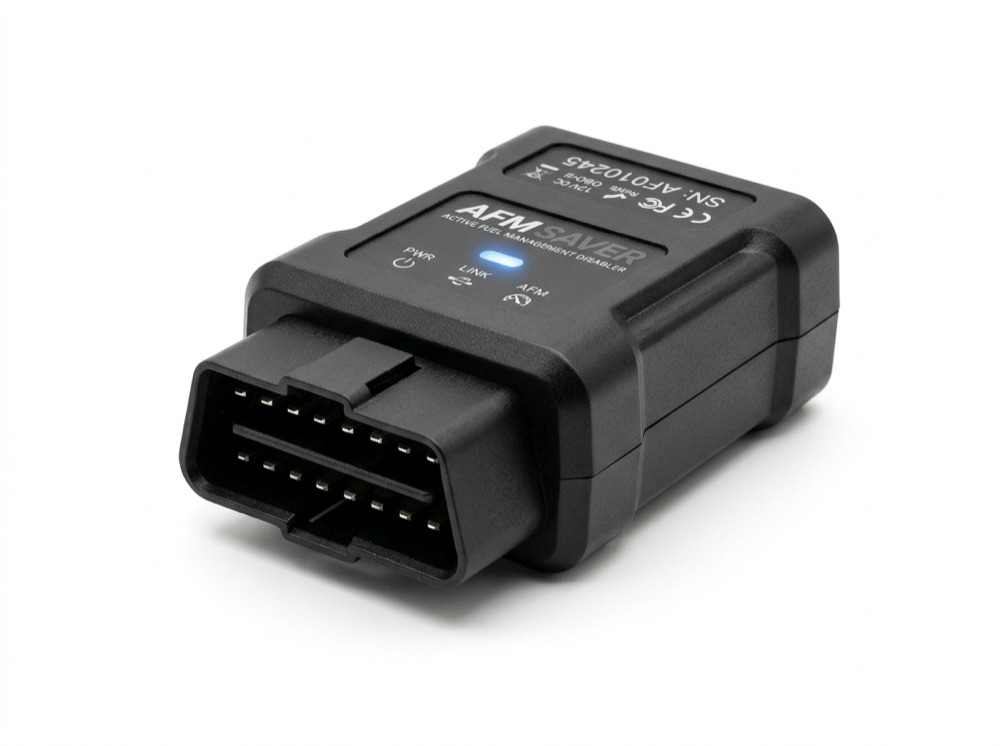
Plug-and-Play V8 Active Cylinder Deactivation Disabler
Eliminates AFM / MDS 4-Cylinder Oil Starvation Cycles
- ✓Full-Time V8 Operation: Prevents PCM from commanding 4-cylinder deactivation mode.
- ✓Constant Oil Pressure: Delivers uninterrupted full-pressure lubrication to all 16 lifter rollers.
- ✓100% Reversible: Connects directly to OBD-II port; leaves zero footprint in factory ECM memory.

BlueDriver Bluetooth Pro OBD-II Diagnostic Scan Tool
Technician Recommended for Enhanced OEM PIDs
- ✓Enhanced Diagnostics: Reads proprietary manufacturer ABS, Airbag, transmission, and body codes.
- ✓Real-Time Telemetry: Graph live oil pressure, coolant temp (ECT), and cam phaser angular deviation.
- ✓Wireless Bluetooth: Full iOS & Android integration with zero monthly subscription fees.
4. Secondary Essential Upgrade: The 70°C Thermal Bypass Valve
From the factory, 2015–2018 GM trucks were equipped with a transmission oil cooler thermal bypass valve calibrated to 90°C (194°F). This valve prevented fluid from flowing to the auxiliary front cooler until transmission sump temperatures exceeded 194°F. In stop-and-go driving, towing, or hot climates, fluid temperatures routinely hovered between 210°F and 235°F. Sustained extreme heat accelerates fluid oxidation, breaks down friction modifier additives, and cooks the torque converter clutch.
In 2021, GM released an updated cold-weather/towing thermal bypass valve assembly (GM Part 86774933 for 8L90 trucks, superseding 85585333 and 84402924). This revised valve opens at 70°C (158°F), dropping average steady-state transmission fluid temperatures by 30°F to 40°F. Operating the 8L90 at 160°F–175°F drastically extends the life of the new Mobil 1 blue-label fluid and prevents future TCC glazing.
5. When Flushing Isn't Enough: Torque Converter Replacement Thresholds
If an 8L90 or 8L45 transmission was driven for more than 15,000 to 20,000 miles while actively shuddering, the repeated metal-to-friction slip cycles cause irreversible physical damage: the carbon clutch lining becomes heat-glazed, compressed, or completely stripped down to bare steel. In these severe cases, new fluid cannot restore the damaged friction surface, and the shudder will persist even after completing TSB 18-NA-355.
If the vehicle continues to vibrate after 200 miles on the new blue-label fluid, the torque converter must be replaced. GM has released updated remanufactured torque converters (GM Part 24293998 for 5.3L / 6.2L 8L90 applications) featuring revised internal clutch friction compounds. Furthermore, installing an OBD-II Active Fuel Management Disabler prevents the engine from dropping into 4-cylinder mode, eliminating the torsional crank harmonics that trigger TCC slip in the first place.
Summary & Maintenance Blueprint
The dreaded GM 8-speed transmission shudder is not an inevitable death sentence for your gearbox. By following the verified engineering protocols established in GM TSB 18-NA-355:
- Perform the Brake-Tap diagnostic test to confirm the vibration originates from the Torque Converter Clutch rather than mechanical driveline runout.
- Execute a complete 20-to-24 quart fluid exchange exclusively using Mobil 1 Synthetic LV ATF HP (Blue Label, Part 19417577) and a fresh OEM transmission filter.
- Replace the factory 90°C thermal bypass valve with the updated 70°C GM thermal bypass assembly (Part 86774933) to keep operating temperatures below 175°F.
- Allow 100 to 200 miles of regular driving for the friction modifier to embed into the converter lining. If vibration remains after 300 miles, replace the converter with the updated OEM unit.
Researching this vehicle or comparing used inventory?
Always cross-reference factory service bulletins, verify warranty coverage, and compare dealer financing rates or insurance quotes before purchasing.
Reader Feedback
Was this technical guide helpful?
Your verification vote informs our ongoing automotive research schedule.