
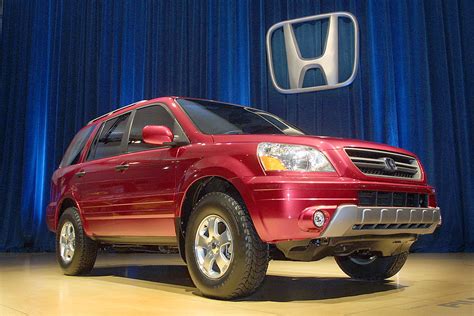
There is no single Honda Pilot “bad year” that applies to every vehicle. A better used-car strategy is to identify years with important recall or service-history questions, then check the exact VIN, powertrain and maintenance record. Certain 2003 Pilots deserve the most urgent safety attention because of the Takata Alpha air-bag recall, while 2016–2020 models warrant extra transmission-specific checks because Honda issued service bulletins for particular 6-speed and 9-speed configurations.
A well-maintained Pilot with completed campaigns and a clean inspection can be a better purchase than a supposedly “good year” with neglected maintenance, crash damage or unresolved recalls.
Honda Pilot years that deserve extra scrutiny
| Model year(s) | Why to look more closely | What to check |
|---|---|---|
| 2003 | Certain vehicles are included in NHTSA’s Takata Alpha air-bag “Do Not Drive” warning when the recall remains unrepaired | Run the VIN through the Honda/NHTSA recall lookup before driving or buying |
| 2003–2015 | Pilot model years appear in NHTSA’s broader Takata recall spotlight | Check the exact VIN and repair status |
| 2016–2017 with 6-speed A/T | Honda bulletin 17-014 covers torque-converter lock-up judder under certain conditions | Road-test for repeatable judder and verify applicable software/ATF service |
| Limited 2016–2017 with 9-speed A/T | Honda issued a warranty extension for an ATF warmer that could leak internally | Confirm VIN applicability and repair history |
| 2016–2019 Touring/Elite and certain 2020 Touring/Elite with 9-speed A/T | Honda bulletin 20-029 addresses intermittent harsh or jerky upshifts | Test steady acceleration cold and warm; verify update history |
| 2016–2020 with 6-speed A/T | Honda bulletin 23-073 addresses a transmission-temperature message under certain high-load conditions | Check service records, warning history and ATF maintenance |
These records are inspection priorities, not automatic “do not buy” labels. A service bulletin describes a condition that may occur on listed vehicles; it does not prove that every vehicle is affected.
Why 2003 deserves special attention
NHTSA includes certain 2003 Honda Pilots in its Takata Alpha air-bag Do Not Drive warning. If the relevant recall is still open, NHTSA says the vehicle should not be driven until the free repair is completed.
Always check the VIN rather than assuming every 2003 Pilot has the same recall status.
What about 2003–2015 Pilots?
NHTSA’s Takata spotlight includes Pilot model years from this period, but recall status is VIN-specific and many vehicles have already been repaired. On an older Pilot, also pay close attention to corrosion, maintenance records, timing-belt history where applicable, fluid service, tires, suspension, brakes and previous collision repairs.
2016–2020: identify the transmission before judging the year
Honda used different transmissions by trim and year, and the service history you should look for depends on which unit is fitted. Official bulletins cover 6-speed torque-converter judder, a limited 9-speed ATF-warmer warranty extension, 9-speed harsh-upshift software updates and a 6-speed high-temperature condition under certain high-load operation.
For the detailed breakdown, see Honda Pilot transmission problems: years and symptoms to check.
Is the 2021 Pilot a year to avoid?
There is no basis in the sources used here for treating every 2021 Pilot as a year to avoid. Judge the individual vehicle by VIN recall status, condition, service history and inspection results rather than a blanket model-year label.
Used Honda Pilot buying checklist
- Check the VIN for open recalls first.
- Identify the exact transmission. Concerns differ between 6-speed, 9-speed and newer 10-speed units.
- Review documented maintenance. Look for fluid service, timing-belt-related service where applicable, software updates and completed campaigns.
- Road-test the vehicle cold and hot. Watch for repeatable judder, harsh shifting, warning messages, overheating, steering/brake issues and abnormal noises.
- Inspect underneath. Age, corrosion, leaks and previous repairs matter greatly on older SUVs.
- Get an independent pre-purchase inspection.
Sources
- NHTSA — Takata Do Not Drive warning
- NHTSA — Takata recall spotlight
- American Honda Service Bulletin 17-014
- American Honda — 2016–17 Pilot ATF warmer warranty extension
- American Honda Service Bulletin 20-029
- American Honda Service Bulletin 23-073
- NHTSA — VIN recall lookup
Related Guides
Is a Honda Pilot Considered a Standard SUV? Why Classifications Differ
What Year Is the Largest Honda Pilot? 2026 Is Longest, but Cargo Is More Complicated
Honda Pilot Tongue Weight Limit: It Changes With Load
Does the Honda Pilot Have Blind-Spot Monitoring? It Depends on Year