
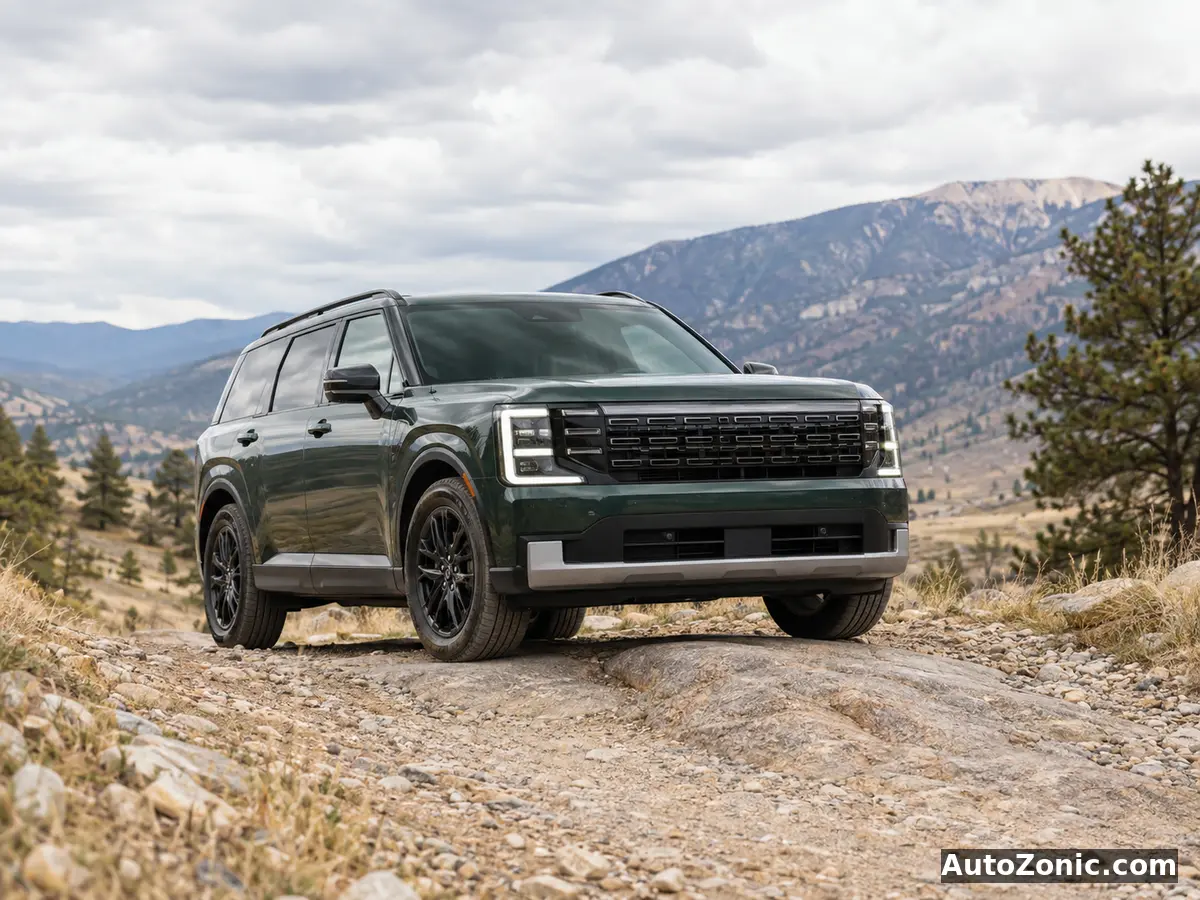
Hyundai Santa Fe ground clearance is 7.0 inches (178 mm) on most 2026 U.S.-market trims and 8.3 inches (211 mm) on the AWD-only Santa Fe XRT. The XRT therefore provides 1.3 inches (33 mm) more clearance than the standard Santa Fe.
Scope: This guide covers the 2026 Hyundai Santa Fe sold in the United States. Ground clearance can change by model year, market, tire size, suspension, load and vehicle condition, so verify the specifications for the exact vehicle you are buying.
2026 Hyundai Santa Fe ground clearance by trim
| 2026 Santa Fe configuration | Minimum ground clearance | Approximate metric value |
|---|---|---|
| SE, SEL, Limited and Calligraphy gas models | 7.0 in | 178 mm |
| Santa Fe Hybrid models | 7.0 in | 178 mm |
| Santa Fe XRT AWD | 8.3 in | 211 mm |
Figures are Hyundai’s published minimum ground-clearance specifications for U.S.-market 2026 vehicles. Metric values are rounded conversions.
Does all-wheel drive increase Santa Fe ground clearance?
Not by itself on the 2026 Santa Fe. Standard gas and hybrid configurations are listed at 7.0 inches, including vehicles equipped with all-wheel drive. The higher 8.3-inch figure belongs to the XRT package, which combines standard HTRAC all-wheel drive with all-terrain tires and its additional ride height.
This distinction matters when comparing listings. “AWD” does not automatically mean that a Santa Fe has XRT ground clearance. Confirm the trim, wheels, tires and factory specification rather than relying only on the drivetrain badge.
How much higher is the Santa Fe XRT?
The 2026 Santa Fe XRT has 1.3 inches more published ground clearance than the 7.0-inch standard vehicle. Hyundai also lists more favorable body-clearance angles for the XRT:
| Clearance measurement | Standard gas Santa Fe | Santa Fe XRT |
|---|---|---|
| Minimum ground clearance | 7.0 in | 8.3 in |
| Approach angle | 17.4° | 19.3° |
| Departure angle | 20.3° | 21.8° |
| Breakover angle | 17.0° | 19.1° |
Ground clearance measures the lowest specified point beneath the vehicle. Approach, departure and breakover angles describe how the body can pass over slopes and crests without contacting the surface. A higher number can help, but tires, traction, wheelbase, load and driver judgment remain important.
Is 7.0 inches enough for normal driving?
For paved roads, driveways, maintained gravel roads and ordinary winter use, 7.0 inches is a practical crossover-SUV figure. It provides more underbody space than a typical passenger car, but it does not turn the standard Santa Fe into a dedicated off-road vehicle.
Real clearance can be reduced by passengers, luggage, towing load, low tire pressure, worn suspension components or non-standard tires. Snow can also conceal curbs, rocks and hardened ice. The published figure should be treated as a vehicle specification, not as permission to drive over an object of the same height.
Who benefits from the XRT’s 8.3 inches?
The extra clearance is most useful for drivers who regularly encounter:
- rutted or uneven gravel access roads;
- steeper driveway transitions;
- moderate snow accumulation;
- campground and trailhead roads;
- small crests where breakover clearance matters.
The XRT also uses all-terrain tires, and Hyundai lists a 4,500-pound maximum towing capacity when properly equipped, compared with up to 3,500 pounds for the 2.5-liter turbo Santa Fe and 2,000 pounds for the hybrid. Towing capacity is separate from ground clearance and must be checked against the exact vehicle’s equipment and labels.
Does the hybrid have less ground clearance?
No difference is shown in Hyundai’s 2026 U.S. specification sheet: standard gas and hybrid Santa Fe models are both listed with 7.0 inches of minimum ground clearance. The hybrid’s battery placement does not produce a lower published clearance figure in this model year.
Why model year matters
The Santa Fe has changed size, platform and design across generations. Search results often combine specifications from unrelated model years, which can produce conflicting figures. The current 7.0- and 8.3-inch numbers should not be applied to every older Santa Fe.
When shopping used, match the specification to the vehicle’s model year, market and trim. Check the owner’s documentation and inspect the tires and suspension, because modifications or wear can make an individual vehicle differ from its original factory configuration.
Can you increase Santa Fe ground clearance?
Aftermarket suspension and tire changes may alter ride height, but they can also affect alignment, speedometer accuracy, braking, steering, driver-assistance calibration, tire clearance and warranty coverage. A modification that raises the body does not necessarily protect the lowest drivetrain or suspension component.
For most buyers who need more factory clearance, choosing the XRT is more predictable than modifying a standard Santa Fe. Ask a qualified Hyundai service facility about compatibility before changing suspension or wheel-and-tire dimensions.
Frequently asked questions
What is the ground clearance of a 2026 Hyundai Santa Fe?
Most 2026 Santa Fe trims have 7.0 inches of minimum ground clearance. The XRT has 8.3 inches.
What is the ground clearance of the Santa Fe XRT?
The 2026 Hyundai Santa Fe XRT is listed at 8.3 inches, or approximately 211 mm.
Does a Santa Fe AWD sit higher than a front-wheel-drive model?
AWD alone does not raise the published 2026 ground-clearance figure. The higher-clearance model is the XRT, which includes AWD and specific tires and chassis packaging.
Does the Santa Fe Hybrid have less ground clearance?
No. Hyundai lists the 2026 Santa Fe Hybrid at 7.0 inches, the same published minimum clearance as standard gas trims.
Is the Santa Fe XRT lifted?
Hyundai describes the XRT as having additional ground clearance. Its published 8.3-inch figure is 1.3 inches higher than the 7.0-inch standard Santa Fe.
Is 7 inches of ground clearance good for snow?
Seven inches can handle normal plowed-road winter use, but snow depth, ice, tire type and hidden obstacles matter. Ground clearance alone does not determine winter capability.
Is ground clearance measured with passengers inside?
Manufacturer specifications describe the vehicle’s published minimum clearance under defined conditions. Real clearance can decrease when the vehicle carries passengers, cargo or trailer tongue weight.
How this article was researched
We matched the 2026 model year and U.S. market, then checked Hyundai’s consumer specifications and official media specification sheet. We kept minimum ground clearance separate from body angles and towing capacity, and converted inches to millimetres using 25.4 mm per inch.
References
- Hyundai USA — 2026 Santa Fe features and specifications
- Hyundai USA — 2026 Santa Fe XRT trim information
- Hyundai News — 2026 Santa Fe specifications PDF
Continue your research
- Hyundai Santa Fe research and ownership guides
- AutoZonic research methodology
- Sources and fact-checking policy
About this article
- Byline
- AutoZonic Editorial Team
- First published
- July 21, 2023
- Last updated
- August 1, 2026
- Article type
- Model-year technical specification guide
- Primary question
- How much ground clearance each 2026 U.S.-market Hyundai Santa Fe configuration provides
- Research basis
- Hyundai USA consumer specifications, Hyundai XRT information and the official 2026 specification sheet
- Scope
- 2026 U.S.-market Santa Fe gas, hybrid and XRT configurations; figures should not be applied to other model years or markets
- Verification
- Trim figures, body angles, towing values and unit conversions were checked against the cited Hyundai sources on August 1, 2026
- Editorial standard
- Published minimum clearance is kept separate from real loaded clearance and off-road capability. See our Editorial Policy.
- Disclosure
- This revision was independently produced and not sponsored by Hyundai. AI-assisted tools may support drafting, but source selection, calculations and published claims were reviewed under AutoZonic’s editorial process. The featured image is an original editorial illustration, not a scale diagram. Report a correction.
Related Guides
Hyundai Santa Fe AWD Ground Clearance (2026)
Is the Honda Pilot a Midsize SUV? Yes—But Honda Uses a Different Label
How to Tell If a Hyundai Was Built in the U.S. or Korea
What Does Tiguan Mean? The Volkswagen Name Story