
RAM 1500 & Jeep 5.7L HEMI Lifter Tick: Camshaft Failure, MDS Roller Seizure & Complete Repair Guide
Automotive Research, ASE Master Technicians & Fact-Checking
Direct Technical Summary
Diagnose the notorious 5.7L HEMI engine tick. We dissect broken exhaust manifold studs vs. seized MDS needle roller lifters, cam lobe wiping, DTCs P0300 & P0305, oiling physics, and repair costs.
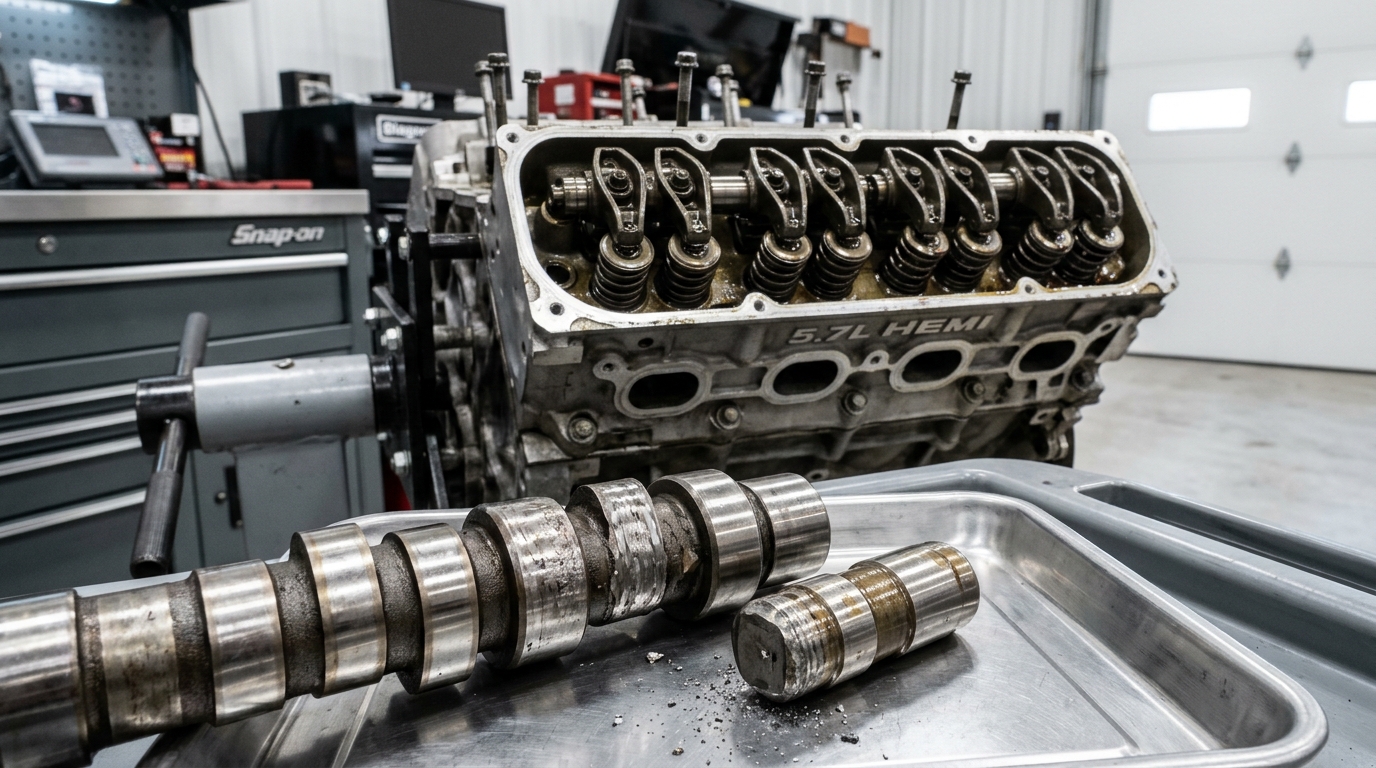
For two decades, the Chrysler / Stellantis 5.7-liter HEMI V8 has powered millions of RAM 1500 pickup trucks, Jeep Grand Cherokees, Dodge Chargers, Challengers, and Durangos, earning a revered reputation for linear pushrod torque and exhaust acoustic punch. Yet beneath this muscle-truck exterior lurks the single most documented, financially devastating, and hotly debated mechanical vulnerability in modern American V8 trucks: the dreaded "HEMI Tick"—a rhythmic tapping noise that frequently escalates into needle roller bearing seizure, ground-down camshaft lobes, and catastrophic cylinder misfire, demanding repair bills between $3,500 and $5,500.
Compounding owner confusion, the automotive internet routinely conflates two radically different failure modes under the generic umbrella term "HEMI Tick": a benign broken exhaust manifold bolt (a $400 external exhaust leak that disappears once the engine reaches operating temperature) and a lethal camshaft and lifter failure (an internal valvetrain destruction that worsens under thermal load and metal shavings into the oiling circuit). In this forensic technical dossier, the AutoZonic Research Desk synthesizes official Chrysler / Stellantis Star Cases (S1309000007), Technical Service Bulletins (TSB 09-002-18), ASE Master Engine Machinist teardowns, and fluid dynamics analysis to explain the precise mechanical anatomy of why HEMI lifters seize, how to differentiate manifold noise from cam wipe using acoustic telemetry, and the exact step-by-step repair options including full MDS deletes and Hellcat non-MDS lifter conversions.
Quick Workshop Diagnostic: 5.7L HEMI Tick at a Glance
- Affected Powertrains: 2009–2024 FCA / Stellantis 5.7L HEMI V8 (Eagle generation with VVT and Multi-Displacement System / MDS) in RAM 1500 (DS Classic & DT), Jeep Grand Cherokee (WK2), Dodge Durango (WD), Charger, and Challenger.
- Root Mechanism: Oil starvation and cavitation in lifter roller needle bearings during extended engine idling, leading to needle roller lockup, flat-spot friction, and accelerated grinding of induction-hardened camshaft lobes.
- Primary Diagnostic Trouble Codes (DTCs):
P0300(Random Misfire),P0305(Cylinder 5 Misfire),P0308(Cylinder 8 Misfire),P000B(Exhaust Camshaft Slow Response Bank 1). - Acoustic Cadence Rule: Exhaust manifold leaks cycle at engine RPM frequency on cold startup and quiet down as iron manifolds expand; valvetrain lifter ticks cycle at half engine RPM (camshaft speed), resonating directly through the aluminum valve cover with increasing temperature.
- Official Manufacturer Documentation: FCA Star Case S1309000007 (Cylinder Misfire at Idle / Camshaft Wear) & TSB 09-002-18.
1. Auditory Telemetry: Broken Manifold Stud vs. Internal Lifter Seizure
The single most critical diagnostic step for any RAM or Jeep owner is determining whether the audible tick emanates from the exterior exhaust flange or inside the engine crankcase. Mismistaking a sheared exhaust bolt for camshaft failure leads to thousands of dollars in unnecessary engine teardown, while ignoring a true valvetrain tick sends micro-shavings of hardened steel through the oil galleys, destroying crankshaft main journals.
| Acoustic Diagnostic Vector | Exhaust Manifold Leak ("False Tick") | Seized Lifter & Cam Wipe ("True Tick") |
|---|---|---|
| Sound Pitch & Timber | Hollow, ticking "puffing" hiss or high-frequency flutter like an air compressor leak. | Sharp, metallic "click-clack" or mechanical hammer strike against hardened steel. |
| Frequency Ratio | Fires once per exhaust pulse (exhaust valve open event). High cyclic frequency. | Rotates at camshaft speed (exact half-engine RPM). Noticeable pause between clicks. |
| Thermal Behavior | Loudest on cold engine startup. Fades or completely silences within 60–180 seconds as cast iron manifold thermally expands to seal gasket. | Persists or gets significantly louder as oil thins to 212°F (100°C) operating temperature. |
| Mechanic's Stethoscope Location | Loudest when probing rear cylinders 7 and 8 near wheel-well liner and manifold heat shield. | Loudest when placed directly on the top surface of the composite/aluminum valve cover above lifter bores. |
| Average Repair Expense | $350 – $700 (Manifold resurface, gasket, and extraction of snapped 10.9-grade studs). | $3,500 – $5,500 (Complete engine teardown, new camshaft, 16 lifters, timing set, and oil flush). |
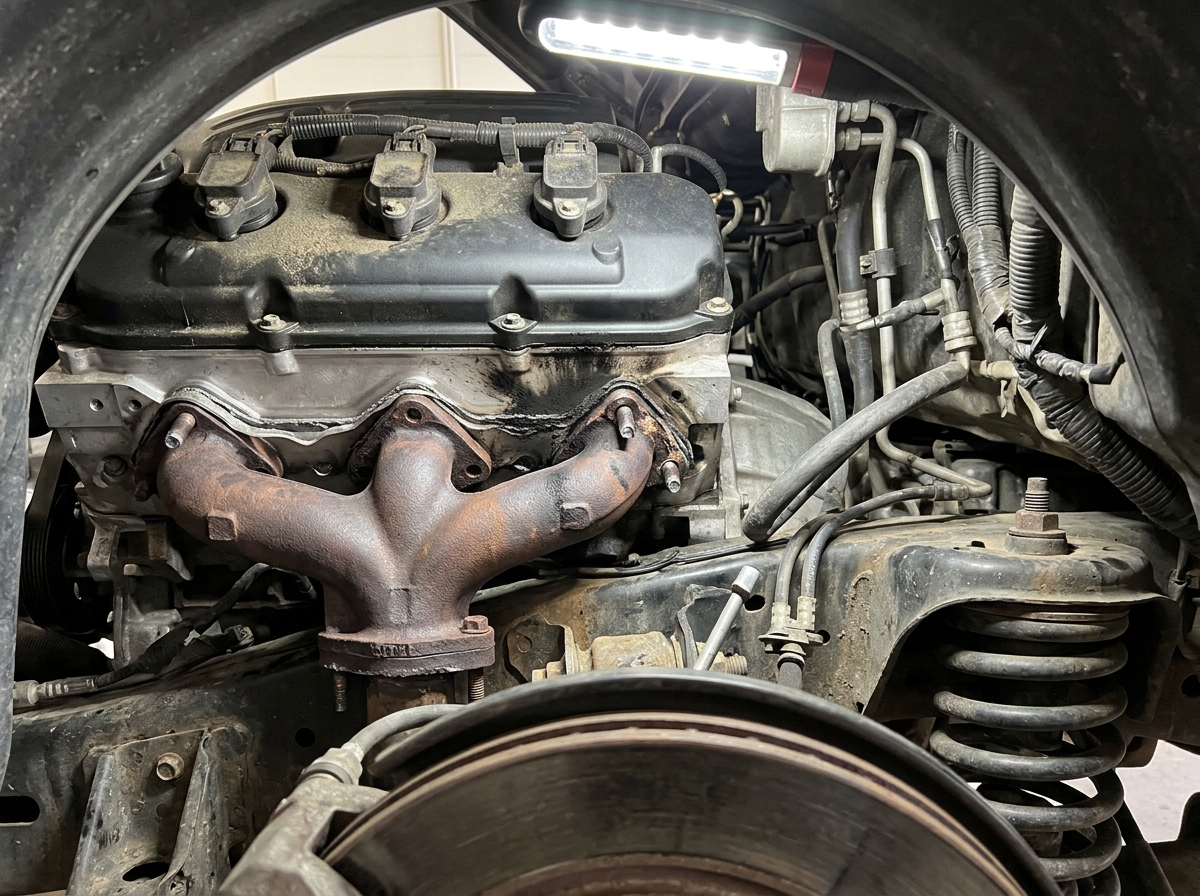
If your tick completely disappears after driving two miles, you are experiencing the ubiquitous broken manifold bolt issue, caused by differential thermal expansion between the cast iron exhaust manifold and the aluminum cylinder head, which shears the rear M8 flange studs (especially cylinders 7 and 8). If the metallic clatter remains audible with the radio off at hot idle, you are witnessing an active mechanical lifter failure.
2. Metallurgical & Fluid Dynamics Physics: Why 5.7L HEMI Lifters Seize
To understand why the 5.7L HEMI valvetrain fails while older pushrod architectures survive hundreds of thousands of miles, we must examine the specific geometry of the 2009+ "Eagle" revision. In this architecture, Stellantis engineers positioned the camshaft deep within the engine block and angled the lifter bores at an extreme 39-degree pushrod angle relative to the cylinder bore axis.
Unlike flat-tappet lifters that rotate continuously to distribute friction, the HEMI utilizes roller hydraulic lifters aligned in plastic retainer trays. The cylindrical roller at the base of each lifter spins on miniature needle bearings packed around a center pin. Three destructive metallurgical and hydrodynamic phenomena converge to destroy these rollers:
-
1. Extended Idling & Hydrodynamic Boundary Lubrication Collapse
The 5.7L HEMI utilizes a variable displacement oil pump. At low idle speeds (550–650 RPM), oil pressure drops to approximately 20–25 PSI. Because the HEMI camshaft sits low in the valley, oil supplied to the lifter roller needles is fed entirely via secondary splash and runoff draining down the pushrod valley rather than direct pressurized galley spray. During prolonged idling (especially in municipal police cruisers, fleet work trucks, and urban traffic), hydrodynamic fluid film pressure collapses, inducing boundary lubrication friction within the micro-needle bearings. -
2. Needle Bearing Skidding and Flat-Spot Formation
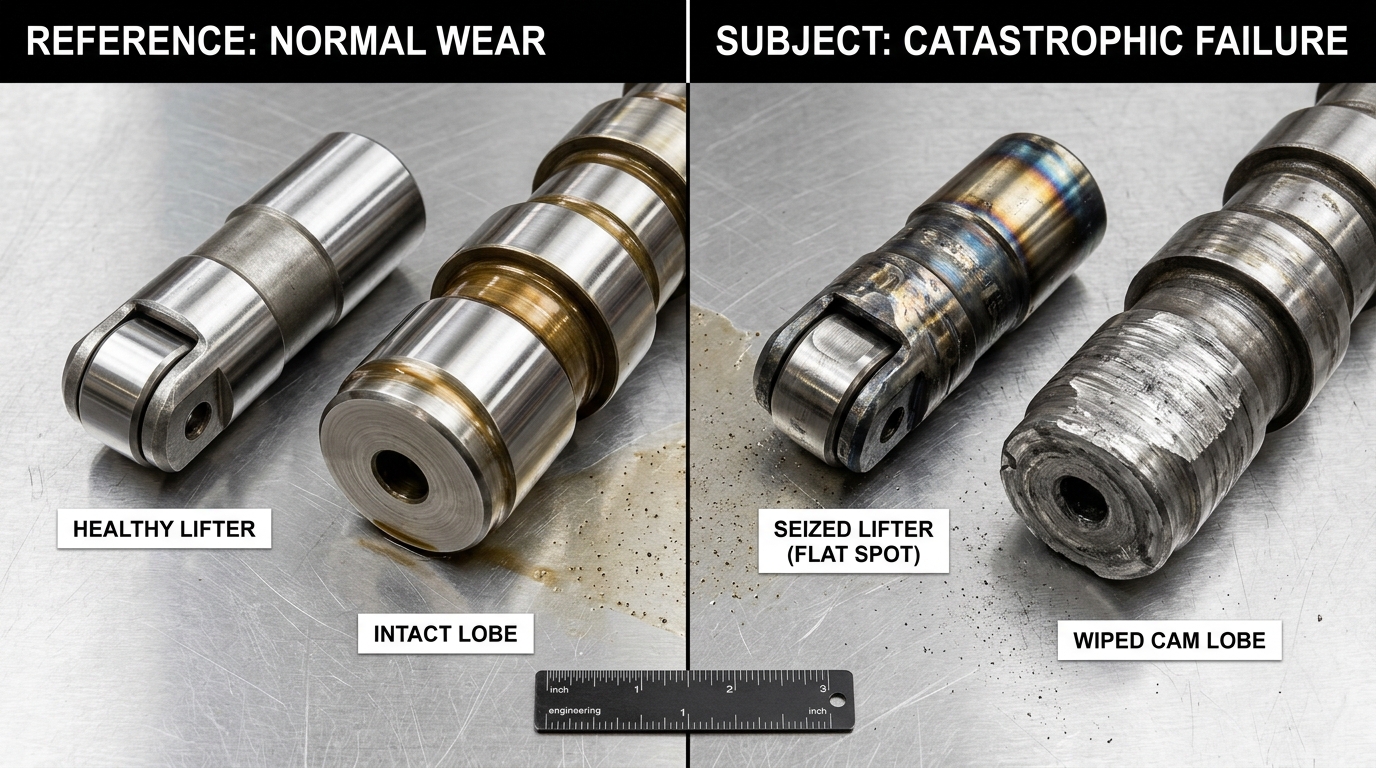
As frictional heat in the dry needle bearings spikes above 300°F (149°C), the needles gall and seize against the center pin. Once the roller stops spinning freely, it transitions from rolling contact to sliding contact across the camshaft lobe. Within 200 miles of driving, the hardened steel camshaft lobe grinds a pronounced flat spot into the stationary lifter roller. -
3. Induction Case-Hardening Breach & Catastrophic Lobe Destruction
The factory HEMI camshaft is constructed of chilled ductile cast iron with an induction surface-hardened layer approximately 0.040 to 0.060 inches deep. Once the seized, flat-spotted lifter roller acts as a stationary chisel, it tears through this surface-hardened skin. As soon as the softer core metal of the camshaft is exposed, wear accelerates exponentially, gouging away 1/8 to 1/4 inch of lobe lift within a few hundred miles. The valve barely opens, choking the cylinder of combustion air and triggering DTCP0300misfire codes.
3. Diagnostic Trouble Codes (DTCs) and Diagnostic Verification Protocol
When camshaft lobe degradation reaches advanced stages, the Powertrain Control Module (PCM) detects abnormal crankshaft rotational acceleration drops and sets specific error codes. Connecting a bi-directional scan tool reveals unmistakable telemetry signatures:
-
DTC P0300 / P0305 / P0308— Cylinder Misfire Detected (Particularly Cylinders 3, 5, 2, or 8)
While MDS activates on cylinders 1, 4, 6, and 7, empirical shop data proves that cam failure occurs with high frequency on cylinders 3 and 5 (non-MDS) as well as MDS cylinders. Because the flattened cam lobe prevents the intake or exhaust valve from achieving full valve lift, air-fuel mixture fails to combust properly, registering thousands of misfire counts primarily under low-RPM heavy load. -
Misfire Count Telemetry Behavior— Idle vs. High RPM Disparity
In a true mechanical cam wipe, real-time cylinder misfire counters skyrocket at idle (where lift duration is already minimal), but may partially stabilize at 2,500+ RPM as momentum forces inertia into the cylinder. If misfire counts do not change with new spark plugs or swapped ignition coils, mechanical valvetrain collapse is confirmed. -
Physical Valve Cover Pull Verification— Pushrod Dial Indicator Test
The definitive, non-invasive shop test requires removing the valve cover and spark plugs. Mount a magnetic dial indicator onto the rocker arm roller above the pushrod tip. Rotate the crankshaft by hand using a 24mm socket on the harmonic balancer bolt. Healthy intake and exhaust lobes deliver approximately 0.300 to 0.320 inches (7.62 to 8.13 mm) of pushrod lift. A wiped lobe measures less than 0.150 inches of lift, providing irrefutable physical confirmation without removing the cylinder heads.
4. Official Manufacturer Bulletins: Stellantis Star Case S1309000007
In response to tens of thousands of warranty claims across the RAM and Jeep dealer network, Stellantis technical engineering issued official internal defect instructions, notably Star Case S1309000007 (titled "Engine Misfire at Idle, Ticking Noise, Camshaft Lobe Wear") and supersession bulletins covering upgraded lifter part numbers.
In Star Case S1309000007, factory engineers instruct service technicians: "Inspect the affected cylinder lifters and camshaft lobes. If any lifter roller is found to be seized, scored, or flat-spotted, the camshaft and ALL 16 lifters along with plastic guide trays must be replaced as an assembly. Engine oil and filter must be drained, oil cooler flushed, and inspected for metallic contamination."
Furthermore, Mopar engineers introduced multiple lifter revisions (superseding older part numbers with revised part numbers 5038784AD for MDS lifters and 5038785AD for non-MDS lifters) featuring tighter needle bearing clearances and hardened pin alloys designed to resist brinelling.
5. Workshop Warnings & Field Notes from the Service Bay
A pervasive internet rumor suggests switching a 5.7L HEMI from the factory-specified 5W-20 (Chrysler MS-6395) to 15W-40 or heavy synthetic 5W-40 to "cushion" the lifter needle bearings. This is dangerous and counterproductive. The Multi-Displacement System relies on high-speed hydraulic solenoid valves that cycle oil passages in 40 milliseconds. Heavy-weight oil increases dynamic viscosity, delaying solenoid response, triggering DTC P3400 (MDS Performance), and actually reducing micro-needle bearing oil ingress during cold winter cold-starts. If you wish to run 5W-30, you must first electronically disable MDS.
Many performance shops advise replacing failing MDS lifters with durable Mopar Hellcat non-MDS lifters. While Hellcat lifters eliminate the collapsible locking pin failure mechanism, you cannot simply drop them into an MDS engine without tuning. If the factory PCM sends a 12V pulse to fire an MDS solenoid and the mechanical lifter fails to collapse, the PCM detects a torque imbalance, throws a permanent Check Engine Light, and locks the transmission into 3rd gear limp mode. A complete Hellcat lifter retrofit requires physical MDS block-off plugs and custom PCM flash calibration or an active MDS disabler module.
To monitor individual cylinder misfire telemetry, identify ticking lifter frequencies before cam destruction, and eliminate 4-cylinder MDS oil starvation cycles, Master Technicians recommend these field-tested tools:

BlueDriver Bluetooth Pro OBD-II Diagnostic Scan Tool
Reads real-time cylinder misfire counters on cylinders 1–8, oil temperature, and freeze-frame sensor data to verify whether your HEMI tick is throwing intermittent P0300 codes before the check engine light illuminates.
- ✓FCA Enhanced Diagnostics: Reads proprietary Chrysler/Dodge/RAM transmission and PCM codes.
- ✓Live Misfire Counter: Pinpoint exact ticking cylinder (Cyl 3 vs Cyl 5 vs Cyl 8).
- ✓Wireless Bluetooth: Seamless iOS & Android pairing with zero monthly subscriptions.
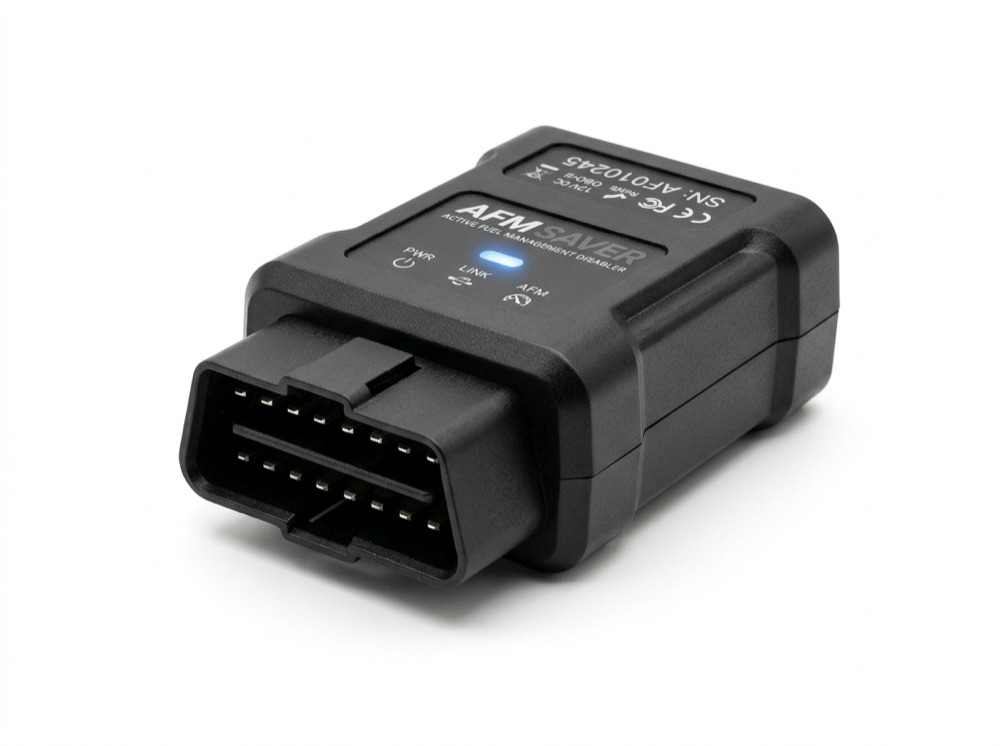
Plug-&-Play V8 Active Cylinder Deactivation Disabler
Prevents the PCM from commanding 4-cylinder deactivation mode, maintaining uninterrupted full-system oil pressure to all 16 lifters and eliminating constant mechanical pin cycling.
- ✓Stops 4-Cylinder Drop: Keeps the HEMI operating in smooth, full-time 8-cylinder mode.
- ✓100% Reversible: Plugs directly into the OBD-II port; leaves zero trace in factory ECM.
- ✓Instant Throttle Response: Eliminates exhaust drone, sluggish low-RPM shudder, and lag.
6. Repair Pathways: OEM Replacement vs. Hellcat Non-MDS Delete vs. Remanufactured Crate
If dial indicator or visual inspection confirms a wiped camshaft, you face three distinct financial and mechanical repair options:
OEM Stock Cam & Lifter Replacement
Install factory Mopar upgraded camshaft and 16 revised MDS/non-MDS lifters.
- Parts Cost: $1,100 – $1,400
- Labor: 18 – 22 hours ($2,400 – $3,200)
- Total: $3,500 – $4,600
- Pros: Retains 100% factory emissions compliance, no tuning required.
- Cons: Risk of recurrence after 80,000–100,000 miles if extended idle continues.
Full Hellcat Non-MDS Mechanical Delete
Install non-MDS performance camshaft, 16 Hellcat lifters, MDS delete plugs, and PCM custom calibration.
- Parts & Tuning: $1,600 – $2,000
- Labor: 20 – 24 hours
- Total: $4,200 – $5,400
- Pros: Permanently cures lifter collapse; unlocks 20–35 WHP; run durable 5W-30 synthetic oil.
- Cons: May not pass strict California CARB smog checks due to custom calibration.
Remanufactured Long Block Replacement
Replace the entire engine with a Jasper or Mopar remanufactured crate engine when bearing metal has contaminated the lower end.
- Engine Assembly: $4,800 – $5,800
- Labor & Fluids: $2,200 – $2,800
- Total: $7,000 – $8,600
- Pros: Includes 3-year / 100,000-mile nationwide warranty; new crankshaft journals and bearings.
- Cons: Highest upfront expenditure.
Frequently Asked Questions (FAQ)
What is the average mileage when the 5.7L HEMI tick starts?
Broken exhaust manifold bolts frequently occur between 45,000 and 70,000 miles due to thermal heat cycles. True camshaft and lifter roller failure typically strikes between 90,000 and 130,000 miles on privately owned trucks, but can appear as early as 35,000 miles on fleet vehicles with high engine idle-hour ratios (such as police pursuit Chargers and municipal RAM work trucks).
Can I keep driving my RAM 1500 with a ticking lifter?
No. Once a lifter roller has seized, every revolution of the engine grinds microscopic hardened metal shavings off the camshaft lobe. These ferrous particles bypass the oil filter bypass valve during cold starts and circulate into the crankshaft rod bearings, oil pump, and variable valve timing phaser. Continuing to drive will transform a $3,500 cam-and-lifter repair into an $8,000 total engine replacement.
Does using synthetic oil prevent the HEMI tick?
Using premium full-synthetic oil (meeting Chrysler MS-6395 standards, such as Pennzoil Ultra Platinum 5W-20) with a 5,000-mile change interval significantly reduces thermal varnishing and sludging inside the lifter oil passages. However, oil quality alone cannot completely overcome mechanical oil starvation caused by hundreds of hours of stationary idling at 600 RPM.
Researching this vehicle or comparing used inventory?
Always cross-reference factory service bulletins, verify warranty coverage, and compare dealer financing rates or insurance quotes before purchasing.
Reader Feedback
Was this technical guide helpful?
Your verification vote informs our ongoing automotive research schedule.