
Mazda 2.5T Cracked Cylinder Head & Hidden Coolant Leak: TSB 01-013/21, Inspection Steps & Free CSP11 Warranty Fix
Lead Automotive Systems Diagnostician
ASE Certified Master Automobile Technician (A1–A8, L1 Specialist)
Direct Technical Summary
Step-by-step diagnostic guide for the 2016-2021 Mazda CX-5, CX-9, and Mazda6 Skyactiv-G 2.5L Turbo cylinder head coolant leak (TSB 01-013/21). Learn how to inspect behind the exhaust manifold, verify affected VIN cutoffs, check for P111A overheat codes, and claim a free replacement under Mazda Customer Support Program CSP11.
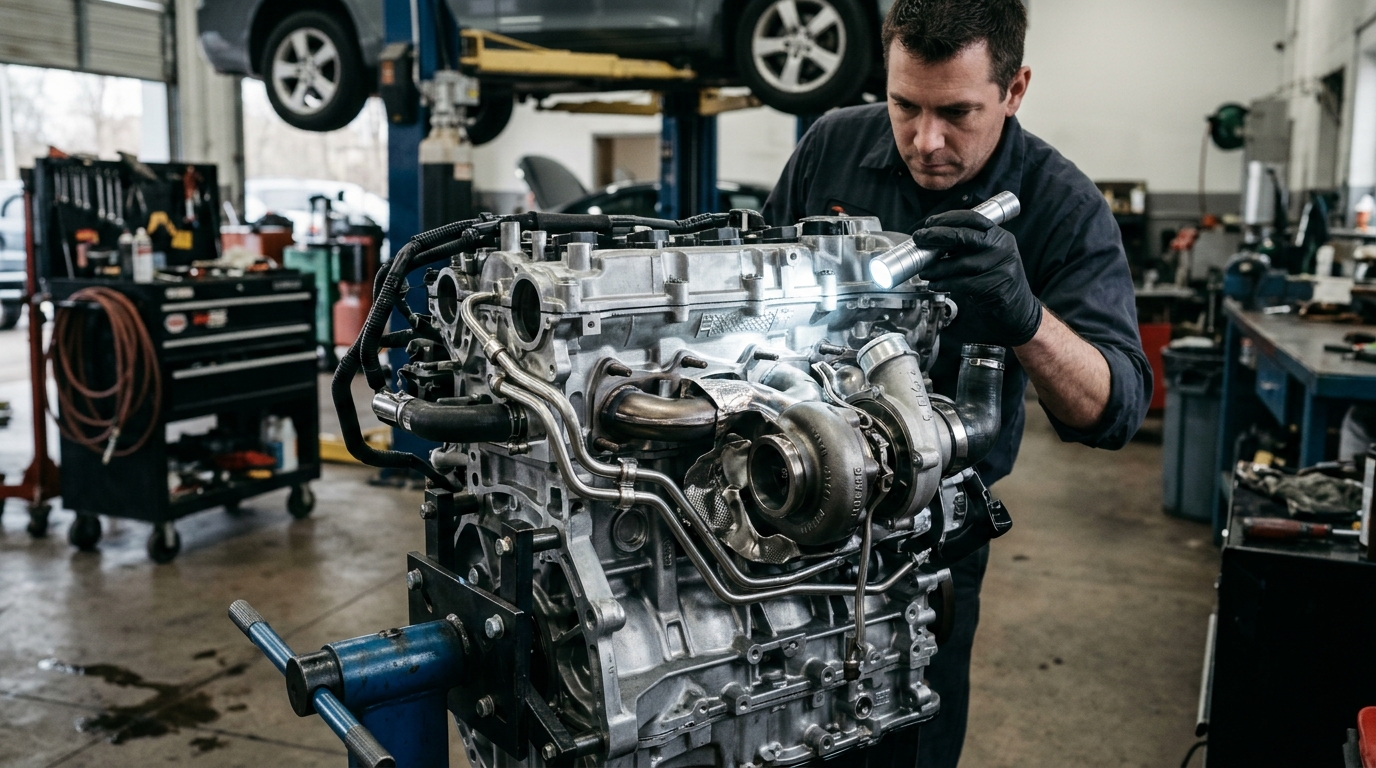
If your 2016–2020 Mazda CX-9, 2019–2020 CX-5, or 2018–2020 Mazda6 with the 2.5L Turbo (Skyactiv-G 2.5T) engine is slowly losing coolant from the overflow bottle with zero puddles on your driveway, do not pay an independent shop $4,500 out of pocket for a head gasket job. You are likely dealing with a known factory casting crack around the rear exhaust manifold stud covered by Mazda TSB 01-013/21 and eligible for a free replacement under Customer Support Program CSP11 (10 years / 120,000 miles).
This guide walks you through the exact 10-minute physical inspection we run on the lift, the exact VIN cutoff numbers to verify on your door jamb, and how to confirm whether coolant is leaking externally or contaminating your engine oil.
Workshop Warning: Why You Never See a Puddle Under the Car
The crack forms directly behind the scorching-hot exhaust manifold and turbocharger assembly on the firewall side of the cylinder head. When pressure builds at 16 PSI, hot FL22 coolant weeps out and immediately flashes to steam against the 1,200°F manifold before a single drop hits the garage floor. If you wait for a puddle or a dashboard overheat light, you have already lost enough coolant to warp the head.
Step 1: Verify Your Door Jamb VIN Against Mazda TSB 01-013/21
Before pulling any tools out, open your driver's door and read the last six digits of your VIN on the B-pillar certification label. Mazda revised the aluminum cylinder head casting and exhaust manifold gasket at the factory on June 9, 2020 (March 25, 2020 for the Mazda6). If your VIN falls below these exact serial numbers, your cylinder head is from the vulnerable casting batch:
| Vehicle Model (2.5T Engine) | Affected Model Years | Affected VIN Cutoff (Lower Than) | Factory Fix Production Date |
|---|---|---|---|
| Mazda CX-9 (2.5L Turbo) | 2016 – 2020 | JM3TC******422801 | June 9, 2020 |
| Mazda CX-5 (2.5L Turbo) | 2019 – 2020 | JM3KF******830243 | June 9, 2020 |
| Mazda6 (2.5L Turbo) | 2018 – 2020 | JM1GL******523967 | March 25, 2020 |
Note: Some early-build 2021 models carrying leftover 2020 inventory heads have occasionally shown the same symptom, though TSB 01-013/21 and CSP11 officially target the serial ranges listed above.
Step 2: Run the 10-Minute Rear-Head & Oil Filter Inspection
You do not need to pull the turbocharger off to confirm this leak. Follow this exact inspection sequence once the engine has cooled for at least 30 minutes:
- Check the Cold Coolant Reservoir: Pop the hood and inspect the white translucent expansion tank on the passenger side. If the level is below the
L(Low) mark even though you topped it off within the last 1,000 miles, pressurize the cooling system to 15–16 PSI using a standard radiator pressure tester. - Sniff the Firewall Area: Start the engine from cold and let it reach operating temperature for 5 minutes. Shut it off, open the hood, and smell near the back of the valve cover by the firewall. A sweet, syrupy ethylene-glycol smell is your first confirmation.
- Remove the Lower Splash Shield: Jack the front end up safely on jack stands. Use a 10mm socket and trim clip tool to drop the plastic undertray beneath the engine oil pan.
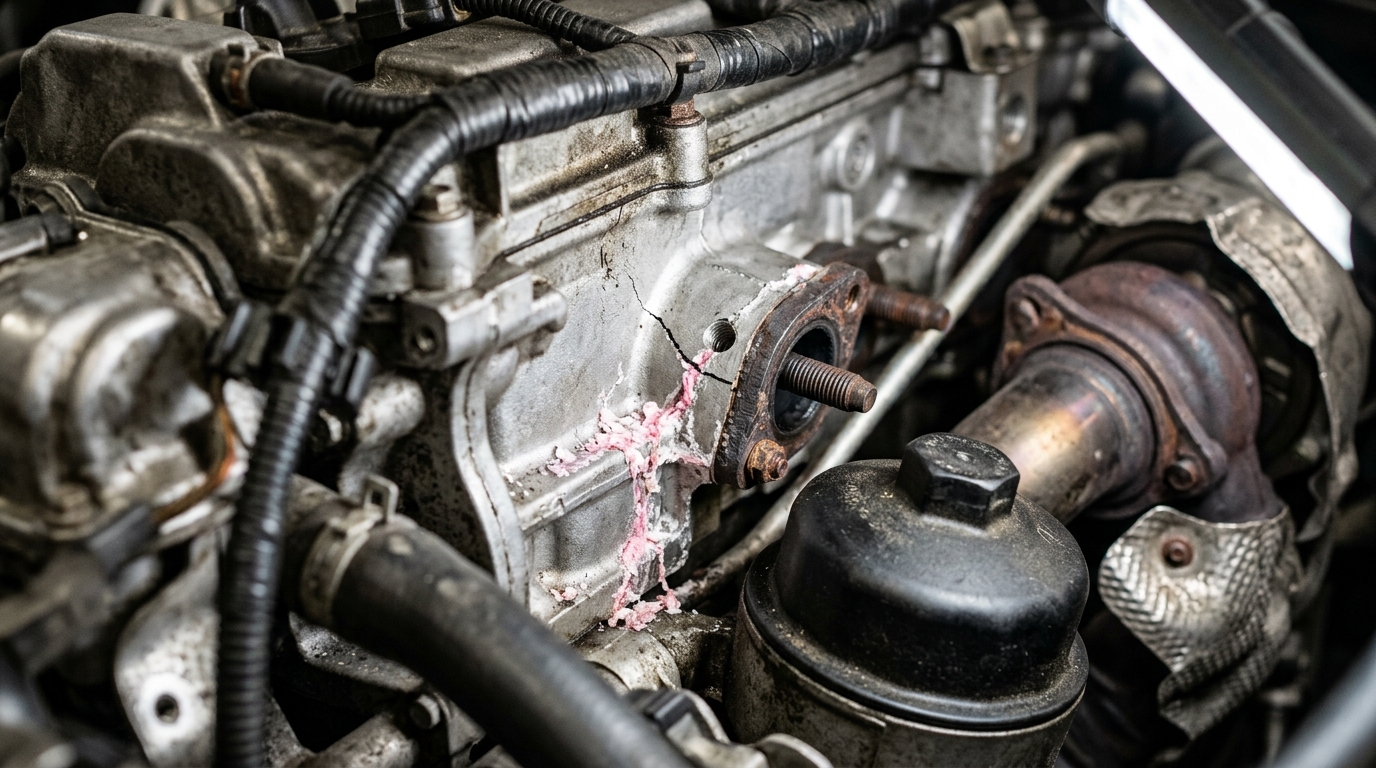
- Shine a Flashlight Above the Oil Filter Housing: Look straight up past the spin-on oil filter toward the rear exhaust manifold flange and cylinder head stud bosses. You are looking for dried, crusty white, pinkish-white, or dark green crystallized residue trailing downward onto the block webbing.
Step 3: Check the Oil Dipstick for Internal Coolant Contamination
Before driving the vehicle another mile, verify that the crack has not breached an internal oil return gallery:
- Pull the Oil Dipstick: Wipe it clean, reinsert it, and check the oil film under bright sunlight. Healthy oil looks amber or dark brown. If it looks like chocolate milk or frothy tan emulsion, coolant is mixing directly into your crankcase.
- Inspect the Oil Filler Cap: Unscrew the 5W-30 oil cap on top of the valve cover and look at the underside. Heavy peanut-butter sludge (beyond a tiny trace of winter condensation) indicates internal cross-contamination.
Critical Decision Rule: Drive vs. Tow
If the oil on your dipstick is clean and you only see external crust behind the manifold, top off the reservoir with genuine Mazda FL22 coolant (or a 50/50 silicate-free Asian green coolant) and drive straight to the dealer. If the oil is milky, do not start the engine—tow it immediately. Glycol destroys crankshaft rod bearings within minutes, turning a free cylinder head replacement into a $9,000 short-block teardown.
Why the Aluminum Head Cracks at the Exhaust Flange
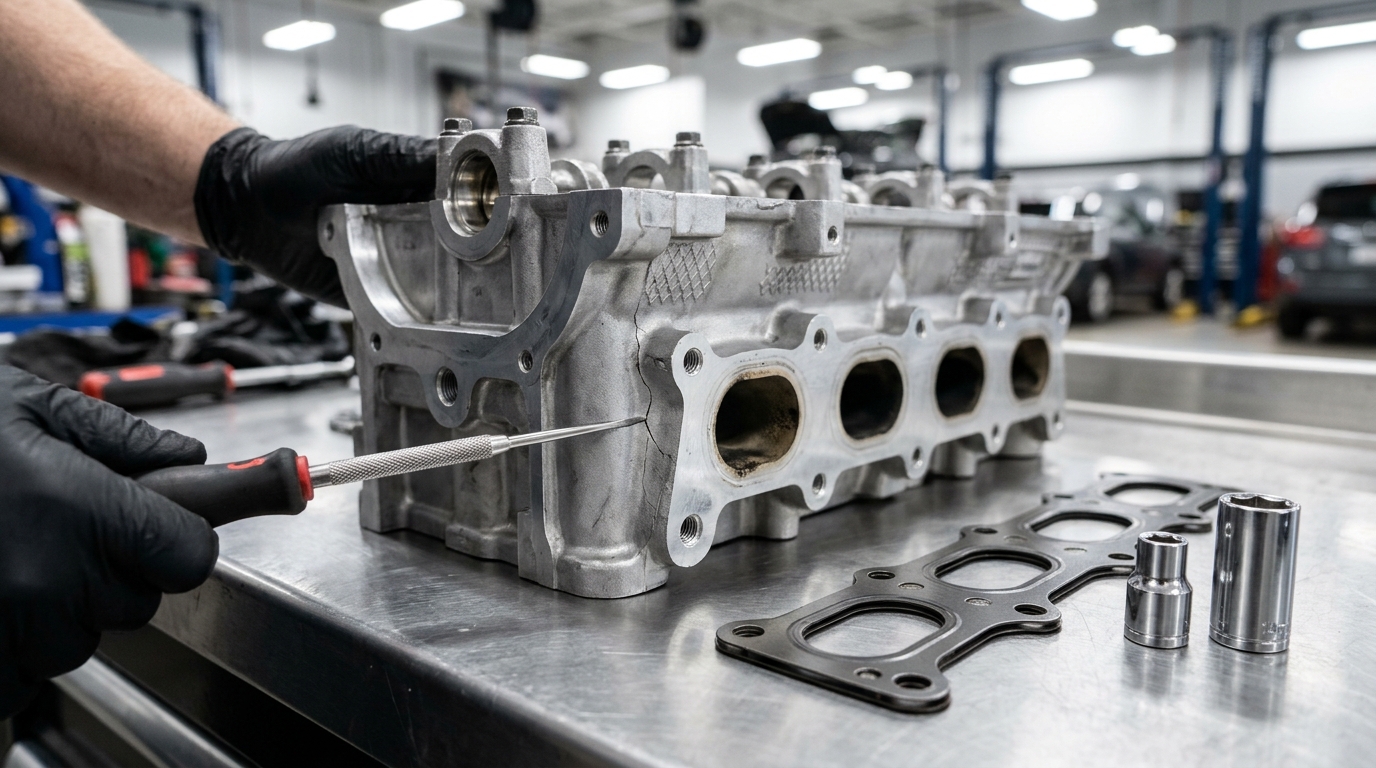
On the Skyactiv-G 2.5T, the exhaust manifold integrates closely with the cylinder head to feed the dynamic pressure turbocharger. Mazda's engineering investigation documented three combined mechanical stressors on pre-June 2020 castings:
- Residual Casting Stress: Early aluminum head castings retained localized stress around the outer exhaust manifold stud bosses near the coolant jacket wall.
- Thermal Expansion Cycles: Repeated boost pulls heat the exhaust flange above 1,200°F while the adjacent coolant jacket runs at 200°F, creating severe expansion shear across the thin aluminum bridge.
- Exhaust System Hang Weight: Suspension bumps and driveline torque twist transfer bending loads from the catalytic converter and downpipe directly into the rear exhaust manifold studs, opening a hairline fracture right through the water jacket.
Telemetry & Diagnostic Thresholds: Normal vs. Confirmed Failure
If your vehicle throws a Check Engine Light or you hook up an OBD-II scan tool, compare live sensor readings against these diagnostic thresholds:
| Diagnostic Check | Normal Spec | Early Warning | Confirmed Head Crack (TSB 01-013/21) |
|---|---|---|---|
| Cooling System Pressure Test | Holds 16 PSI for 15 min | Drops 1–2 PSI over 15 min | Drops > 3 PSI + weeping behind manifold |
| Coolant Temperature (ECT PID) | 190°F – 205°F | Spikes to 220°F+ on hills | > 235°F + Limp Mode (Forced Power Cut) |
| Primary Overheat DTC | None | Pending P0117 / P0118 | Stored P111A (Over-Temp Forced Limited Power) |
| Exhaust Flange Residue | Clean dry aluminum | Faint white chalky haze | Thick pink/green crust above oil filter |
Step 4: How to Claim a Free Repair Under Mazda CSP11
Under Customer Support Program CSP11, Mazda extended the powertrain warranty specifically for this defect to 10 years or 120,000 miles (whichever comes first) from the original in-service date—even if you are the second or third owner. Follow these exact steps at the dealership:
- Do Not Flush or Pressure-Wash the Engine: Leave the crusty coolant residue intact behind the exhaust manifold. Technicians must photograph the active leak trail to get Mazda warranty authorization.
- Cite TSB 01-013/21 and CSP11 by Name: Tell the service advisor: "I am losing FL22 coolant from the exhaust side of the cylinder head. Please run my VIN for Customer Support Program CSP11 and inspect per TSB 01-013/21."
- Verify the Updated Parts on Your Repair Order: When the work is completed, confirm the invoice lists the modified replacement cylinder head and the redesigned multi-layer exhaust manifold gasket, not a basic resurface or sealant patch.
- Already Paid Out of Pocket? If you previously paid an independent shop or dealer to fix this exact leak before CSP11 launched, submit your itemized repair receipt and proof of payment through Mazda's reimbursement portal for a refund.
Frequently Asked Questions (Mazda 2.5T Cylinder Head Crack)
Can I use stop-leak additive to seal the Mazda 2.5T cylinder head crack?
No. Stop-leak pellets and liquid glass sealants plug the narrow turbocharger coolant feed lines and heater core long before they seal a pressurized crack on a 1,200°F exhaust flange. Worse, adding stop-leak contaminates the cooling system and can void your free replacement under CSP11.
Are 2021, 2022, and 2023 Mazda 2.5T engines safe from this crack?
Yes, vehicles built after June 9, 2020 (and March 25, 2020 for the Mazda6) received the revised cylinder head casting with reinforced material thickness around the exhaust stud bosses and the updated gasket design. Note that some 2021 2.5T models had a separate valve stem seal oil consumption TSB (01-011/22), which is unrelated to the coolant leak.
How much does a Mazda 2.5T cylinder head replacement cost without warranty?
Out of warranty (over 120,000 miles or outside the 10-year window), replacing the cylinder head on a Skyactiv-G 2.5T typically costs between $4,200 and $5,800 at a dealership or $3,400 to $4,500 at an independent import specialist, as the timing cover, turbocharger, and high-pressure fuel system must all be stripped.
What does code P111A mean on a Mazda CX-5 or CX-9?
DTC P111A stands for "Engine Coolant Over Temperature Condition - Forced Limited Power." The PCM triggers this code and cuts turbo boost when low coolant causes cylinder head temperatures to spike past safe limits. If you see P111A, pull over immediately and inspect the coolant reservoir.
Found this repair guide useful?
Mark AutoZonic as a preferred source and our technical teardowns show up first in your Google results. One click, no account.
Researching this vehicle or comparing used inventory?
Always cross-reference factory service bulletins, verify warranty coverage, and compare dealer financing rates or insurance quotes before purchasing.
Reader Feedback
Was this technical guide helpful?
Your verification vote informs our ongoing automotive research schedule.