
GM 6.2L EcoTec3 (L87 / L86) Engine Failure: Spun Rod Bearings, Crankshaft Knock & Replacement Guide
Automotive Research, ASE Master Technicians & Fact-Checking
Direct Technical Summary
Diagnose the widespread GM 6.2L V8 EcoTec3 (L87/L86) bottom-end failures. We break down spun connecting rod bearings, low oil pressure codes (P0521/P0524), TSB 23-NA-045, and NHTSA defect investigations.
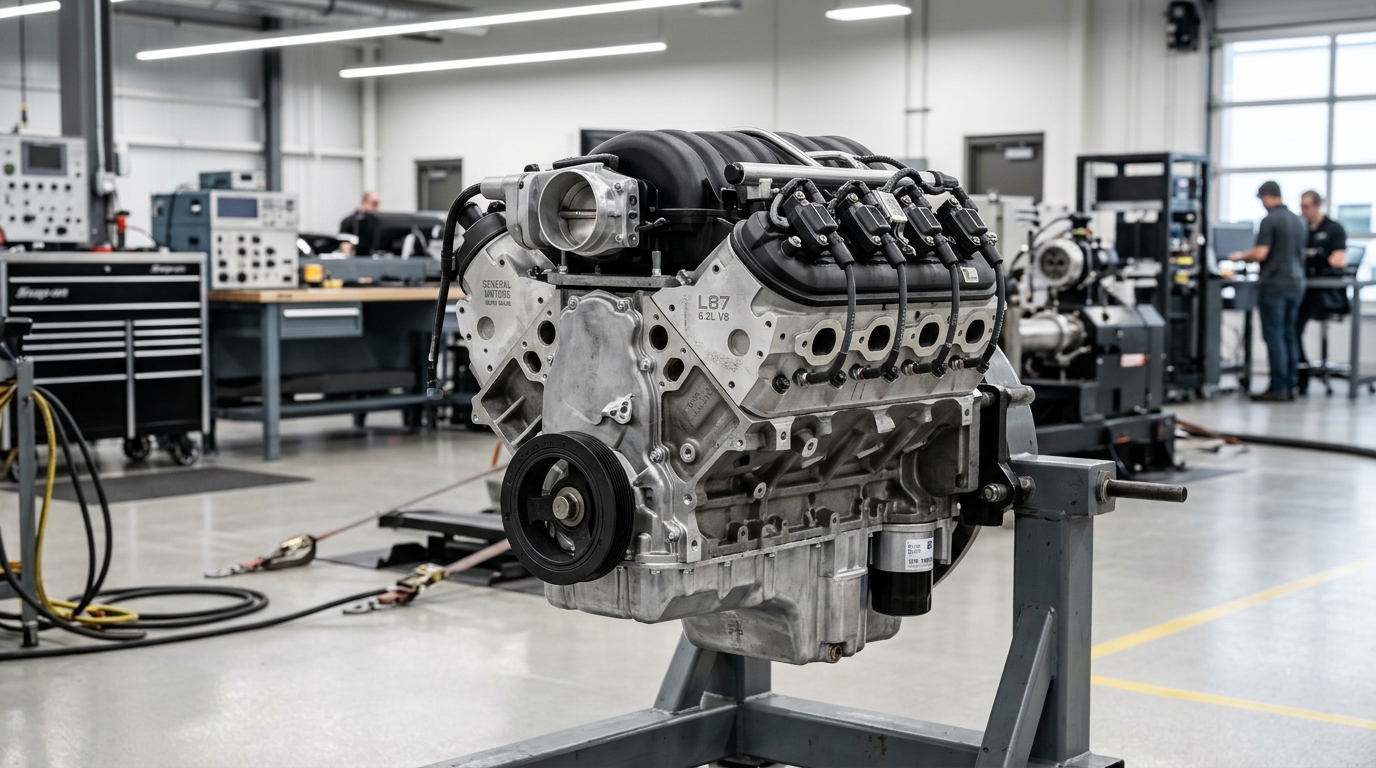
The General Motors 6.2-liter EcoTec3 V8 (engine designation L87 in current T1XX platform trucks and L86 in prior K2XX models) represents the performance pinnacle of GM’s legendary small-block engine family. Delivering 420 horsepower and 460 lb-ft of torque with an all-aluminum block, high-flow cylinder heads, and direct injection, it is the premier powerplant chosen for flagship trucks and luxury SUVs including the Chevrolet Silverado 1500 High Country, GMC Sierra 1500 Denali, Cadillac Escalade, Chevrolet Tahoe RST, Suburban, and GMC Yukon Denali. However, behind its commanding exhaust note lies one of the most alarming mechanical crises in modern American truck manufacturing: catastrophic bottom-end rotating assembly failure, frequently occurring between 12,000 and 45,000 miles (20,000 to 72,000 km).
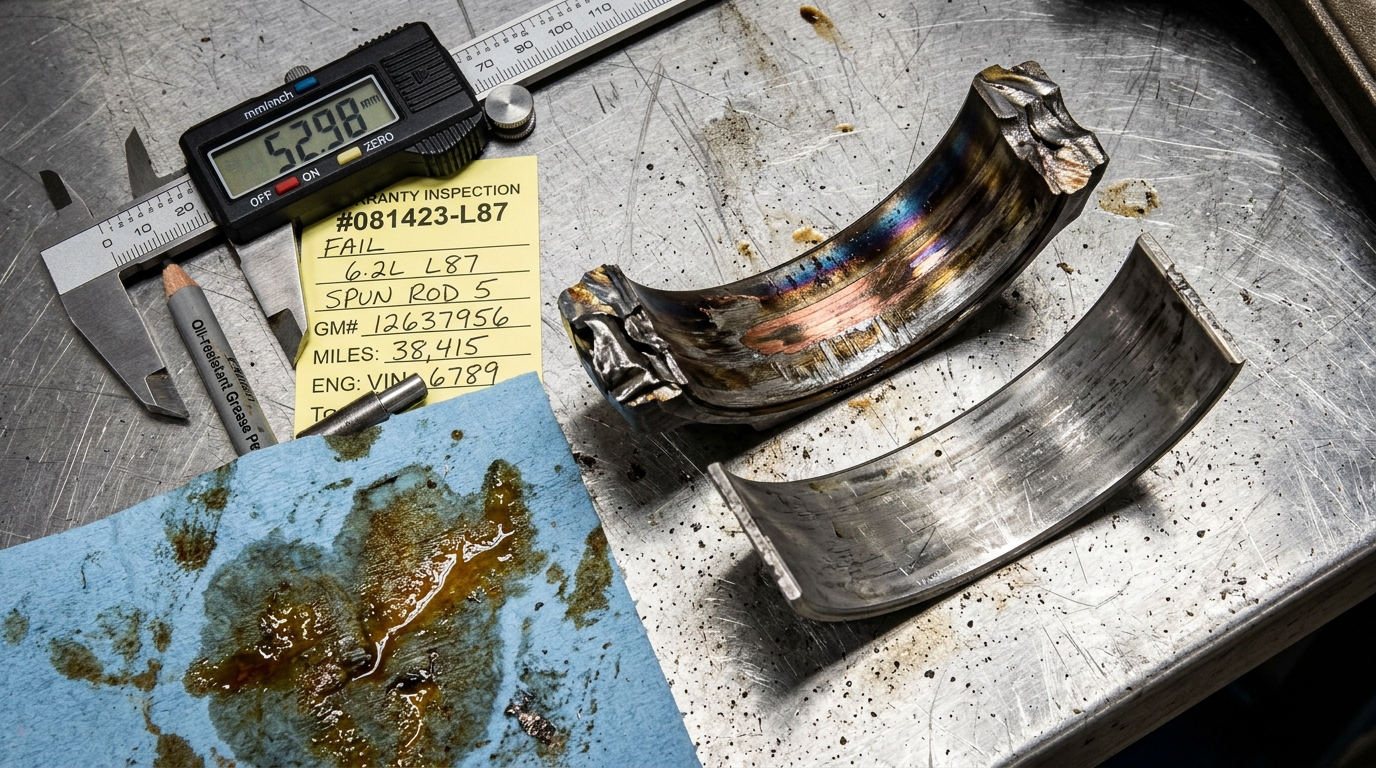
For thousands of owners, the disaster begins abruptly: while cruising under moderate throttle or towing, the digital instrument cluster flashes an urgent "Oil Pressure Low - Stop Engine" warning accompanied by a rhythmic, metallic hammer tap that rapidly accelerates into a violent rod knock before the engine completely seizes. The failure is not caused by neglected oil changes or track abuse—it is the catastrophic delamination and spinning of the tri-metal connecting rod bearings on the forged steel crankshaft journals. In response to mounting dealership warranty replacements, GM published Technical Service Bulletin TSB #23-NA-045, while the National Highway Traffic Safety Administration launched defect evaluation NHTSA DP23-003 covering sudden vehicle stalls and engine lockups. In this comprehensive forensic dossier, the AutoZonic Engineering Desk analyzes the fluid dynamic physics of the L87 bearing wipe, details diagnostic trouble codes (DTC P0521 / P0524), outlines warranty approval tactics, and compares full-time V8 disabler modules against dealership engine crate replacements.
Quick Workshop Diagnostic: GM 6.2L EcoTec3 (L87 / L86) Engine Failure at a Glance
- Affected Powertrains: 6.2L V8 EcoTec3 (L87 with Dynamic Fuel Management / DFM; L86 with Active Fuel Management / AFM) across 2019–2024 Chevrolet Silverado 1500, GMC Sierra 1500, 2021–2024 Cadillac Escalade, Tahoe, Suburban, and Yukon Denali.
- The Primary Mechanical Defect: Connecting rod bearing delamination and spin on journals #1, #2, #7, or #8. Caused by tight manufacturing oil clearance tolerances (0.0010–0.0018 in), crankshaft journal micro-finish anomalies from the engine plant, and variable-displacement oil pump hydraulic pressure dips during DFM cylinder transitions.
- Signature Warning Symptoms: Low oil pressure alert on dash (<15 psi warm idle), rhythmic bottom-end metallic knock that increases in frequency with engine RPM, or sudden rotational lockup while driving.
- Official Manufacturer Service Bulletin: GM TSB #23-NA-045 (issued February 2023; instructs dealerships to inspect oil filter pleats for non-ferrous copper flakes and measure rod journal runout).
- Federal Defect Status: NHTSA Defect Petition DP23-003 opened by the Office of Defects Investigation (ODI) investigating engine failure and loss of motive power at highway speeds.
- Repair Reality: When a rod bearing spins, the fractured-cap connecting rod bore is permanently distorted and the crankshaft journal is gouged. GM guidelines require a complete replacement long-block engine assembly (part #
12699105/12723326), costing $11,500 to $14,800 out-of-warranty.
1. Auditory Diagnosis: Connecting Rod Bearing Knock vs. DFM Valvetrain Lifter Tick
Because the GM 6.2L EcoTec3 V8 utilizes high-pressure direct fuel injection (running at 2,175 PSI) and a complex Dynamic Fuel Management (DFM) valvetrain equipped with 16 electro-hydraulic deactivating valve lifters, the engine produces several distinctive mechanical sounds. Distinguishing benign valve ticking from terminal connecting rod bearing failure is critical for vehicle survival:
| Acoustic & Diagnostic Indicator | DFM Collapsed Valve Lifter / Pushrod | L87 Connecting Rod Bearing Failure |
|---|---|---|
| Pitch & Timbre | High-pitched, rapid metallic ticking or sewing machine clicking echoing from the upper cylinder head. | Deep, hollow, heavy metallic "thud-thud" or hammer tap radiating from the bottom oil pan area. |
| RPM & Frequency Multiplier | Cycles at half engine speed (camshaft speed). Roughly 1 tick per 2 crankshaft rotations. | Cycles at full crankshaft rotational speed (1:1 ratio). Doubles immediately with engine RPM. |
| Load Sensitivity | Stays relatively consistent under light load or deceleration; may quiet down slightly as oil warms. | Loudest under moderate acceleration between 1,800 and 2,800 RPM. Knocks violently under torque load. |
| Oil Pressure Gauge Response | Oil pressure remains normal (typically 30 to 45 psi at operating temperature). | Sudden precipitous drop in oil pressure; fluctuates wildly or drops below 14 psi at warm idle. |
| Mechanic's Stethoscope Location | Sharpest when probing the aluminum valve cover directly above cylinders 3, 5, 4, or 6. | Overwhelmingly loudest when probing the cast aluminum oil pan skirt or bellhousing housing flange. |
2. The Failure Physics: Why Do GM 6.2L Connecting Rod Bearings Wipe Out?
To understand why a heavy-duty, large-displacement V8 suffers premature bearing failure while predecessor LS-series engines regularly reached 300,000 miles, we must examine the intersection of crankshaft metallurgy, oil clearance tolerances, and DFM hydraulic management.
-
1. Ultra-Tight Bearing Clearance Tolerances & Hydrodynamic Rupture
In the pursuit of low cold-start emissions and corporate average fuel economy (CAFE), GM calibrated the Gen V LT/EcoTec3 engine architecture around ultra-thin 0W-20 dexos1 Gen 3 synthetic motor oil. To maintain oil film pressure with thin oil, factory bearing-to-journal clearance was tightened to 0.0010 to 0.0018 inches (0.025 to 0.045 mm). Under heavy brake mean effective pressure (BMEP)—especially when accelerating a 6,000-lb full-size SUV up a highway grade—the microscopic hydrodynamic oil wedge compresses. Any micro-inch surface imperfection punctures the oil film, creating instantaneous metal-to-metal contact. -
2. Manufacturing Micro-Finish Defects at GM Engine Plants
Internal engineering analyses cited in federal filings indicate that crankshaft rod journals produced at GM's Tonawanda and Romulus engine facilities between 2020 and 2023 suffered from surface roughness (Ra) anomalies on specific crankshaft production batches. Microscopic machining chatter marks acted as rotary files against the soft babbitt overlay, rapidly shaving off the top protective layer and contaminating the oil stream with abrasive metallic debris. -
3. Dynamic Fuel Management (DFM) Oil Pressure Fluctuations
Unlike older Active Fuel Management (AFM) systems that only switched between 8-cylinder and 4-cylinder modes, the L87’s Dynamic Fuel Management operates across 17 distinct cylinder firing patterns, cycling individual cylinders off and on hundreds of times per minute. The variable-displacement vane-type oil pump uses an electronic solenoid valve to actively throttle oil pressure down to 24–30 psi during low-load cruising. When the driver abruptly demands full throttle, the sudden torque surge hits the crankshaft journals milliseconds before the oil pump can ramp hydraulic pressure up to 50+ psi, inducing boundary-lubrication bearing shear. -
4. Bearing Tang Shear & Rotational Spin
Once the soft babbitt and copper layers heat past 450°F (232°C), frictional drag between the spinning crankshaft journal and the bearing shell exceeds the retention capability of the locating tangs. The bearing shell shears its tabs and rotates inside the connecting rod big-end bore. This blocks the oil feed hole completely. Starved of all lubrication, the bearing welds itself to the crankshaft journal, snapping the connecting rod beam or windowing the cast aluminum block.
3. Diagnostic Trouble Codes (DTCs) & Telemetry Thresholds
When bearing delamination commences, GM GDS-2 dealership diagnostic tablets, high-end scan tools, and telemetry loggers register clear electronic warning codes:
| DTC Code | Generic SAE Description | GM ECM Trigger Logic | Physical Correlation to L87 Bottom-End |
|---|---|---|---|
| P0521 | Oil Pressure Sensor Range/Performance | Target vs. actual oil pressure delta exceeds calibrated 10–12 psi margin for >5 seconds. | Bearing clearance widening bleeds oil volume, or pickup screen is partially clogged with bearing flakes. |
| P0524 | Engine Oil Pressure Too Low | Engine oil pressure drops below 14.0 psi (96 kPa) at hot idle under operating temperature. | Critical warning: multiple rod bearings have wiped; immediate shutdown required to prevent block windowing. |
| P0300 | Random / Multiple Cylinder Misfire | Crankshaft position sensor detects angular acceleration deceleration across specific cylinder firing. | Severe rotational drag from a dragging rod bearing or companion DFM lifter collapse on the same bank. |
| P0011 | Camshaft Timing Over-Advanced (Bank 1) | VVT camshaft phaser fails to achieve commanded advance angle within calibrated delay. | Microscopic copper and bronze bearing particulate has clogged the camshaft actuator oil control valve (OCV). |
| Telemetry Parameter | GM Factory Nominal Specification | Failure / Teardown Threshold |
|---|---|---|
| Hot Idle Oil Pressure (600 RPM @ 212°F) | 22.0 – 32.0 psi | <15.0 psi (Immediate mechanical inspection required) |
| Cruising Oil Pressure (2,000 RPM) | 42.0 – 58.0 psi | <30.0 psi (Indicates internal hydraulic leakage) |
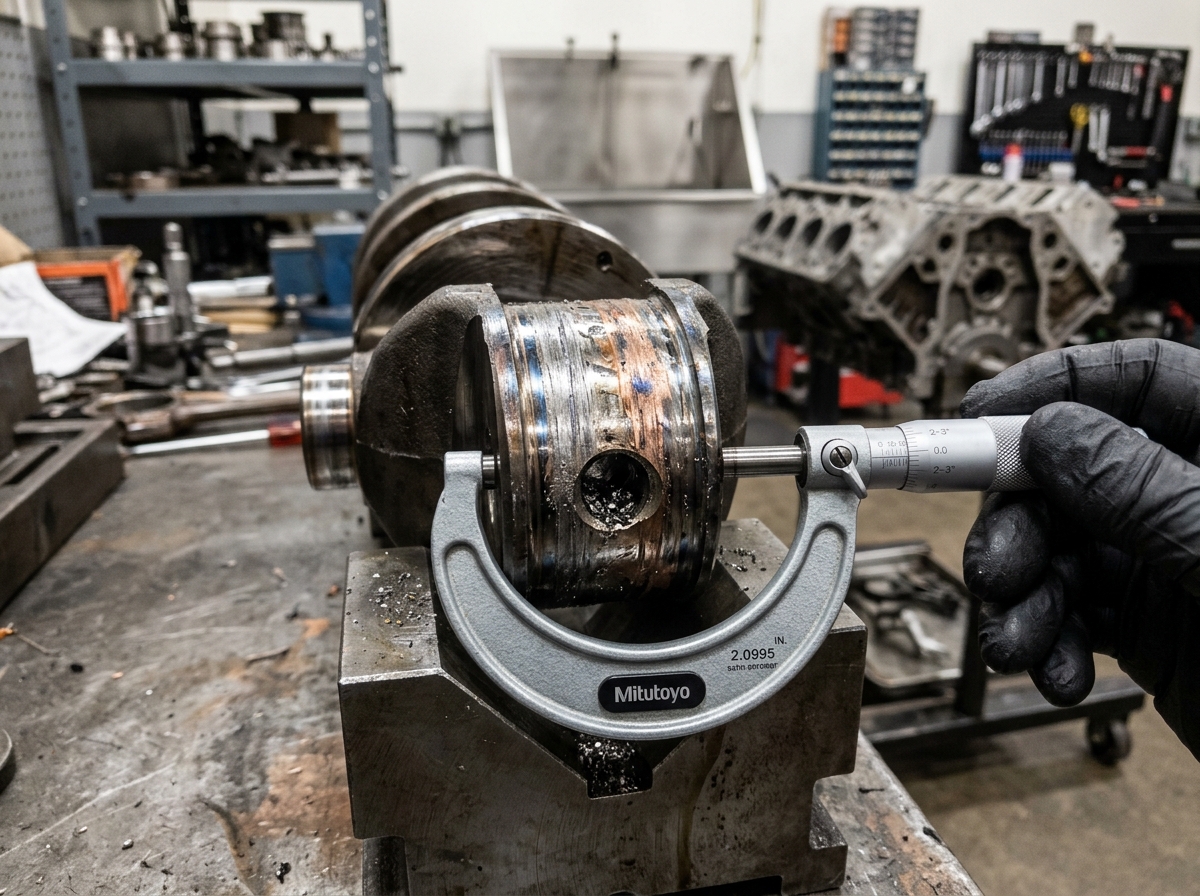
| Rod Bearing Oil Clearance | 0.0010 – 0.0018 in (0.025 – 0.045 mm) | >0.0035 in (0.089 mm) / Spun condition |
| Used Oil Analysis: Copper (Cu) Content | 0 – 15 PPM (parts per million) | >65 PPM (Severe rod bearing intermediate bronze wear) |
| Used Oil Analysis: Lead / Tin (Pb / Sn) | 0 – 8 PPM | >35 PPM (Active babbitt layer delamination) |
4. Workshop Warnings & Field Notes from the Service Bay
When experiencing bottom-end knock or low oil pressure, do not permit the dealership to perform an oil change and discard your canister filter. Dealership service advisors often attempt to dismiss early rod knock as "normal direct-injection valve clatter" or blame customer oil maintenance intervals. Before dropping off your truck, use a billet aluminum filter cutter to slice open the filter canister. If you see non-ferrous bronze/copper flakes trapped between the paper pleats, you have irrefutable metallurgical evidence of bearing delamination under GM TSB #23-NA-045, legally obligating GM corporate warranty authorization for a replacement long-block.
Some independent shops attempt to save money by dropping the oil pan in-chassis, using emery cloth to polish out the scored crankshaft journal, and rolling in a standard replacement bearing shell. This repair will fail within 500 miles. Modern GM EcoTec3 connecting rods feature cracked-cap powdered metal construction; when a bearing spins, the intense frictional heat permanently anneals and distorts the rod big-end bore out-of-round. Furthermore, the micro-hardness depth of the induction-hardened forged crankshaft journal is compromised. Once a bearing spins, nothing short of a complete crankshaft and connecting rod replacement—or a full long-block crate assembly—will survive.
To eliminate destructive DFM/AFM cylinder deactivation oil pressure cycling, and to inspect oil filter pleats for non-ferrous bronze/copper bearing flakes before presenting your vehicle to a GM dealership service department, Master Technicians recommend these verified workshop tools:
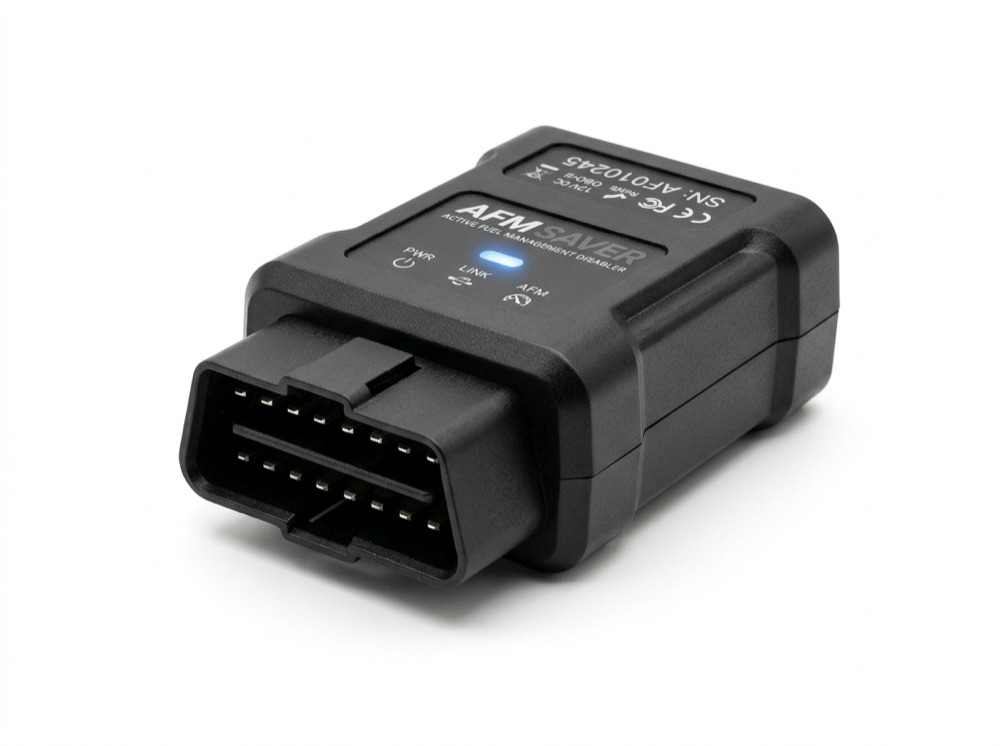
Plug-and-Play V8 Active Cylinder Deactivation Disabler
Eliminates AFM / MDS 4-Cylinder Oil Starvation Cycles
- ✓Full-Time V8 Operation: Prevents PCM from commanding 4-cylinder deactivation mode.
- ✓Constant Oil Pressure: Delivers uninterrupted full-pressure lubrication to all 16 lifter rollers.
- ✓100% Reversible: Connects directly to OBD-II port; leaves zero footprint in factory ECM memory.
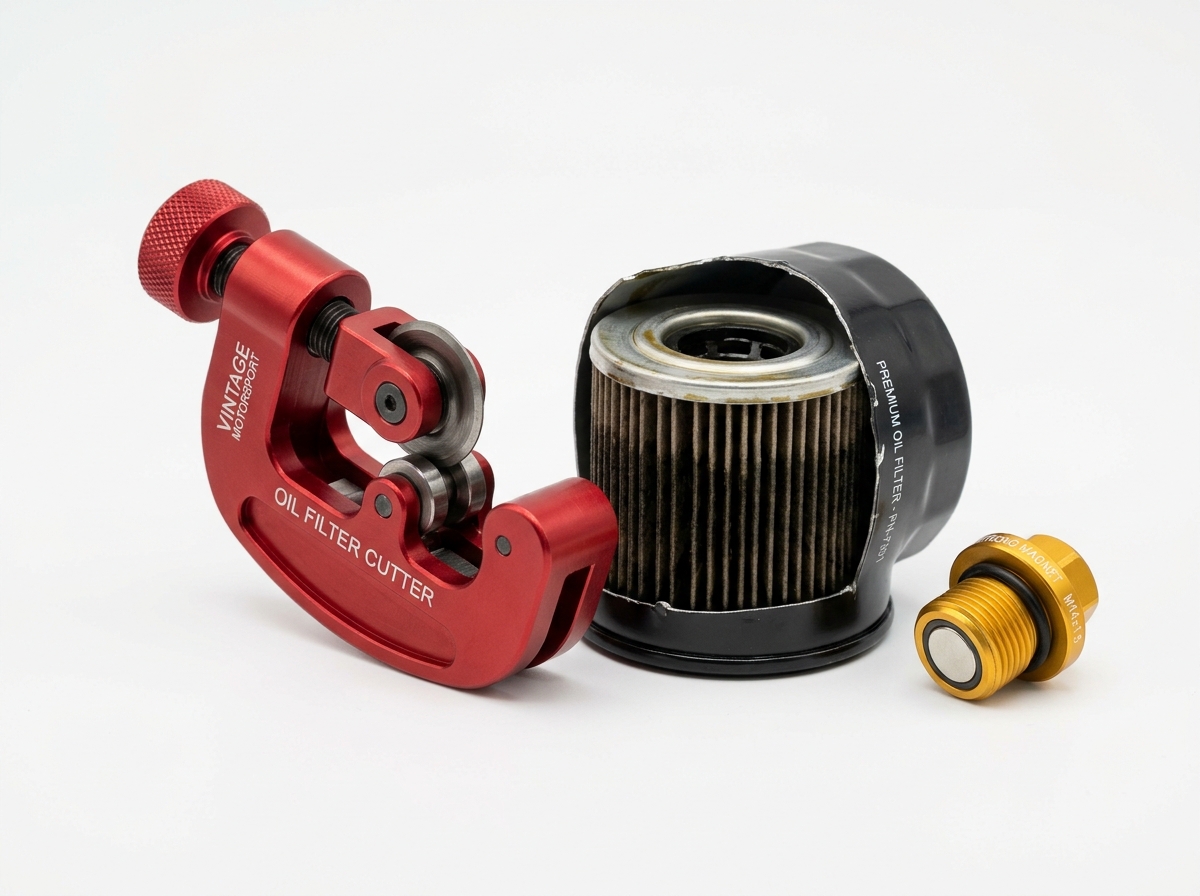
Billet Aluminum Oil Filter Inspection Cutter Tool
Early Metal Swarf & Bearing Flake Detection
- ✓Clean Billet Cutting: Hardened roller bearings slice filter canister without creating metal filings.
- ✓Irrefutable Dealer Proof: Microscopic inspection of paper pleats for copper/bronze bearing flakes.
- ✓Universal Fitment: Accommodates spin-on and cartridge filters from 2-3/8" to 5" diameter.
5. Step-by-Step Action Blueprint: How to Navigate GM Dealer Engine Replacement
If your GM 6.2L EcoTec3 V8 displays low oil pressure warnings or develops a bottom-end knock, execute this four-stage warranty protocol:
-
Stage 1: Document Active Diagnostic Freeze-Frame Telemetry
Before calling roadside assistance, connect an OBD-II diagnostic scanner to read and screenshot freeze-frame parameters for DTC P0521 or P0524. Document the exact oil pressure, engine RPM, and engine runtime. Do NOT clear the codes; clearing codes deletes the freeze-frame timestamps required by GM Warranty Operations. -
Stage 2: Demand Flatbed Towing (Do Not Attempt to Drive)
Call Chevrolet Roadside Assistance (1-800-243-8872) or GMC Roadside (1-800-462-8782). Request a flatbed tow. Driving an engine with an active spun bearing risks throwing a connecting rod through the side of the engine block, which can cause an underhood oil fire and complicate core return authorizations. -
Stage 3: Reference GM Technical Service Bulletin 23-NA-045
Instruct the service advisor in writing: "Please perform oil filter pleat inspection and rod bearing examination in accordance with GM TSB #23-NA-045." This bulletin instructs technicians to remove the oil filter, cut it open, inspect for non-ferrous debris, and drop the oil pan to inspect rod caps. When metallic debris is confirmed, corporate authorizes a complete long-block assembly (GM Part #12699105/12723326). -
Stage 4: Protect Warranty Coverage with Maintenance Verification
Have your oil change maintenance records organized (receipts showing dexos1 Gen 3 certified 0W-20 oil and factory filter part numbers within GM's 7,500-mile interval). If out of the 5-year/60,000-mile powertrain warranty but under 100,000 miles, request a GM Corporate Goodwill Assistance adjustment citing NHTSA Defect Petition DP23-003.
6. Full Platform Compatibility: Which GM Vehicles Are Affected?
Because the 6.2L EcoTec3 V8 serves as General Motors' flagship small-block across both the K2XX and T1XX architectures, the connecting rod bearing defect impacts millions of high-end utility vehicles:
| Vehicle Nameplate | Chassis Architecture | Model Years Affected | Engine Code & Management |
|---|---|---|---|
| Chevrolet Silverado 1500 (High Country, LTZ, RST) | T1XX Platform | 2019 – 2024 | 6.2L L87 (Dynamic Fuel Management) |
| GMC Sierra 1500 (Denali, AT4, SLT) | T1XX Platform | 2019 – 2024 | 6.2L L87 (Dynamic Fuel Management) |
| Cadillac Escalade & Escalade ESV | T1XX Platform | 2021 – 2024 | 6.2L L87 (Dynamic Fuel Management) |
| Chevrolet Tahoe & Suburban (Premier, High Country) | T1XX Platform | 2021 – 2024 | 6.2L L87 (Dynamic Fuel Management) |
| GMC Yukon & Yukon XL (Denali, AT4) | T1XX Platform | 2021 – 2024 | 6.2L L87 (Dynamic Fuel Management) |
| Silverado / Sierra / Yukon Denali (Prior Generation) | K2XX Platform | 2014 – 2018 | 6.2L L86 (Active Fuel Management) |
Frequently Asked Questions (FAQ)
Can I disable Dynamic Fuel Management (DFM) to prevent rod bearing failure?
While disabling DFM with an OBD-II plug-and-play module (such as the Range DFM Disabler) keeps the engine in full-time 8-cylinder mode—preventing oil pressure dips during cylinder transitions and protecting the 16 hydraulic valve lifters from collapsing—it cannot cure an existing metallurgical manufacturing defect on an already-scored crankshaft journal. However, on healthy engines, eliminating DFM deactivation dramatically reduces valvetrain stress and maintains constant oil pump pressure.
What does GM charge to replace a 6.2L L87 engine out of warranty?
At an authorized Chevrolet or GMC dealership, a complete long-block engine replacement (including GM crate engine, oil cooler lines, intake gaskets, fluids, and 18 to 22 book labor hours) typically invoices between $11,500 and $14,800. Independent engine specialist facilities typically execute the long-block swap for $8,500 to $10,500 using genuine GM or Jasper remanufactured assemblies.
Can I switch from 0W-20 to 5W-30 motor oil in my GM 6.2L V8?
Many independent engine builders and performance shops recommend switching to GM dexos1 Gen 3 certified 5W-30 or 0W-40 synthetic motor oil to provide a thicker hydrodynamic cushion across the crankshaft rod journals, especially for vehicles that tow or operate in high-temperature climates. Note that while 5W-30 improves film strength, operating non-recommended oil viscosity while under factory powertrain warranty can provide dealerships with an excuse to contest warranty claims unless supported by oil analysis.
Researching this vehicle or comparing used inventory?
Always cross-reference factory service bulletins, verify warranty coverage, and compare dealer financing rates or insurance quotes before purchasing.
Reader Feedback
Was this technical guide helpful?
Your verification vote informs our ongoing automotive research schedule.