
GM 5.3L & 6.2L EcoTec3 DFM vs. AFM Lifter Collapse: 17-Mode Deactivation Failure, Bent Pushrods, TSB 21-NA-149 & Permanent Delete Guide
Automotive Research, ASE Master Technicians & Fact-Checking
Direct Technical Summary
Forensic engineering analysis of GM 5.3L and 6.2L EcoTec3 V8 hydraulic lifter collapse across Active Fuel Management (AFM) and Dynamic Fuel Management (DFM) systems. We examine locking pin shear, oil aeration in the VLOM, camshaft lobe delamination, TSB 21-NA-149, diagnostic DTC triggers (P0300, P050D), and permanent mechanical delete vs. Range disabler intervention.
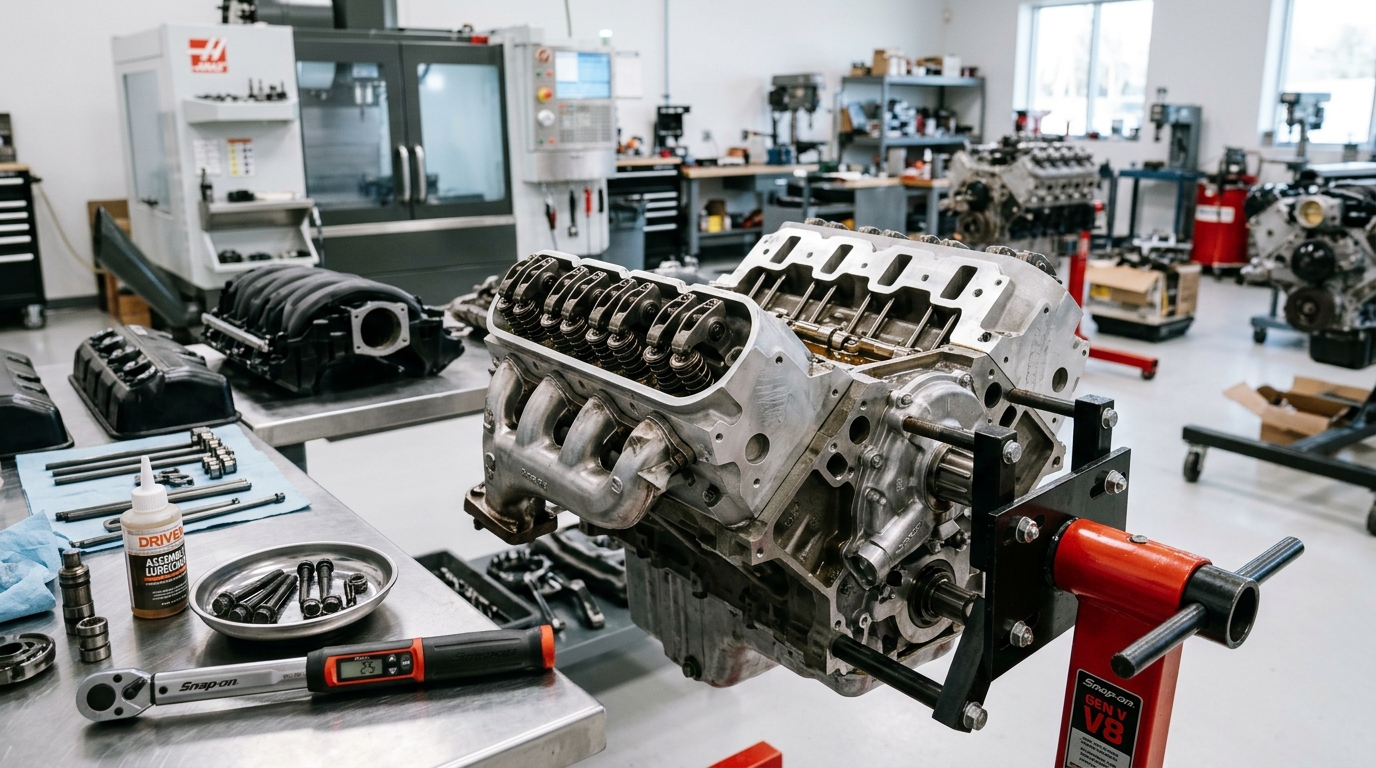
Across modern General Motors full-size trucks and SUVs—including the Chevrolet Silverado 1500, GMC Sierra 1500, Tahoe, Suburban, Yukon, and Cadillac Escalade—few mechanical failures carry the catastrophic reputation or widespread financial severity of collapsed hydraulic lifters on the 5.3L EcoTec3 (L83 / L84) and 6.2L EcoTec3 (L86 / L87) Gen V small-block V8 engines. What begins as an intermittent metallic chirping or high-frequency tapping noise on cold start frequently progresses within hundreds of miles into a flashing Check Engine light, violent cylinder misfires, bent hardened steel pushrods, and permanent camshaft lobe delamination that requires a $4,500 to $7,500 complete engine teardown.
While dealership service departments routinely treat this issue as isolated valvetrain wear or attempt piecemeal single-cylinder lifter replacements under factory warranty, forensic mechanical analysis reveals a systemic architectural conflict between hydraulic oil aeration, thermal cycling, and the microscopic tolerances of the spring-loaded mechanical locking pins inside GM’s cylinder deactivation lifters. To understand how to diagnose, mitigate, or permanently eliminate this vulnerability, technicians and owners must understand the operational physics separating older 8-lifter Active Fuel Management (AFM) from the far more complex 16-lifter Dynamic Fuel Management (DFM) systems.
1. Valvetrain Architecture: Active Fuel Management (AFM) vs. Dynamic Fuel Management (DFM)
General Motors introduced cylinder deactivation on the Gen IV LS platform in 2007 under the Active Fuel Management (AFM / Displacement on Demand) banner, carrying an updated iteration into the 2014–2018 Gen V EcoTec3 platform (L83 5.3L and L86 6.2L). On Gen V AFM engines, deactivation is binary: the engine runs either as a full 8-cylinder V8 or cuts spark and fuel while collapsing the lifters on exactly four fixed cylinders—specifically cylinders 1, 7, 4, and 6. The remaining four cylinders utilize conventional, non-deactivating hydraulic roller lifters.
Beginning in 2019 on the redesigned T1XX platform trucks, GM introduced Dynamic Fuel Management (DFM) on the updated L84 (5.3L) and L87 (6.2L) engines. Engineered in partnership with Tula Technology, DFM abandons the simple 4-cylinder deactivation scheme in favor of 17 distinct cylinder firing patterns. Depending on throttle load and vehicle speed, DFM can fire anywhere from two to eight cylinders in continuously shifting sequences. To achieve this, GM eliminated conventional lifters entirely: every single one of the 16 lifters on an L84 or L87 engine is a specialized deactivating lifter.
On 2014–2018 AFM engines, lifter failure is mathematically confined to cylinders 1, 7, 4, and 6. On 2019–2026 DFM engines (L84/L87), because all 16 lifters incorporate internal locking pins, springs, and high-pressure oil control circuits, failure can occur on any cylinder at any time. Field telemetry shows failures frequently manifesting on cylinders 2, 3, 5, and 8—cylinders that were completely immune to deactivation failure on older Gen V platforms.
2. Forensic Teardown: Why AFM and DFM Lifters Mechanically Collapse
A standard hydraulic roller lifter relies on a rigid outer body enclosing a hydraulic plunger that maintains zero lash against the pushrod through engine oil pressure. In contrast, an AFM/DFM lifter is a dual-body telescopic assembly consisting of an outer housing with the roller wheel, an internal plunger that seats the pushrod, a heavy lost-motion spring, and two hardened steel locking pins controlled by pressurized engine oil.
Under normal 8-cylinder operation, high-tension internal springs force the locking pins outward into a machined locking groove in the outer body, locking the inner plunger to the outer housing so the lifter acts as a solid mechanical unit. When the engine control module (ECM) commands cylinder deactivation, solenoids in the Valve Lifter Oil Manifold (VLOM) open, shooting a pulse of pressurized oil (above 22 psi) through dedicated block passages into the lifter body. This hydraulic pressure overcomes the spring tension, pushing the locking pins inward (disengaged). With the pins disengaged, the outer housing telescopes freely over the inner plunger, absorbing the camshaft lobe motion into the lost-motion spring without transferring lift to the pushrod, leaving the intake and exhaust valves shut.
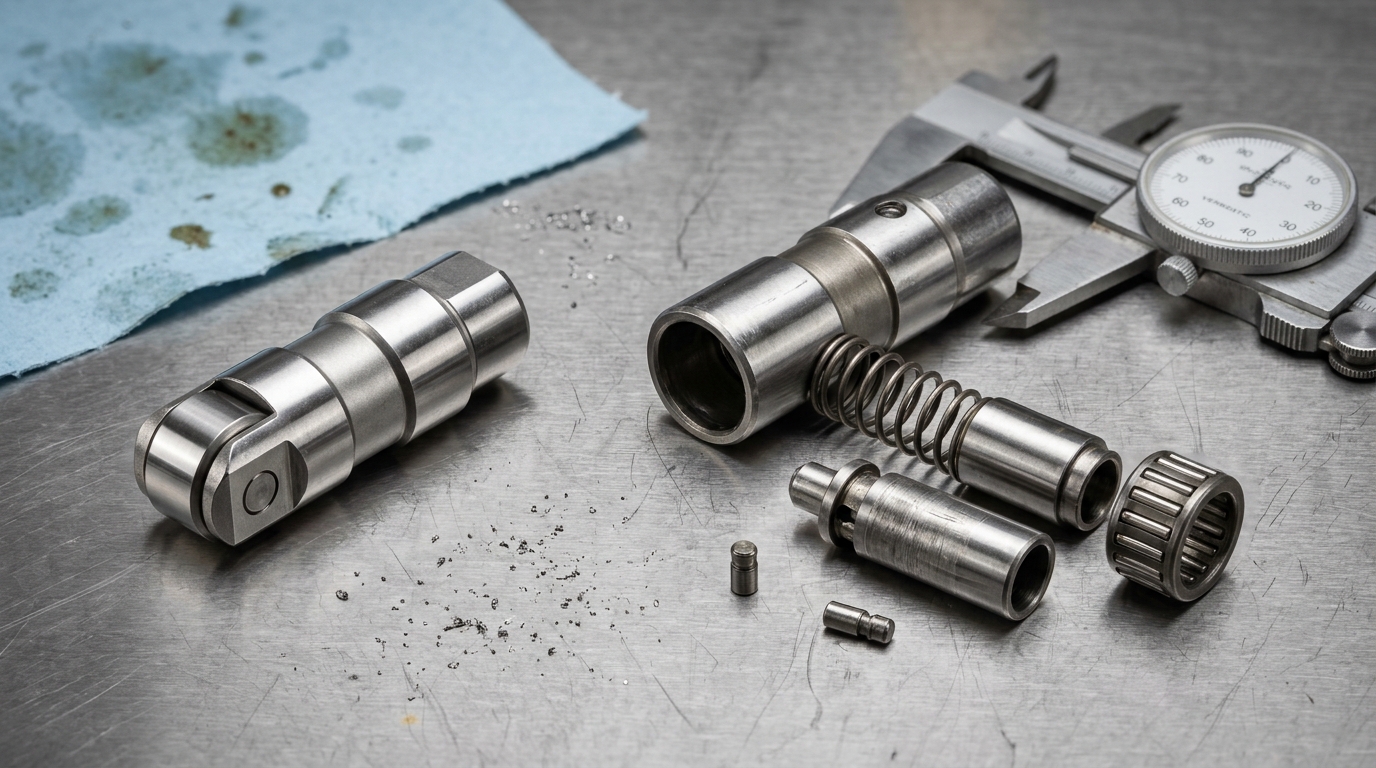
Catastrophic failure occurs when this transition fails in one of two specific mechanical modes:
- Mode 1: Locking Pin Retraction Seizure (The Classic Collapsed Lifter): Microscopic carbon varnish, oil sludge, or microscopic machining debris jams the locking pins in the disengaged position. When the ECM commands the cylinder back to active V8 mode, the pins fail to spring outward. With zero hydraulic lock, the inner plunger bottoms out, introducing approximately 0.160 inches of dead mechanical lash into the valvetrain. As the camshaft lobe pushes the roller up, the rocker arm and pushrod hammer violently into the lifter cup, bending the pushrod or fracturing the valve spring.
- Mode 2: Partial Pin Engagement and Shear: If oil pressure in the VLOM drops or aerates during a high-RPM transition, the locking pins only partially extend into the locking collar. Under full valve spring load (over 300 lbs of open spring pressure), the sheer force snaps the hardened tips of the locking pins or mushrooms the receiver bore, permanently jamming the lifter in a collapsed state and throwing the roller off-axis.
- Mode 3: Roller Axle Seizure and Camshaft Grinding: Once a lifter collapses and introduces excessive lash, the roller wheel bounces uncontrollably against the camshaft lobe ramp rather than rolling smoothly over it. Within 200 to 500 miles of driving with this tapping noise, the needle bearings inside the roller seize, turning the hardened steel roller into a stationary chisel that grinds the camshaft lobe down to a rounded circle.
3. Primary Sources: GM Technical Service Bulletins & NHTSA Action
The prevalence of valvetrain failures across the Gen V small-block family has generated multiple manufacturer service documents and regulatory oversight:
- GM TSB 21-NA-149: Outlines the official service diagnostic procedure for 2019–2023 vehicles equipped with 5.3L L84 and 6.2L L87 engines exhibiting misfires, valvetrain ticking, or bent pushrods. The bulletin instructs technicians to inspect all 16 lifters, verify pushrod straightness, and check camshaft lobe base circle dimensions. Notably, GM updated the procedure to mandate replacing both cylinder head gaskets, all lifter guide trays, and inspecting for cylinder bore scuffing if metal debris circulated.
- GM Special Coverage Bulletin N202314840 / PIP5521E: Details conditions where oil pump control valve stuck positions cause low hot-idle oil pressure, directly precipitating VLOM starvation and premature lifter pin de-synchronization.
- NHTSA Defect Investigation PE21-023: Evaluated sudden loss of motive power at highway speeds on GM full-size trucks following sudden valve spring breakage and lifter collapse, which drops active cylinders and can cause catastrophic valve-to-piston contact.
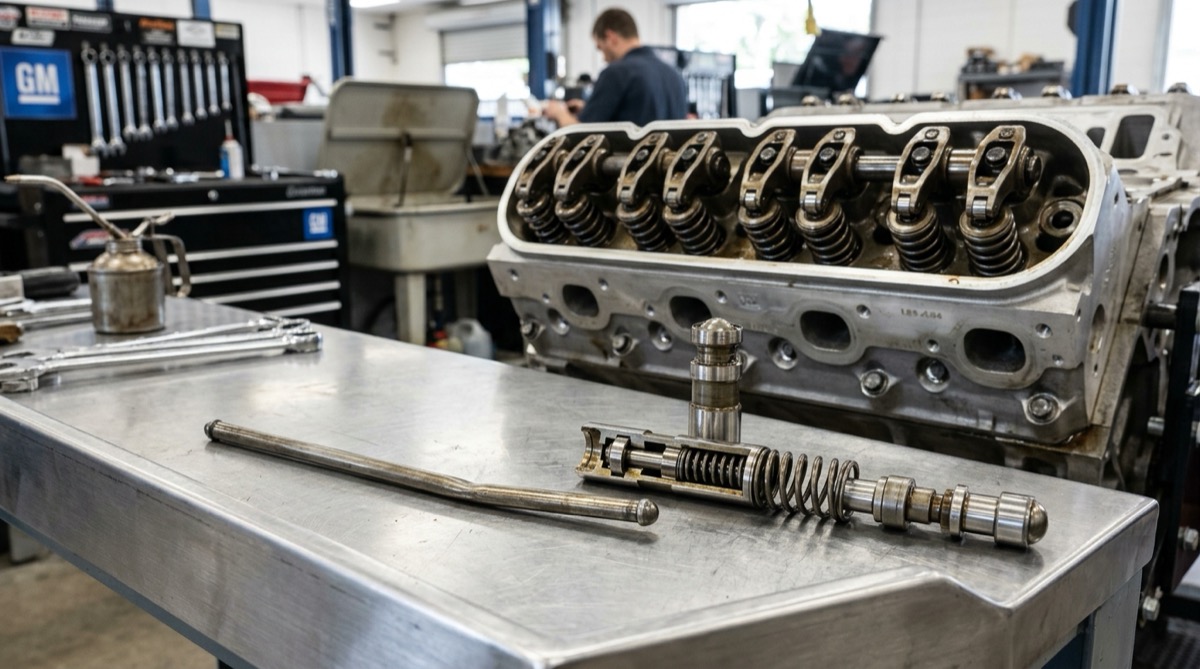
4. Telemetry & Failure Thresholds: Normal vs. Collapsed Valvetrain Specs
When diagnosing suspected AFM/DFM valvetrain failure, technicians must not rely solely on audible stethoscopes. Physical measurement of pushrod runout, oil pressure gallery telemetry, and scan tool misfire counters reveal whether a lifter has mechanically collapsed:
| Diagnostic Parameter | Factory Nominal Spec | Impaired / Warning Threshold | Catastrophic Failure Threshold |
|---|---|---|---|
| Lifter Plunger Lash Play | 0.000 in (Hydraulic Preload: 0.050–0.080 in) | > 0.025 in loose lash | > 0.140–0.160 in (Pin Fully Collapsed) |
| Hot Idle Engine Oil Pressure | 24.0 – 35.0 psi @ 600 RPM | 18.0 – 22.0 psi | < 16.0 psi (VLOM Starvation & Pin Float) |
| Pushrod Total Indicator Runout (TIR) | < 0.002 in (0.05 mm) | 0.005 – 0.010 in | > 0.020 in (Visibly Bent / Hammered) |
| Camshaft Lobe Base Circle Wear | 0.000 in deviation | 0.003 – 0.008 in scoring | > 0.040 in (Ground Flat / Wiped Lobe) |
| Live Misfire Counter (Tech2 / BlueDriver) | 0 misfires per 1,000 engine revs | 5 – 25 misfires (Cold start P050D) | > 150+ continuous (Flashing CEL, P0300) |
5. Diagnostic DTC Protocol: Tracking the Misfire Pathway
When an AFM or DFM lifter begins collapsing, the engine control module registers a distinct sequence of diagnostic trouble codes:
- P0300 (Random / Multiple Cylinder Misfire Detected): The earliest general alert. Often appears intermittently during cold startup or when transitioning out of V4/DFM cruise on the highway.
- P0301 through P0308 (Cylinder-Specific Misfires): Identifies the exact cylinder where the lifter has failed. On 2014–2018 AFM engines, suspect cylinders 1, 7, 4, or 6 first. On 2019+ DFM engines, verify cylinder-by-cylinder data on an enhanced scan tool.
- P050D (Cold Start Rough Idle): Frequently triggered on direct-injected Gen V engines when a lifter fails to fully pump up after overnight oil drain-down, causing incomplete valve opening and erratic combustion until oil heat expands the lifter body.
- P0011 / P0016 (Camshaft Position Timing Correlation): In advanced failures where the lifter roller has seized and ground down the camshaft lobe, the reduced lobe profile alters the effective valve timing and angular velocity of the camshaft, setting correlation faults.
6. Prevention & Remediation: Electronic Disabler vs. Full Mechanical Delete
Once a truck owner understands the mechanical fragility of the deactivating lifter pins, two distinct philosophies exist for safeguarding or permanently fixing the vehicle:
Option A: Electronic Disabler Module (Preventative Intervention)
For trucks where the lifters are currently healthy, silent, and showing zero misfires, an electronic OBD-II disabler—such as the Range Technology AFM/DFM Disabler—is the most widely proven non-invasive safeguard. The module plugs directly into the vehicle's diagnostic port and continuously commands the ECM to keep the engine in 100% full V8 mode. By suppressing cylinder deactivation signals, the VLOM never energizes the solenoids, high-pressure oil pulses are prevented from reaching the lifter towers, and the mechanical locking pins remain permanently seated in their engaged position.
An electronic disabler is strictly a preventative measure, not a repair. If your engine is already exhibiting an active valvetrain tick, a bent pushrod, or a wiped camshaft lobe, software cannot heal damaged metal. Plugging an AFM disabler into an engine with an already-collapsed lifter will not restore valve opening or eliminate the misfire. It must be deployed before physical failure occurs.
Option B: Complete Mechanical AFM/DFM Delete (The Permanent Fix)
When a lifter has mechanically failed and damaged the camshaft, the only permanent, bulletproof solution is a full mechanical delete kit. This involves:
- Pulling both cylinder heads and discarding all 8 (or 16) deactivating lifters.
- Installing 16 non-AFM GM LS7-style or Gen V performance hydraulic roller lifters and standard plastic lifter guide trays.
- Replacing the factory deactivation camshaft with a standard non-AFM billet camshaft (matching standard lobe lift profiles).
- Replacing the VLOM plate with a solid, non-valved valley cover plate to permanently seal the block oil towers.
- Flashing the ECM via custom tuning (HP Tuners) to disable the AFM/DFM diagnostic routines and DTCs.
To safeguard GM Gen V EcoTec3 valvetrains against lifter collapse, monitor real-time cylinder misfire telemetry, and read proprietary GM enhanced diagnostic trouble codes, Master Technicians recommend these field-verified equipment solutions:
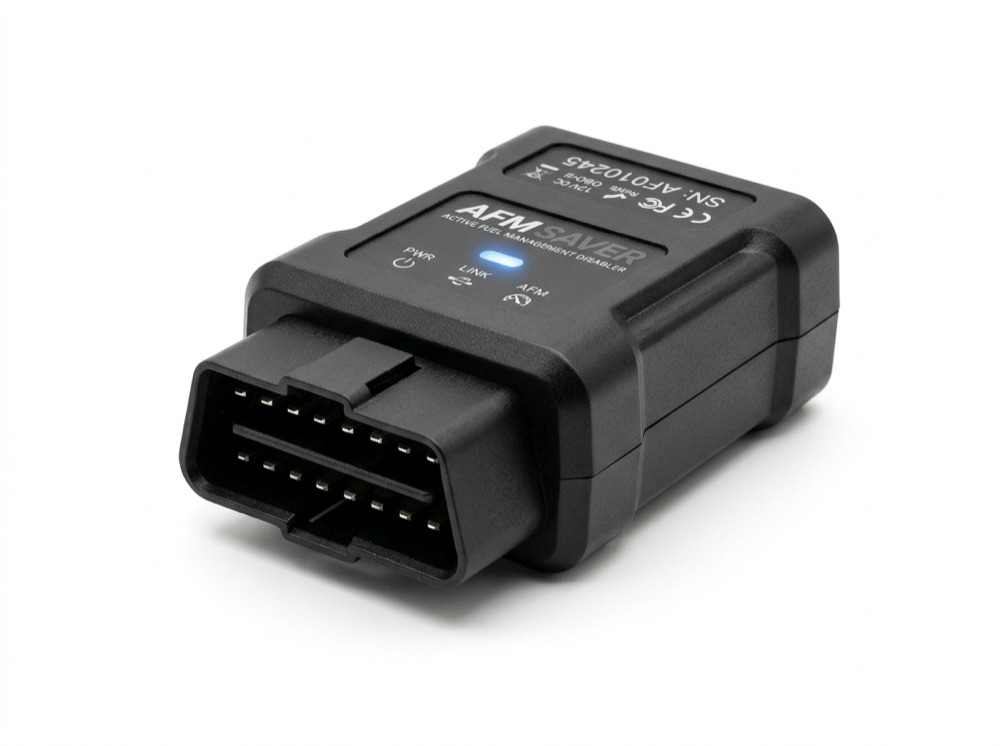
Plug-and-Play V8 Active Cylinder Deactivation Disabler
Eliminates AFM / MDS 4-Cylinder Oil Starvation Cycles
- ✓Full-Time V8 Operation: Prevents PCM from commanding 4-cylinder deactivation mode.
- ✓Constant Oil Pressure: Delivers uninterrupted full-pressure lubrication to all 16 lifter rollers.
- ✓100% Reversible: Connects directly to OBD-II port; leaves zero footprint in factory ECM memory.

BlueDriver Bluetooth Pro OBD-II Diagnostic Scan Tool
Technician Recommended for Enhanced OEM PIDs
- ✓Enhanced Diagnostics: Reads proprietary manufacturer ABS, Airbag, transmission, and body codes.
- ✓Real-Time Telemetry: Graph live oil pressure, coolant temp (ECT), and cam phaser angular deviation.
- ✓Wireless Bluetooth: Full iOS & Android integration with zero monthly subscription fees.
7. Step-by-Step Diagnostic Protocol for Suspected Valvetrain Ticking
If your 5.3L or 6.2L truck develops an audible valvetrain noise, execute this step-by-step diagnostic sequence before authorizing an engine replacement:
- Scan for Live Misfires: Connect an enhanced OBD-II scan tool (such as BlueDriver) and navigate to live cylinder misfire history. Identify which specific cylinder is registering counts. If misfires cluster exclusively on cylinders 1, 7, 4, or 6 (AFM), the odds of an AFM lifter collapse exceed 90%.
- Check Hot Oil Pressure: Warm the engine to operating temperature (212°F / 100°C) and check oil pressure at idle. If pressure drops below 18 psi, suspect oil pump control valve sticking or oil pickup tube O-ring deterioration starving the VLOM.
- Remove the Valve Cover: Pull the valve cover on the affected cylinder bank. Crank the engine manually with a breaker bar on the harmonic balancer bolt while watching the rocker arms. If a rocker arm shows excessive loose play or fails to pivot fully while its neighbor moves, that lifter is mechanically collapsed.
- Roll Test the Pushrod: Loosen the rocker arm bolt (22 ft-lb torque on reassembly) and remove the pushrod. Roll the pushrod across a precision flat surface or glass table. Any wobble or air gap confirms a bent pushrod caused by a lifter collapsing at high RPM.
- Borescope the Cam Lobe: Insert an inspection borescope down the pushrod bore into the lifter valley. Inspect the camshaft lobe surface. If the lobe exhibits spalling, pitting, or flat-spotting, a lifter replacement alone will fail within 1,000 miles; the camshaft must be replaced.
Forensic Diagnostic Verdict
General Motors EcoTec3 V8 engines (L83, L84, L86, L87) are among the most robust bottom-end platforms in modern automotive history, capable of exceeding 300,000 miles on crankshaft and cylinder bore durability. However, the complex hydraulic locking pins inside AFM and DFM deactivating lifters represent an undeniable structural failure point. For healthy trucks, deploying an electronic OBD-II disabler immediately eliminates the cycling wear responsible for locking pin fatigue. For trucks already suffering from collapsed lifters, bypassing dealership piecemeal repairs in favor of a complete mechanical non-AFM delete kit restores permanent, bulletproof V8 reliability.
Researching this vehicle or comparing used inventory?
Always cross-reference factory service bulletins, verify warranty coverage, and compare dealer financing rates or insurance quotes before purchasing.
Reader Feedback
Was this technical guide helpful?
Your verification vote informs our ongoing automotive research schedule.