
Ford Super Duty 7.3L Godzilla V8 Camshaft & Lifter Delamination: Low Idle Oil Pressure, Roller Spalling Teardown & $8,000 Long-Block Repair Guide
Automotive Research, ASE Master Technicians & Fact-Checking
Direct Technical Summary
Forensic engineering analysis of hydraulic roller lifter failure and camshaft lobe spalling/delamination across 2020-2024 Ford Super Duty 7.3L Godzilla V8 engines (F-250, F-350, E-Series). We examine early variable-displacement oil pump calibrations (5-8 PSI hot idle), metallurgical needle bearing fatigue, metal contamination spread, and the Ford crate long-block replacement protocol.
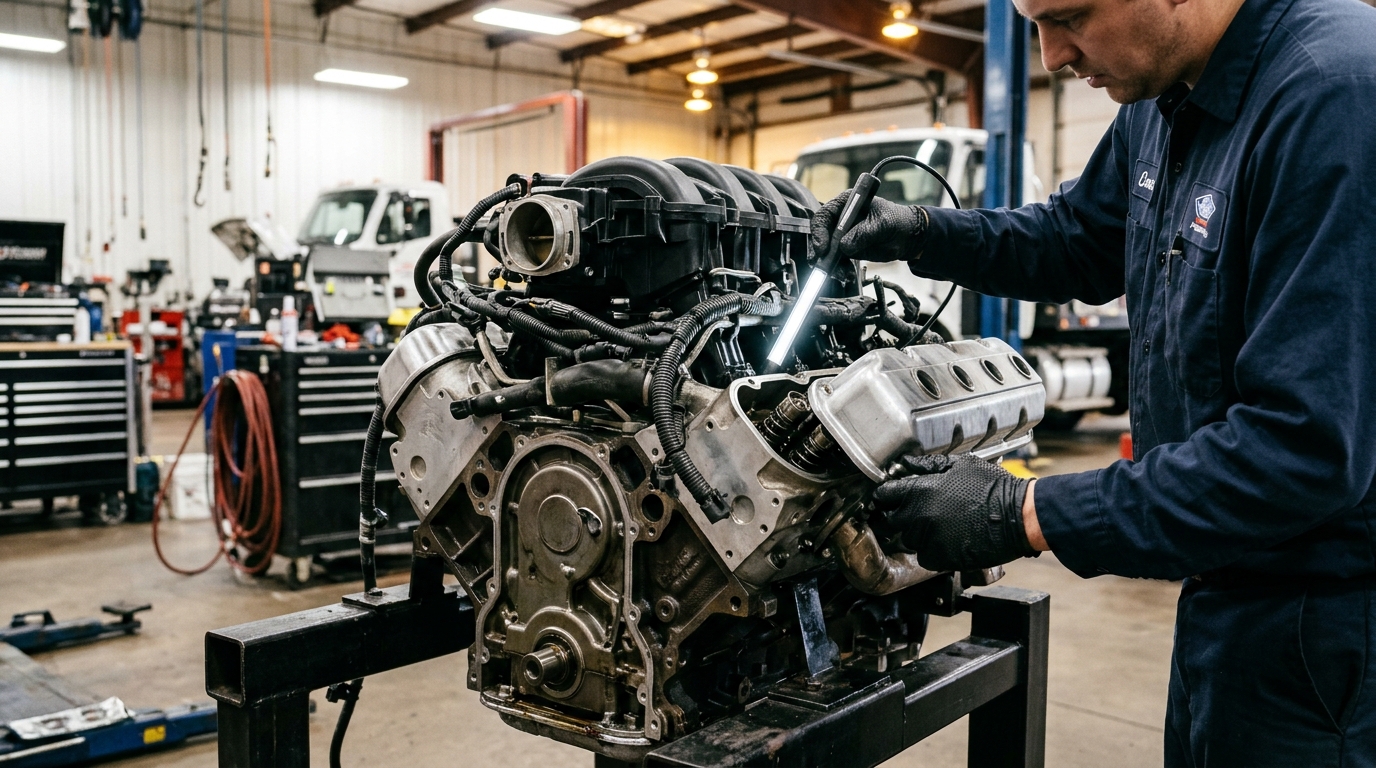
When Ford introduced the 7.3-liter "Godzilla" V8 for the 2020 model year Super Duty line (powering the F-250, F-350, F-450, F-550, and commercial E-Series cutaways), truck enthusiasts and fleet operators widely celebrated the powertrain. Billed as the antidote to modern diesel emission complexity, DEF headaches, and $15,000 fuel system repairs, the Godzilla was engineered around old-school durability tenets: a heavy cast-iron deep-skirt block, forged steel crankshaft, variable camshaft timing (VCT), and a proven overhead valve (OHV) pushrod architecture designed to achieve 430 horsepower and 475 lb-ft of torque on 87-octane pump gas without turbochargers.
However, as early production 2020 through 2023 fleet vehicles, RV haulers, and commercial work trucks have crossed the 35,000 to 75,000-mile threshold, an alarming mechanical pattern has surfaced across independent repair facilities and fleet teardown benches: a progressive, rhythmic valvetrain ticking noise at idle that quickly escalates into persistent misfires, loss of high-load towing power, and catastrophic metal circulation throughout the engine. In severe cases, what begins as a faint top-end click ends with dealerships quoting $8,000 to $10,000 for a complete crate long-block replacement.
Teardown forensics conducted on damaged powerplants reveal that the root cause is not random valvetrain wear. Instead, it is a predictable mechanical progression: hydraulic roller lifter needle bearing failure leading to roller lockup, which subsequently grinds down the induction-hardened camshaft lobe in a destructive failure mechanism known metallurgically as spalling or surface delamination. In this dossier, we analyze the engineering root causes behind the Godzilla valvetrain failure, the role of early variable-displacement oil pump calibrations, authentic telemetry, and the exact workshop protocol required to determine whether an engine can be saved or must be condemned.
Workshop Warning: The Deceptive Dashboard "Idiot Gauge"
The factory instrument cluster oil pressure gauge on 2020–2024 Ford Super Duty trucks is not an analog transducer readout; it is a computer-buffered dummy switch. The instrument needle automatically snaps to the dead-center "normal" midpoint whenever engine oil pressure exceeds approximately 5 to 6 PSI. A 7.3L Godzilla operating at a dangerously starved 7 PSI hot idle will display perfectly normal oil pressure on the dashboard right up until the lifter roller seizes and wipes the camshaft lobe. Technicians must always install a mechanical master pressure gauge into the 1/4" NPT oil gallery test port above the oil filter adapter to verify authentic hydraulic pressure.
The Failure Anatomy: Spalling vs. Delamination Mechanics
To understand why the Godzilla valvetrain fails, one must examine the interface between the hydraulic roller lifter and the camshaft lobe. Unlike overhead cam (OHC) designs where cam lobes actuate rocker arms or bucket tappets directly above the cylinder head, the Godzilla relies on a traditional in-block camshaft actuating 16 hydraulic roller lifters, hardened steel pushrods, and shaft-mounted rocker arms.
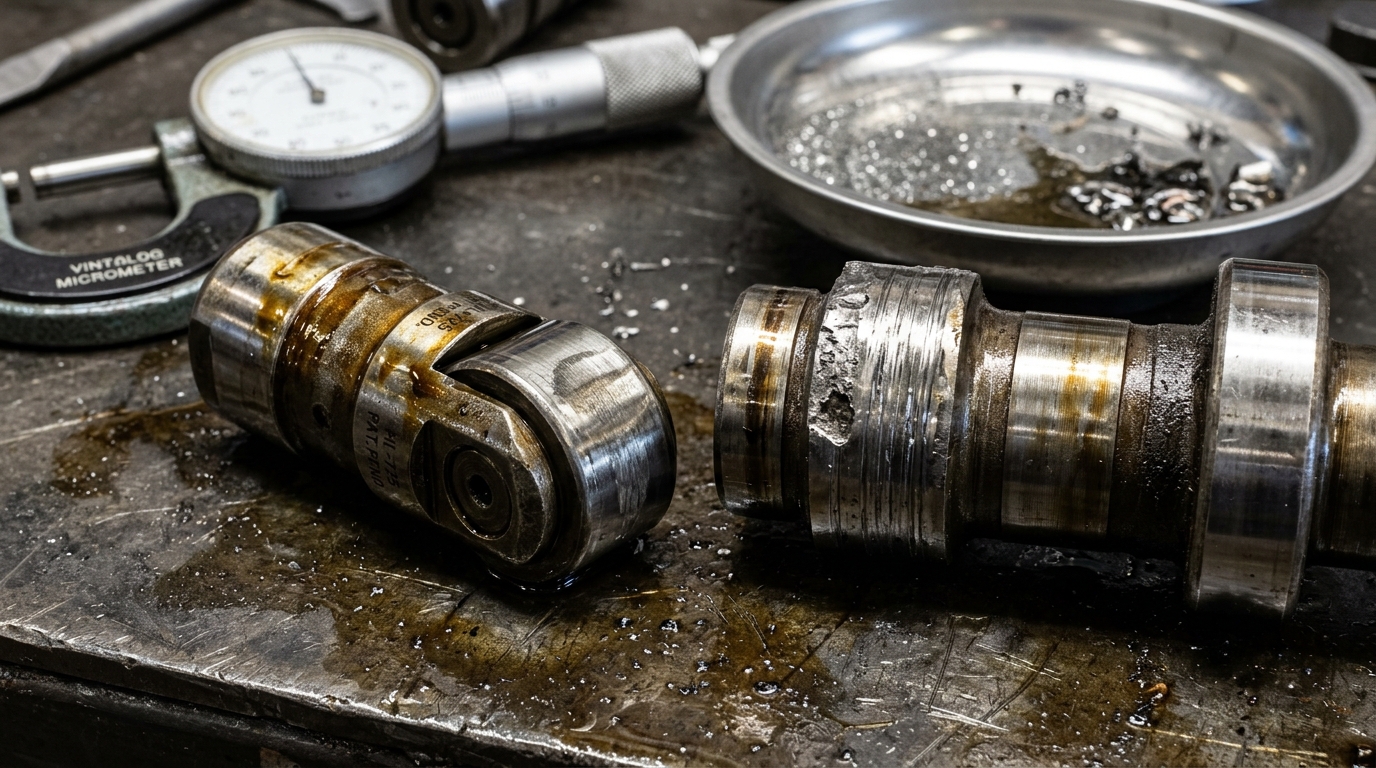
The lifter features a hardened steel outer roller wheel rotating on an internal needle bearing assembly, held in place by a center axle pin. Under normal conditions, this roller glides smoothly over the egg-shaped camshaft lobe profile, converting rotational velocity into linear vertical pushrod lift with minimal sliding friction. However, under cyclic shear stress and boundary lubrication starvation, the microscopic surface layer of the camshaft lobe undergoes severe metallurgical fatigue:
- Needle Bearing Micro-Weld & Roller Lockup: Microscopic friction inside the lifter roller’s internal needle bearings causes localized heat-soak. When oil film thickness collapses, the tiny cylindrical needles gall against the center axle pin. Eventually, the roller wheel ceases to spin freely and locks into a stationary position.
- Skidding Friction & Heat Generation: Instead of rolling across the cam lobe, the seized roller acts as a stationary carbide lathe tool. Every revolution of the camshaft forces the hardened lobe to scrape against the flat-spotted lifter face, generating instantaneous contact temperatures exceeding 800°F (427°C).
- Surface Spalling (Delamination): The induction-hardened case layer of the cast-iron/steel camshaft (typically hardened to 55–60 HRC to a depth of 0.050 to 0.080 inches) separates from the ductile core material beneath. Small crater-like pits form, rapidly propagating across the nose of the lobe until large flakes of hardened steel break off.
- Lash Expansion & Top-End Tap: As the lobe loses 0.040" to 0.120" of profile height, the hydraulic lifter's internal plunger reaches maximum extension and can no longer take up mechanical lash. The rocker arm begins hammering the pushrod tip on every valve cycle, generating the characteristic rhythmic tapping sound audible in the cab.
The Root Cause: The Variable-Displacement Oil Pump & Idle Starvation
Why are roller lifters seizing on an engine built for commercial heavy-duty service? Forensic investigations across ASE master shops and fleet engine builders point directly to the intersection of two design decisions: the variable-displacement vane oil pump calibration and high engine idle runtime.
To comply with stringent corporate average fuel economy (CAFE) standards and reduce parasitic horsepower drag, Ford equipped the 7.3L Godzilla with an electronic variable-displacement vane oil pump. Rather than a traditional fixed-displacement gear pump that pushes continuous volume proportional to engine RPM, the Godzilla’s pump incorporates an internal eccentric ring controlled by a pulse-width modulated (PWM) solenoid operated by the Powertrain Control Module (PCM).
In early PCM calibrations (specifically 2020 through early 2022 factory firmware), the PCM commanded minimal oil pump displacement whenever the engine was operating at curb idle (600 RPM). At normal operating temperatures (195°F–215°F oil temp), hot idle oil pressure routinely dropped to a meager 5 to 8 PSI.
While 7 PSI may supply sufficient hydrodynamic film pressure for wide journal main and connecting rod bearings at zero load, it is catastrophically inadequate for the valvetrain lifter galleries. In the Godzilla block, oil must travel from the front-mounted pump through the main oil galleys, past the filter and cooler, and ascend into the lifter galleys. At 6 PSI, the tiny needle bearings inside the roller lifters receive virtually zero pressurized spray—they must rely entirely on oil splash and residual boundary film.
For commercial fleet vehicles, utility trucks, ambulances, and RV haulers that frequently sit with extended idle times (often running 50 to 100 idle hours per 1,000 odometer miles with the air conditioning on), this persistent low-pressure boundary state starves the needle bearings, accelerating thermal breakdown and bearing seizure.
Telemetry & Diagnostic Criteria: Normal vs. Failure Thresholds
When evaluating a 7.3L Godzilla presenting with valvetrain noise or intermittent misfire DTCs, technicians must measure physical oil pressure and valvetrain lash against verified OEM engineering specifications:
| Diagnostic Parameter | Factory Spec (Normal) | Marginal / Warning | Confirmed Failure Threshold |
|---|---|---|---|
| Hot Idle Oil Pressure (200°F Oil) | 25 – 35 PSI | 12 – 18 PSI (Early Calibration) | < 10 PSI (Lifter Boundary Starvation) |
| 2,000 RPM Oil Pressure (Hot) | 45 – 65 PSI | 35 – 42 PSI | < 30 PSI (Pump Vane / Bearing Washout) |
| Rocker Arm / Pushrod Lash | Zero Lash (Hydraulic Preload) | 0.010" – 0.025" (Lifter Bleed Down) | > 0.040" (Wiped Lobe / Seized Roller) |
| Primary Misfire DTCs | None (Zero Counts) | Intermittent High-Load Misfire | P0300, P0303, P0307 (Persistent Hard Code) |
| Oil Filter Pleat Contamination | Zero Visible Debris | Trace Microscopic Particulate | Visible Silver Flakes & Bronze Shavings |
Statistically, Cylinders 3 and 7 exhibit the highest incidence of lifter spalling on the Godzilla architecture. This correlates with the hydraulic flow geometry of the internal lifter oil galleries, where fluid velocity drops slightly at the rear crossover galleys before equalizing across the bank.
The Catastrophic Secondary Damage: Metal Contamination Spread
The single most dangerous aspect of 7.3L Godzilla cam and lifter failure is not the loss of valvetrain lift—it is the circulation of hardened steel shrapnel throughout the lubricating circuit.
When a camshaft lobe is ground down by a seized roller, approximately 2 to 5 grams of case-hardened steel particulate are sheared into the oil valley. This metal is significantly harder than standard cast iron. While the oil filter canister (typically a Motorcraft FL-820S) catches larger chips, fine microscopic abrasive dust (5 to 20 microns) bypasses the filter element under cold-start high-differential bypass valve events.
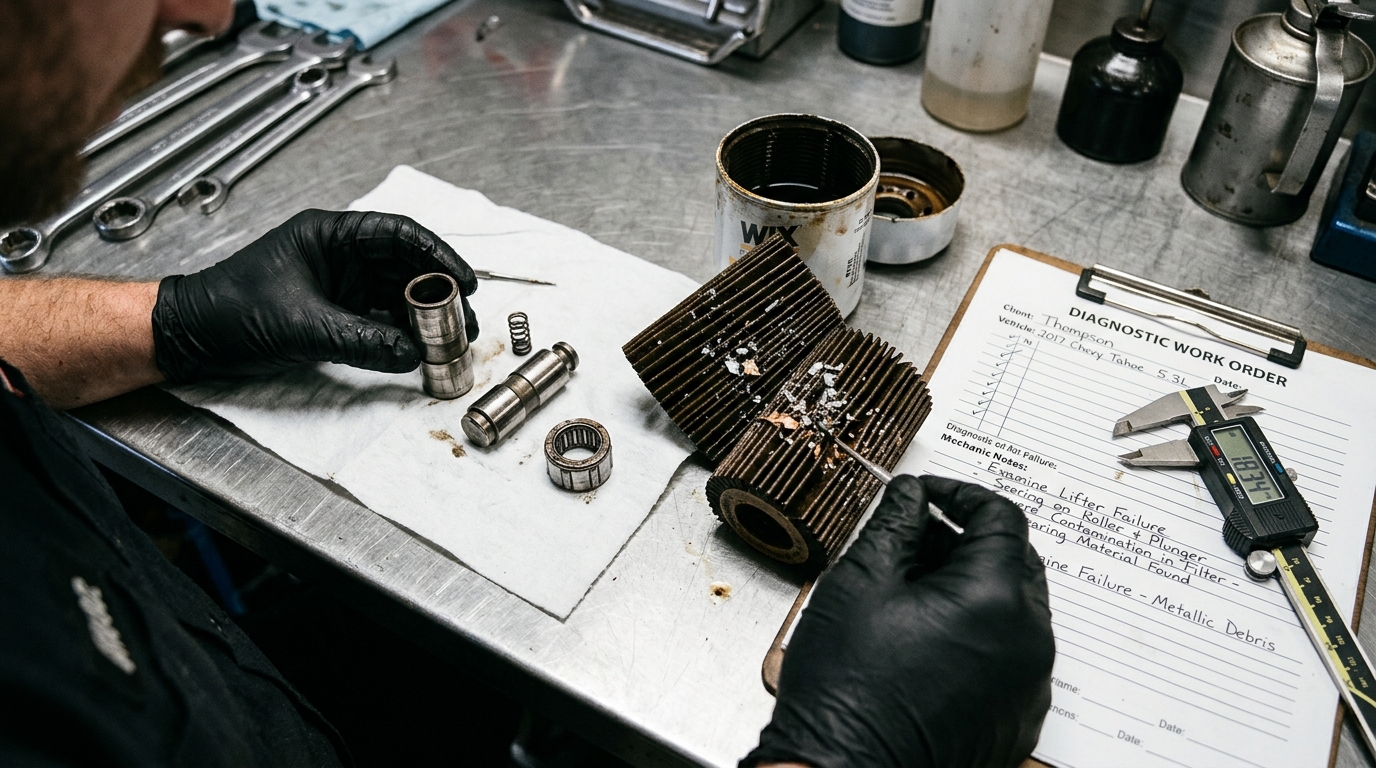
Once this abrasive slurry enters the lubrication galleries, secondary collateral damage is rapid and severe:
- Variable Displacement Oil Pump Vane Scoring: The tight-tolerance sliding vanes inside the oil pump housing get heavily scored by circulating steel particles. This permanently destroys the pump's ability to maintain hydraulic seal, dropping cold and hot oil pressure permanently.
- Crankshaft Journal Scoring: The bimetal or tri-metal rod and main bearings embed the steel flakes into their softer aluminum/babbit lining. The embedded particles turn the bearing into an abrasive grinding wheel, carving circular gouges into the micro-polished forged steel crankshaft journals.
- Piston Skirt & Cylinder Wall Scuffing: Oil squirt jets directed at the underside of the Godzilla pistons spray the contaminated oil directly against the cylinder bores, creating vertical scoring marks that cause oil consumption and compression loss.
Critical Field Caveat: The "Cam & Lifter Only" Replacement Trap
When an out-of-warranty truck presents with a wiped cam lobe, owners frequently attempt to save money by having an independent shop install a new camshaft and a set of lifters without pulling the engine. This is almost universally fatal to the engine. If the oil filter pleats show visible metallic glitter, fine hardened steel particulate has already circulated through the crankcase oil cooler and variable-displacement pump. Installing new $1,200 cam and lifters into a contaminated block will result in the new roller lifters seizing or the rod bearings spinning within 1,500 to 5,000 miles. Unless the engine is completely removed, completely stripped to a bare block, hot-tanked, and fitted with a brand-new oil pump and oil cooler, a full Ford crate long-block replacement (Part: LC3Z-6006-A) is the only permanent repair.
Ford Technical Service Bulletins, SSMs & Factory Revisions
In response to growing fleet reports, Ford engineering released multiple calibration updates and internal component revisions:
1. PCM Idle Strategy Recalibration (TSB 22-2142 & Successors)
Ford issued updated powertrain control module software flashes for 2020–2022 Super Duty models. The primary functional change of this recalibration is twofold: it raises the curb idle speed from approximately 600 RPM to 750 RPM when the engine is fully heat-soaked, and it commands a higher duty cycle on the oil pump control solenoid. This elevates minimum hot idle oil pressure from ~7 PSI up to a safe 18 to 24 PSI, significantly improving lubrication to the upper lifter galleys during extended stationary idle periods.
2. Revised Hydraulic Roller Lifters (OEM Part: JL3Z-6500-A / LC3Z-6500-A)
For late-2022 and 2023+ production, Ford transitioned to an updated hydraulic roller lifter design. The revised lifters feature modified oil feed porting, improved heat-treated needle bearing retainers, and tighter internal plunger tolerances designed to prevent rapid bleed-down under high thermal stress.
3. Updated Camshaft Metallurgy
Replacement crate engines and post-2023 assembly line engines incorporate revised camshafts with optimized lobe induction hardening depths and micro-finished surface profiles, reducing friction coefficients and increasing surface fatigue resistance against spalling.
Step-by-Step Diagnostic & Repair Workflow
If you own or service a 2020–2024 Ford Super Duty with the 7.3L Godzilla and suspect valvetrain deterioration, follow this verified five-step forensic triage protocol before making repair decisions:
- Acoustic Stethoscope Isolation: With the engine idling at operating temperature, place a mechanic's stethoscope directly onto the valve covers adjacent to each cylinder. A failing lifter produces a distinct, metallic clicking or clacking that corresponds directly to camshaft speed (exactly half of crankshaft engine speed). If the noise is loudest at the bottom of the oil pan, suspect a rod bearing rather than a lifter.
- Cut Open the Oil Filter Canister: Do not just drain the oil. Use an oil filter cutting tool to cleanly slice open the Motorcraft FL-820S canister. Remove the pleated paper element, slice the pleats, and spread the media flat under bright sunlight or an inspection LED. If you observe fine silver glitter or magnetic steel flakes trapped in the pleats, camshaft spalling has occurred.
- Measure Mechanical Oil Pressure: Remove the oil pressure sensor switch and thread in a mechanical gauge with a high-pressure hydraulic hose. Confirm hot idle pressure. If hot idle pressure is below 12 PSI at 750 RPM, check PCM calibration version and inspect pump control solenoid harness.
- Borescope Valvetrain Inspection: Remove the valve cover corresponding to the noisy bank. Inspect pushrod tips for discoloration or excessive lash. Rotate the crankshaft manually and observe pushrod lift height. A wiped lobe will show noticeably reduced pushrod stroke compared to adjacent cylinders.
- Verify Powertrain Warranty Status: The 7.3L Godzilla is covered under Ford's 5-year / 60,000-mile Powertrain Limited Warranty (or 5-year / 100,000-mile commercial fleet coverage on qualifying fleet accounts). If metal contamination is proven in the oil filter, insist on a complete long-block assembly replacement under warranty rather than a dealership teardown and cam-only patch repair.
Preventative Best Practices for 7.3L Godzilla Owners
For truck owners whose engines are currently running quietly, implementing specific preventative operating habits can drastically minimize the probability of premature lifter failure:
- Flash the Latest Ford PCM Calibration: Ensure your truck’s PCM has been updated by a dealer or via Ford IDS/Forscan with the latest calibration software that commands elevated idle RPM and increased oil pump pressure.
- Ditch Extended 10,000-Mile Oil Intervals: While Ford’s Intelligent Oil Life Monitor (IOLM) frequently suggests intervals up to 10,000 miles, commercial fleet teardowns demonstrate that heavy-load shear breaks down 5W-30 viscosity rapidly. Adopt a strict 5,000-mile (8,000 km) interval using full-synthetic API SP / Ford WSS-M2C961-A1 certified 5W-30 motor oil.
- Avoid Unnecessary High-Idle Stationary Running: If your truck must idle for extended periods on job sites, engage the factory upfitter switches or high-idle mod to elevate stationary engine speed to 1,000–1,200 RPM, which forces the variable oil pump to maintain 45+ PSI of hydraulic pressure across the top end.
Found this repair guide useful?
Mark AutoZonic as a preferred source and our technical teardowns show up first in your Google results. One click, no account.
Researching this vehicle or comparing used inventory?
Always cross-reference factory service bulletins, verify warranty coverage, and compare dealer financing rates or insurance quotes before purchasing.
Reader Feedback
Was this technical guide helpful?
Your verification vote informs our ongoing automotive research schedule.