
Ford 3.5L & 3.7L Cyclone V6 Internal Water Pump Failure: Weep Hole Clog, Oil Pan Milkshake & Complete Timing Chain Repair Guide
Automotive Research, ASE Master Technicians & Fact-Checking
Direct Technical Summary
Diagnose the catastrophic Ford 3.5L/3.7L internal water pump failure. We dissect chain-driven pump physics, clogged weep holes, milky oil-coolant sludge, class-action litigation, and $3,000 timing teardowns.
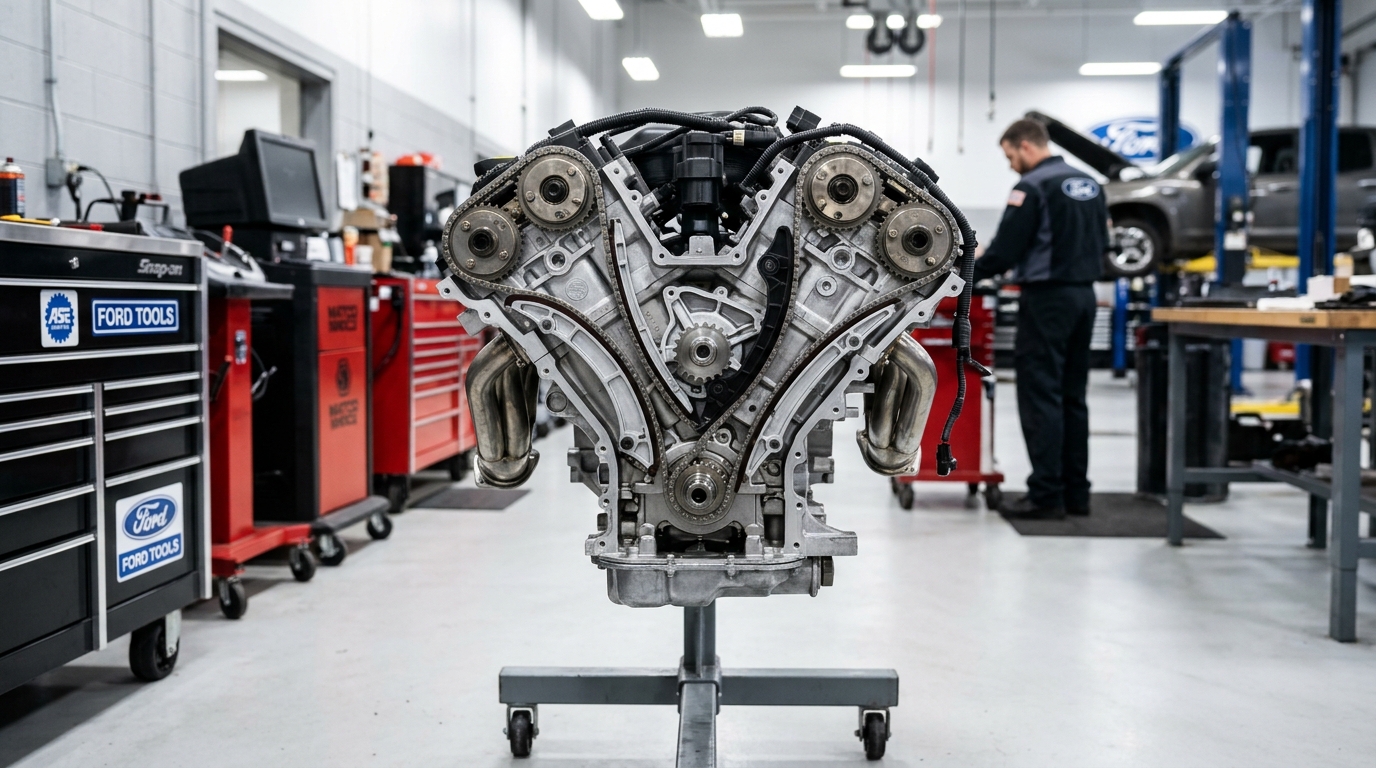
Between 2007 and 2019, Ford Motor Company installed its naturally aspirated and twin-turbocharged 3.5-liter and 3.7-liter Cyclone (Duratec 35 / 37) V6 engines into millions of the most popular crossover SUVs and sedans in North America, including the Ford Explorer, Edge, Flex, Taurus, Fusion Sport, and Lincoln MKX / MKS. Renowned for punchy V6 horsepower and robust aluminum block architecture, these transverse powertrains harbor one of the most controversial, catastrophic, and financially devastating design vulnerabilities in modern automotive engineering: an internally mounted, timing chain-driven engine water pump.
In conventional automotive engines, an external water pump failure causes harmless coolant to drip onto the driveway from an exposed serpentine belt pulley. In the transverse Ford 3.5L Cyclone, however, the water pump is buried completely inside the sealed front timing cover. When its dynamic internal shaft seals wear out—typically between 80,000 and 125,000 miles—and its microscopic cast weep hole becomes obstructed by road silt or engine grime, pressurized ethylene glycol coolant is channeled directly into the engine's internal oil galleys. The result is instant lubrication failure, the creation of a milky 'mayonnaise milkshake' oil sludge, and complete crankshaft bearing seizure while driving at highway speeds, leaving owners with catastrophic engine failure and repair bills ranging from $2,800 for a timing service to $9,500 for a long-block replacement.
Following high-profile federal multidistrict class-action litigation (In re: Ford Motor Co. DPS6 / Duratec 3.5L Water Pump Litigation in U.S. District Court) and thousands of roadside teardowns, the AutoZonic Technical Research Desk provides this definitive forensic engineering guide. We analyze the fluid dynamics of why the weep hole clogs, the exact step-by-step diagnostic verification protocol to catch coolant cross-contamination before your rotating assembly destroys itself, and the essential specialized service tools required to safely execute a complete timing chain and water pump overhaul.
Quick Workshop Diagnostic: Ford 3.5L / 3.7L Water Pump Failure at a Glance
- Affected Vehicles: 2007–2019 Ford Explorer, 2007–2018 Ford Edge, 2009–2019 Ford Flex, 2008–2019 Ford Taurus (including Police Interceptor Sedan/Utility), 2009–2012 Ford Fusion Sport, 2007–2018 Lincoln MKX, 2009–2016 Lincoln MKS, and 2010–2019 Lincoln MKT equipped with transverse 3.5L or 3.7L Cyclone V6. (Note: Longitudinal rear-wheel-drive F-150 and Mustang 3.5L/3.7L use an external, serpentine belt-driven water pump and are immune).
- Primary Failure Sequence: Dynamic coolant seal failure → external weep passage blockage → secondary oil seal blowout → high-pressure coolant (16 PSI) dumps into oil pan → hydrodynamic bearing wipe → terminal engine lockup.
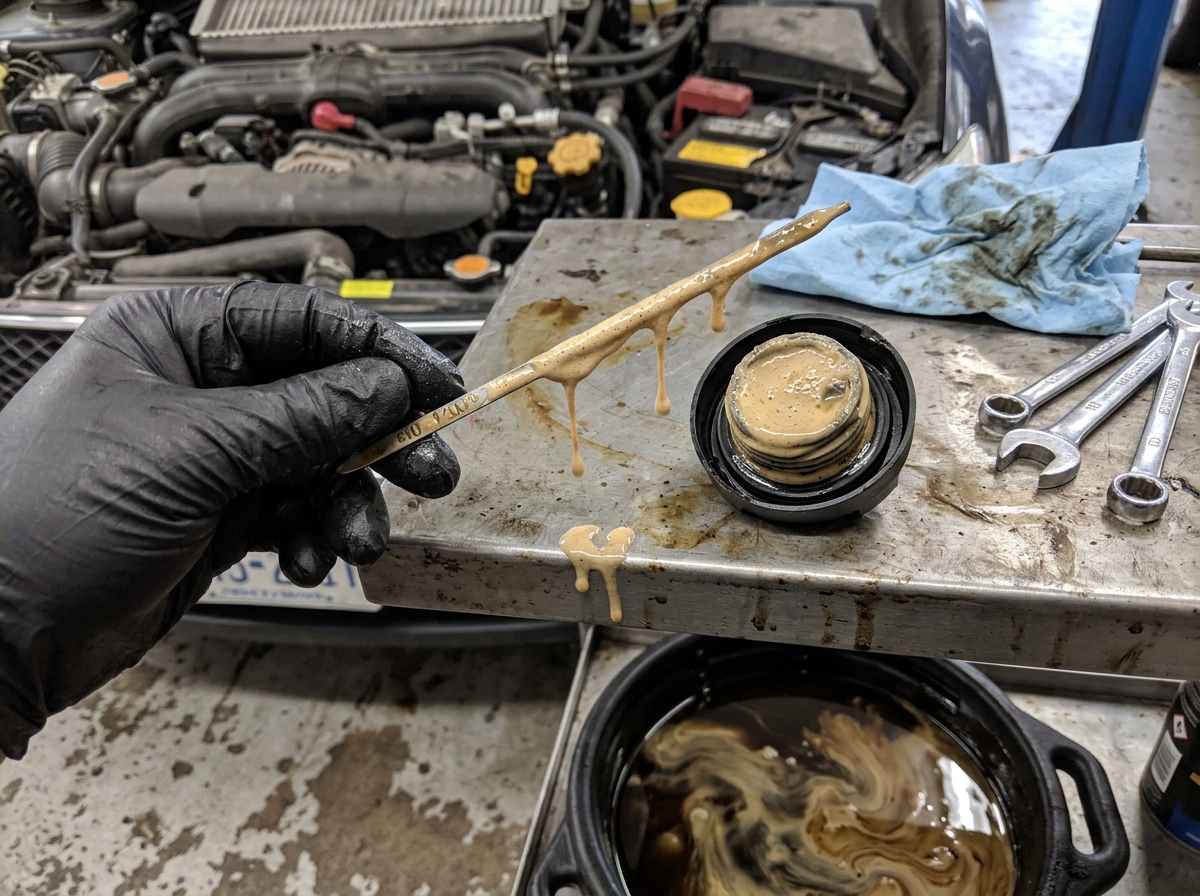
- Tell-Tale Diagnostic Signs: Rapid mystery drop in degas bottle coolant level with zero puddle beneath the vehicle; creamy tan "milkshake" foam beneath the oil filler cap; engine oil level measuring 2–3 quarts above the hash marks on the dipstick; sweet maple syrup odor from exhaust or heater core.
- Diagnostic Trouble Codes (DTCs):
P0117(Engine Coolant Temperature Sensor 1 Circuit Low),P0128(Coolant Thermostat Below Regulating Temperature),P0217(Engine Coolant Overtemperature Condition),P0016 / P0018(Crankshaft/Camshaft Timing Correlation if timing chain jumps teeth from failed pump bearings). - OEM Service Part Supersession: Ford Part Number
AT4Z-8501-A/ MotorcraftPW-519(Superseded upgraded dual-lip PTFE seal water pump).
1. Auditory & Physical Symptoms: How to Detect Internal Coolant Ingress Early
Because the Cyclone water pump is concealed beneath a cast aluminum front timing cover secured by 24 perimeter bolts, owners cannot perform a simple visual inspection of the pump pulley. You must rely on physical telemetry and fluid sampling:
| Diagnostic Inspection Point | Normal Healthy Condition | Internal Water Pump Failure Signature |
|---|---|---|
| Engine Oil Dipstick Reading | Amber to dark brown liquid; oil level seated between crosshatch min/max markers. | Thick, frothy, milky tan "coffee with cream" emulsion; fluid level reads 1–3 inches ABOVE max mark due to coolant volume displacement. |
| Under Oil Filler Cap | Clean dry plastic or light oil film. | Heavy build-up of thick, mayonnaise-like creamy foam condensed on the underside of the screw cap from hot coolant vapor. |
| Coolant Degas Bottle Level | Stable coolant volume between MIN and MAX hot/cold fill lines. | Empties 1 to 2 quarts every 200 miles with ZERO ground puddles or exterior hose leaks. |
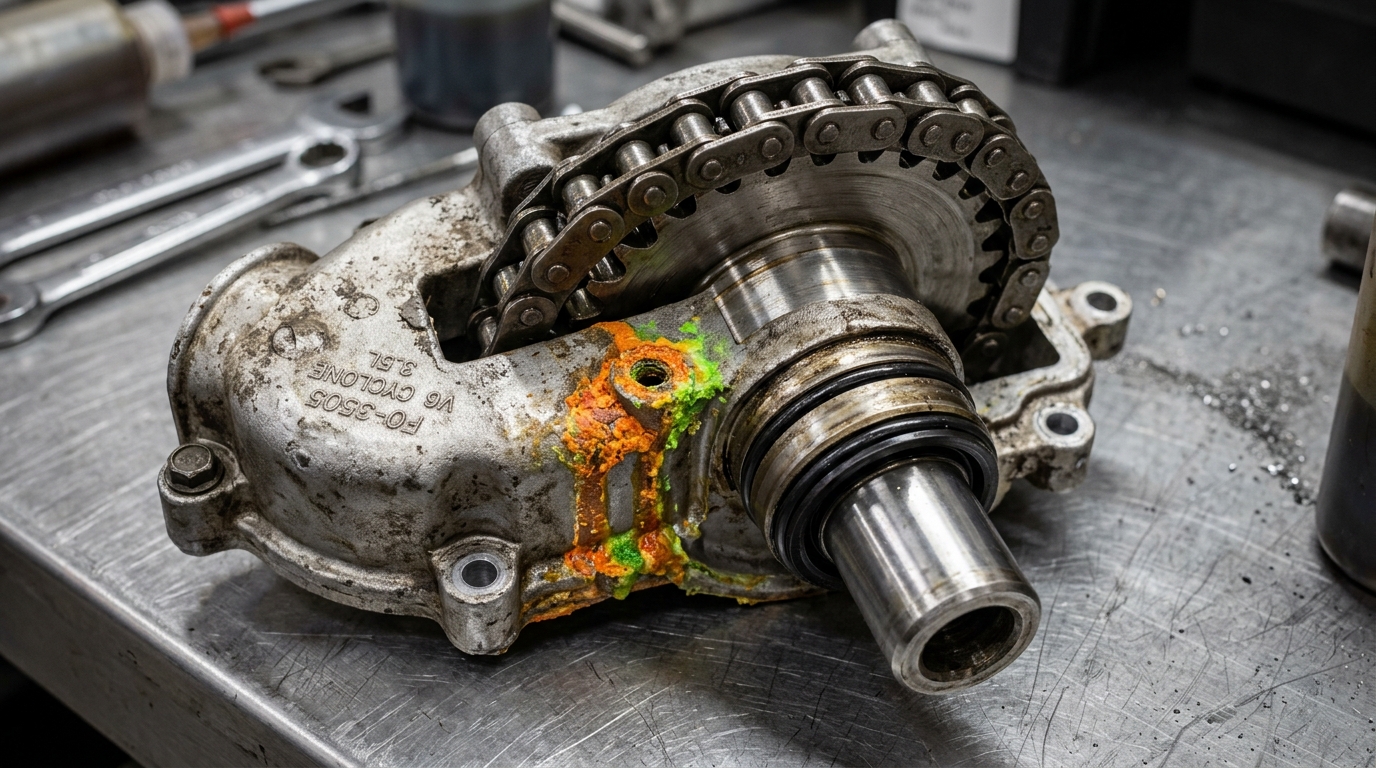
| External Weep Hole Inspection Port | Completely dry cast aluminum boss behind A/C compressor bracket. | Crusted orange or green Motorcraft coolant stalactites dripping down the front of the lower crankcase (indicates primary seal breach before secondary inner seal blowout). |
| Engine Acoustic Telemetry | Smooth mechanical purr at idle with standard injector clicking. | High-pitched timing chain whine/growl as worn pump bearings wobble, transitioning to violent bottom-end metallic rod knocking. |
2. Metallurgical & Fluid Dynamics Physics: The Blocked Weep Hole Failure Mechanism
Why did Ford engineers place a component with a finite lifespan inside a sealed engine timing case? The transverse packaging constraints of front-wheel-drive and all-wheel-drive engine bays forced engineers to minimize engine block length. By tucking the water pump into the 60-degree engine valley and driving it off the backside of the primary timing chain, Ford shaved four inches off the total engine footprint.
To prevent catastrophic oil contamination, Ford designed the water pump with a dual-chamber seal system separated by an atmospheric isolation cavity:
-
1. The Primary Dynamic Mechanical Coolant Seal
Facing the cooling jacket, a spring-loaded ceramic/carbon face seal keeps 16–18 PSI of hot pressurized coolant contained inside the impeller chamber. -
2. The External Atmospheric Weep Hole Channel
Between the coolant seal and the inner oil seal sits an isolation void with an engineered drain path. Ford cast a narrow, 4mm-diameter relief passage that traverses through the front aluminum engine casting, terminating outside the engine behind the A/C compressor and alternator mounting bracket. In theory, when the primary seal degrades, leaking coolant is meant to drip harmlessly down the exterior of the engine, alerting the technician during routine oil changes. -
3. The Weep Hole Obstruction & Secondary Inner Seal Blowout
In the real world, the tiny 4mm external weep passage frequently clogs with road salt, dust, or minor oil mist weeping from adjacent gasket flanges. Once the weep hole is obstructed, leaking coolant fills the atmospheric isolation chamber. Because the cooling system operates under thermal pressure (16 PSI), hot coolant exerts continuous hydraulic force against the secondary inner rubber lip seal. This secondary seal is designed only to retain unpressurized engine oil splash—not pressurized liquid. Within hours of highway driving, the secondary seal fails, and gallons of pressurized coolant cascade directly into the lower crankcase.
3. Chemical Breakdown: How Ethylene Glycol Destroys Crankshaft Bearings
When engine oil and water mix, they do not simply coexist; they undergo severe mechanical emulsification driven by the spinning crankshaft counterweights. At 2,500 RPM, the crankshaft acts as an industrial blender, whipping the 5W-20 motor oil and 50/50 ethylene glycol coolant into a viscous, sticky emulsion.
Ethylene glycol contains corrosion inhibitors, silicates, and organic acids that aggressively attack the thin tin, copper, and lead (babbitt) overlays of the crankshaft main and connecting rod bearings. Crucially, water-glycol emulsion possesses virtually zero hydrodynamic shear strength: under combustion pressure (over 1,200 PSI during the power stroke), the fluid film between the crankshaft journal and the bearing shell ruptures completely. Metal-to-metal contact occurs, generating localized temperatures exceeding 600°F (315°C). The soft bearing material melts, smears across the oil galleys, and spins within the connecting rod bore, resulting in catastrophic engine seizure or thrown rods punching through the aluminum block.
4. Federal Class-Action Litigation & Ford Service History
The severity of this failure spawned high-stakes federal consumer litigation: In re: Ford Motor Co. DPS6 / Duratec 3.5L Water Pump Litigation (filed in the U.S. District Court for the Eastern District of Michigan). Lawsuits alleged that Ford was aware of the internal water pump defect as early as 2008 through warranty claims and internal engineering memos, yet failed to redesign the weep hole or issue a safety recall.
While federal courts dismissed portions of the nationwide class-action claims on statutory warranty duration limits (because failures commonly struck outside the 5-year/60,000-mile powertrain warranty window), Ford quietly issued internal technical bulletins and revised service parts:
-
Upgraded Water Pump Assembly (AT4Z-8501-A / PW-519):
The revised factory pump incorporates an upgraded PTFE double-lip mechanical seal with reinforced spring tension and a wider weep cavity baffle designed to minimize sludge clogging. -
Mandatory Timing Component Replacement Protocol:
Ford master service manuals mandate that whenever the timing cover is pulled to replace a leaking water pump, the primary timing chain (AT4Z-6268-C), secondary cam-to-cam chains, hydraulic timing chain tensioners (AT4Z-6L266-B), and plastic guide shoes must be replaced simultaneously, as coolant-thinned oil accelerates chain elongation and guide shoe wear.
5. Workshop Warnings & Field Notes from the Service Bay
The Ford 3.5L/3.7L Cyclone is a strict interference engine. When you release the primary timing chain tensioner to unbolt the water pump, the camshafts on Bank 1 and Bank 2 are under immense valve spring pressure from open cylinders. Never attempt this repair without the dedicated Ford Camshaft Holding Tools (OTC 303-1248 / CTA 2880). Without these holding blocks bolted across the flats of the camshafts, the camshafts will violently rotate up to 30 degrees, snapping intake valves against the flat tops of the stationary pistons and bending valve stems instantly.
If an owner has driven even 15 miles with a milky oil milkshake in the pan, simply replacing the water pump and refilling the crankcase is an expensive trap. Ethylene glycol permanently degrades the rod bearing babbit. Technicians must pull the lower oil pan and cut open the oil filter pleats. If copper or bronze flakes are present, the crankshaft journals have already scored. Installing a $3,000 timing service on an engine with compromised bearings guarantees the engine will throw a rod through the block within 1,000 miles. Always inspect the lower end before investing in front timing labor.
Because unbolting the internal water pump requires completely disassembling the front timing drive on an interference engine, Master Technicians require these exact specialized tools to prevent bent valves and diagnose early coolant temp spikes:
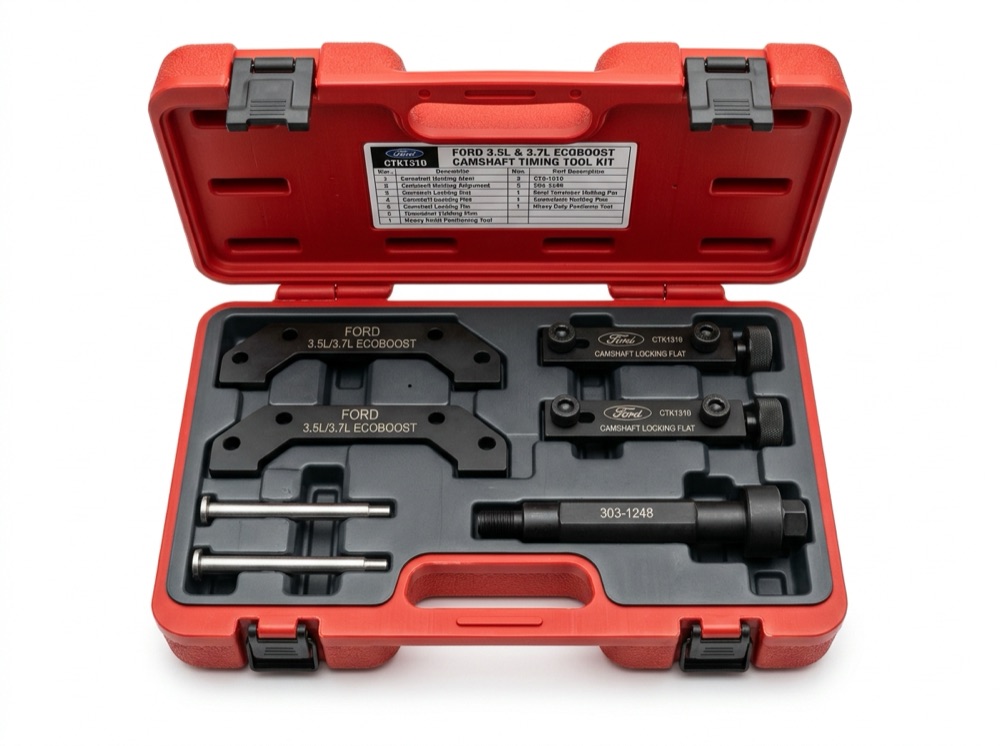
Ford 3.5L & 3.7L Camshaft Alignment & Holding Tool Kit
Absolute mandatory requirement for water pump replacement. Clamps directly across the flat machined lobes of Bank 1 and Bank 2 camshafts, locking them solidly at Top Dead Center (TDC) to eliminate valve-to-piston contact when the primary chain is removed.
- ✓Hardened High-Carbon Steel: Will not bend or flex under heavy valve spring pressure.
- ✓Tensioner Pin Included: Locks secondary tensioner plunger during chain servicing.
- ✓Full Coverage: Fits all Ford 3.5L naturally aspirated, 3.5L EcoBoost, and 3.7L V6 engines.

BlueDriver Bluetooth Pro OBD-II Diagnostic Scan Tool
Monitors live Engine Coolant Temperature (ECT) sensor readings in real-time, logs intermittent P0117/P0128 cooling codes, and reads proprietary Ford enhanced PCM data before temperature gauge spiking occurs.
- ✓Enhanced Ford Diagnostics: Reads proprietary Ford powertrain, ABS, and body modules.
- ✓Live Graphing: Track real-time coolant spikes and cylinder head temperature (CHT).
- ✓No Hidden Fees: Complete wireless functionality with zero monthly subscriptions.
6. Repair Cost Breakdown: Preventive Water Pump Job vs. Remanufactured Engine
Because accessing the water pump requires removing the intake manifold, valve covers, engine mount brackets, power steering/AC compressors, and front timing cover, labor time is intensive:
Preventative Water Pump & Full Timing Overhaul
Replaced BEFORE bearing damage occurs (coolant caught in weep hole or early reservoir drop).
- OEM Parts: Upgraded water pump, primary chain, guides, tensioners, gaskets ($600 – $850).
- Labor: 11.0 to 14.5 flat-rate book hours ($1,800 – $2,500).
- Total Expense: $2,400 – $3,350.
- Outcome: Restores engine reliability for an additional 100,000+ miles.
Complete Remanufactured Long-Block Replacement
Required when coolant circulated into crankcase and destroyed connecting rod bearings.
- Crate Engine: Jasper or Ford Reman 3.5L Long-Block ($4,500 – $5,800).
- Labor: 18.0 to 22.0 hours engine R&I ($3,000 – $3,800).
- Total Expense: $7,500 – $9,600.
- Outcome: Replaces entire rotating assembly; zero-mile powertrain warranty.
Frequently Asked Questions (FAQ)
Does the Ford F-150 3.5L EcoBoost suffer from this internal water pump failure?
No. In rear-wheel-drive longitudinal applications (such as the Ford F-150, Ford Expedition, Ford Transit, and Ford Mustang), the 3.5L and 3.7L engines utilize an external water pump mounted to the front cover and driven by the serpentine accessory belt. If that pump fails, coolant drips harmlessly onto the ground outside the engine. The catastrophic internal chain-driven design is strictly limited to transverse front-wheel-drive and all-wheel-drive platforms (Explorer, Edge, Flex, Taurus, Lincoln MKX).
At what mileage does the Ford 3.5L water pump typically fail?
Field data from municipal police fleets and consumer warranty claims indicates failure typically occurs between 95,000 and 130,000 miles. However, vehicles subject to severe heat cycles or neglected coolant maintenance (where acidic degraded coolant corrodes the dynamic seals) have experienced internal seal failure as early as 70,000 miles.
Can I drive my Ford Explorer if the low coolant light comes on?
If your coolant reservoir is empty and you see no puddles on the ground, do not add coolant and continue driving. Immediately pull the dipstick and inspect the oil cap. If the oil is milky or the level is rising, the coolant has entered the oil pan. Running the engine for even 5 more minutes will wipe the rod bearings, transforming a $2,800 timing job into an $8,500 engine replacement.
Researching this vehicle or comparing used inventory?
Always cross-reference factory service bulletins, verify warranty coverage, and compare dealer financing rates or insurance quotes before purchasing.
Reader Feedback
Was this technical guide helpful?
Your verification vote informs our ongoing automotive research schedule.