
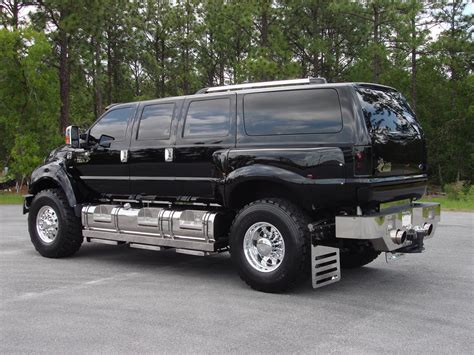
Quick answer: Ford does not sell a current F-850 in its U.S. truck lineup. Ford’s present medium-duty range is the F-650 and F-750. If you see a modern truck advertised or badged as an “F-850,” do not assume it is a factory Ford model. The description may be a typo, an informal upfitter label or confusion between the F-750 name and a Class 8 truck.
Key takeaways
- There is no current factory Ford F-850 listed in Ford’s U.S. commercial-truck catalog.
- Ford currently markets the F-650 and F-750 as its medium-duty F-Series trucks.
- A custom body, suspension or equipment package does not change the manufacturer’s model identity.
- The VIN, certification label and incomplete-vehicle label are more reliable than an online listing or decorative badge.
- Do not use invented F-850 towing, payload, engine or price figures to make a purchase decision.
What Ford actually sells in this part of the lineup
| Ford range | What it covers | Important distinction |
|---|---|---|
| Super Duty pickup and chassis cab | Heavy-duty F-Series models and commercial chassis | Configuration and ratings vary by VIN. |
| F-650 | Medium-duty commercial truck | Available for vocational bodies and fleet applications. |
| F-750 | Ford’s larger current medium-duty offering | This is the top model shown in Ford’s current F-650/F-750 range. |
| “F-850” listing | Not a current Ford catalog model | Verify the underlying VIN, certification labels and original build record. |
Why do “Ford F-850” listings appear?
There are several plausible explanations, but none should be accepted without checking the truck:
- Typing or naming error: The seller may mean F-750, F-650 or another F-Series model.
- Vehicle-class confusion: “Class 8” describes a weight category; it is not the same thing as a Ford F-850 model name.
- Upfitter or fleet terminology: A body builder may add equipment, decals or an internal fleet description that is not Ford’s factory model designation.
- Decorative badge: Exterior badges can be removed, replaced or added.
- Historical or incomplete reference: Ford has used many truck designations over decades. A claim about an older truck still needs a year-specific VIN and documentation.
How to identify the truck correctly
- Decode the VIN: Use the VIN from the dashboard and paperwork, not a number supplied only in the advertisement.
- Read the door certification label: Confirm the manufacturer, model information, GVWR and axle ratings.
- Check the incomplete-vehicle label: Chassis cabs and commercial trucks may have an additional label before a final-stage manufacturer installs the body.
- Identify the final-stage manufacturer: Box trucks, buses, tow trucks and specialty vehicles may have been completed by another company.
- Request the original build information: A Ford commercial dealer can check the VIN and equipment record.
The National Highway Traffic Safety Administration’s VIN decoder can help confirm basic manufacturer and vehicle information. For applicable F-Series vehicles, Ford also provides a VIN-based towing calculator. Neither a hitch nor a seller’s claimed towing number proves the truck’s factory rating.
Do not rely on the old F-850 specifications
The previous version of this page described a supposed 2019 F-850 with conflicting engines, payloads, towing capacities and prices. Those figures did not match a current Ford-produced model and should not be used. Commercial-truck capacity is configuration-specific; the door label, axle ratings, body installation and Ford documentation control.
What should you shop for instead?
If you need a current Ford medium-duty chassis, begin with the F-650/F-750 lineup and match the wheelbase, cab, engine, brake system, axle ratings and intended body to the job. If the required gross vehicle weight is beyond that range, compare purpose-built heavier commercial trucks rather than treating “F-850” as a trim above F-750.
Used-truck verification checklist
- VIN on the truck matches the title and seller’s documents.
- Door certification label is present and legible.
- Final-stage manufacturer label matches the installed body.
- GVWR and GAWR are appropriate for the intended load.
- No seller-created badge is being used as proof of model or capacity.
- Towing and payload claims are supported by vehicle-specific documentation.
How we evaluated the claim
We checked Ford’s current U.S. commercial-truck lineup and powertrain information. Ford lists F-650 and F-750 medium-duty trucks, not a current F-850. Because commercial vehicles are frequently upfitted, we also used VIN and certification-label verification as the deciding method.
Sources
- Ford — Current F-650 and F-750 commercial-truck lineup
- Ford — F-650/F-750 powertrain information
- Ford — VIN-based towing calculator
- NHTSA — VIN Decoder
Related Guides
Is a Honda Pilot Considered a Standard SUV? Why Classifications Differ
Is 91 Octane Worth It Instead of 87? Check the Fuel Label First
Does the Ford 2.3 EcoBoost Require Premium Fuel?
How to Improve Honda Fit Fuel Economy: 15 Safe Steps